Under the Trees (1902) – by Hamilton Wright Mabie, illustrated by C.L. Hinton
A Pastoral Symphony in Green: C.L. Hinton’s Under the Trees
In the quiet dawn of the twentieth century, a remarkable book emerged from the press of Dodd, Mead & Company in New York—a volume that would become a treasure of the American Arts and Crafts movement and a testament to the harmonious marriage of text and illustration. Hamilton Wright Mabie’s Under the Trees, published in 1902 with illustrations and decorations by Charles Louis Hinton, is a work of exquisite beauty that transports readers to a world where nature, art, and pastoral innocence exist in perfect accord .
Hamilton Wright Mabie (1846–1916) was a distinguished American essayist, editor, and critic whose writings celebrated the spiritual and moral dimensions of the natural world . A minister by training and a nature writer by calling, Mabie was deeply influenced by Emersonian transcendentalism, finding in fields and forests the reflection of divine goodness . Under the Trees collects twenty lyrical essays with titles that read like a meditation on the turning seasons: “An April Day,” “The Heart of the Woods,” “A Mountain Rivulet,” “The Mystery of Night,” and “Eventide” . Each chapter invites the reader to pause, to observe, and to find in nature’s rhythms a balm for the soul.
But it is the contribution of Charles Louis Hinton (1869–1950) that elevates this volume from a mere nature book to a work of art. Hinton, an artist of considerable skill whose work spanned sculpture, painting, and illustration, approached Under the Trees as a total design project . The result is a book in which every page bears the imprint of his hand.
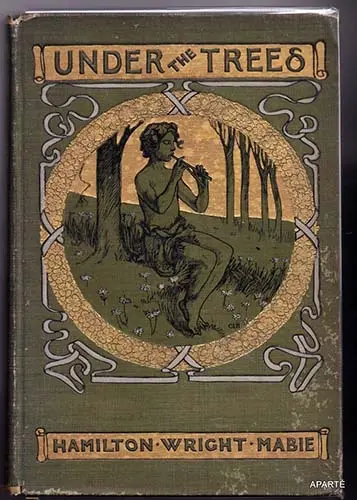
The first edition of 1902 is a masterpiece of the bookbinder’s art. Bound in green pictorial cloth, the cover features a striking design in gold, black, and white: a young boy with panpipes, surrounded by wreaths and ribbons—a motif that announces the pastoral spirit of the text . The top edge is gilded, while the fore and bottom edges remain untrimmed, a nod to the Arts and Crafts tradition . The cream endpapers are printed with a delicate green leaf pattern, and the title page is decorated throughout with marginal ornaments in green .
Inside, Hinton’s illustrations unfold like a pastoral symphony. Six full-page plates, each protected by a tissue guard with a decorative, descriptive banner, capture scenes of classical grace: nude or lightly draped youths and maidens, often playing shepherd’s pipes or reclining amidst stylized foliage . But the true genius of Hinton’s work lies in the marginal decorations that frame every page of text. On each spread, delicate drawings of children, flowers, and pastoral scenes surround the printed words, creating a seamless integration of image and meaning . The illustrations are rendered in a soft green ink—a palette that evokes the natural world without overwhelming the text.
Hinton’s style reflects the dual influences of Art Nouveau and the classical revival. His figures possess an idealized, Grecian quality—elongated, serene, and timeless—yet they are rendered with the sinuous lines and decorative patterning characteristic of the period . The effect is one of extraordinary harmony: a book in which text and image, nature and art, the nineteenth century and the classical past, all coexist in peaceful balance.
The publication of Under the Trees coincided with a broader movement in American book design that valued craftsmanship, artistry, and the integration of all elements of the book. Hinton, who designed the binding as well as the illustrations, created a volume that embodies these ideals . The book was printed by John Wilson and Son in Cambridge, Massachusetts, on heavy, quality paper.
Today, Under the Trees is a prized collectible, particularly among admirers of the American Arts and Crafts movement and of illustrated nature books. First editions in good condition—with their green pictorial bindings intact, their plates clean, and their tissue guards present—are increasingly scarce and sought after . The book’s fragility, as a volume intended for hands-on appreciation, means that surviving copies in fine condition are true treasures.
In the pages of Under the Trees, Mabie’s prose finds its perfect visual counterpart. “It is inexhaustible life, overflowing with unconsciousness and boundless fulness, that she forever reveals,” he writes of Nature . Hinton’s illustrations—those graceful figures with their pipes and wreaths—give that revelation visible form. It is a book that invites us to step out of the rush of modern life and into a world where time moves more slowly, where the woods are enchanted, and where art and nature, hand in hand, offer a glimpse of the sublime.
Recommended for Collectors
- The Secret Garden (1911) by Frances Hodgson Burnett, illustrated by Charles Robinson – For another early 20th-century celebration of nature’s magic
- Woodland Tales (1921) by Ernest Thompson Seton – For more nature stories with a similar rustic spirit
- Among the Meadow People (1897) by Clara Dillingham Pierson, illustrated by F.C. Gordon – A comparable pastoral children’s classic
Art Gallery: C.L. Hinton – Under the Trees 1902
![C.L. Hinton - Under The Trees [hinton-trees01] (art, illustrations)](https://www.nocloo.com/wp-content/plugins/justified-image-grid/timthumb.php?src=https%3A%2F%2Fwww.nocloo.com%2Fart%2Fhinton-trees%2Fhinton-trees01.jpg&h=280&q=90&f=.jpg "C.L. Hinton - Illustrations for Under the Trees 1902")
![C.L. Hinton - Under The Trees [hinton-trees02] (art, illustrations)](https://www.nocloo.com/wp-content/plugins/justified-image-grid/timthumb.php?src=https%3A%2F%2Fwww.nocloo.com%2Fart%2Fhinton-trees%2Fhinton-trees02.jpg&h=280&q=90&f=.jpg "C.L. Hinton - Illustrations for Under the Trees 1902")
![C.L. Hinton - Under The Trees [hinton-trees03] (art, illustrations)](https://www.nocloo.com/wp-content/plugins/justified-image-grid/timthumb.php?src=https%3A%2F%2Fwww.nocloo.com%2Fart%2Fhinton-trees%2Fhinton-trees03.jpg&h=280&q=90&f=.jpg "C.L. Hinton - Illustrations for Under the Trees 1902")
![C.L. Hinton - Under The Trees [hinton-trees04] (art, illustrations)](https://www.nocloo.com/wp-content/plugins/justified-image-grid/timthumb.php?src=https%3A%2F%2Fwww.nocloo.com%2Fart%2Fhinton-trees%2Fhinton-trees04.jpg&h=280&q=90&f=.jpg "C.L. Hinton - Illustrations for Under the Trees 1902")
![C.L. Hinton - Under The Trees [hinton-trees05] (art, illustrations)](https://www.nocloo.com/wp-content/plugins/justified-image-grid/timthumb.php?src=https%3A%2F%2Fwww.nocloo.com%2Fart%2Fhinton-trees%2Fhinton-trees05.jpg&h=280&q=90&f=.jpg "C.L. Hinton - Illustrations for Under the Trees 1902")
![C.L. Hinton - Under The Trees [hinton-trees06] (art, illustrations)](https://www.nocloo.com/wp-content/plugins/justified-image-grid/timthumb.php?src=https%3A%2F%2Fwww.nocloo.com%2Fart%2Fhinton-trees%2Fhinton-trees06.jpg&h=280&q=90&f=.jpg "C.L. Hinton - Illustrations for Under the Trees 1902")
![C.L. Hinton - Under The Trees [hinton-trees07] (art, illustrations)](https://www.nocloo.com/wp-content/plugins/justified-image-grid/timthumb.php?src=https%3A%2F%2Fwww.nocloo.com%2Fart%2Fhinton-trees%2Fhinton-trees07.jpg&h=280&q=90&f=.jpg "C.L. Hinton - Illustrations for Under the Trees 1902")