A Secret Revealed: Charles Robinson’s The Secret Garden
There are certain books that seem to have been waiting for a particular artist—text and image destined to meet across the years, each illuminating the other. Frances Hodgson Burnett’s The Secret Garden, first published in 1911, is such a work, and Charles Robinson’s 1911 first UK edition stands as one of the most beautiful interpretations of this beloved classic. It is a volume that captures the quiet magic of Burnett’s tale with all the delicacy and sensitivity that Robinson brought to his finest work.
Frances Hodgson Burnett (1849–1924) had already achieved fame with Little Lord Fauntleroy and A Little Princess when she published The Secret Garden. The novel tells the story of Mary Lennox, a spoiled, orphaned child sent to live with her reclusive uncle in Yorkshire. There, she discovers a neglected garden, locked behind a door for ten years, and through the act of bringing it back to life, she heals herself, her invalid cousin Colin, and the broken household around her. It is a story of transformation, of the healing power of nature, and of the quiet miracles that unfold when we tend to what has been forgotten.
Charles Robinson (1870–1937) was one of the most versatile illustrators of the Edwardian era. A member of the remarkable Robinson family—his brothers Thomas and William Heath were also celebrated illustrators—he had made his name with A Child’s Garden of Verses (1896) and his own Alice’s Adventures in Wonderland (1907). His style was characterized by delicate line work, a subtle sense of color, and an extraordinary ability to convey emotion through the subtlest of gestures. The Yorkshire moors, the hidden garden, the awakening of spring—these were subjects perfectly suited to his sensibility.
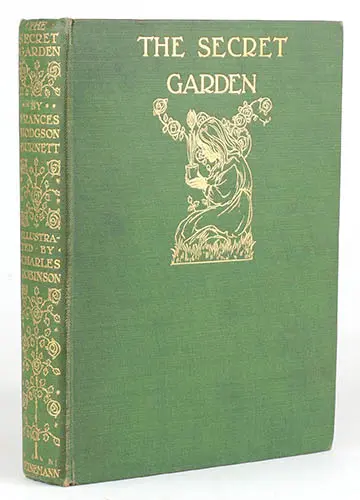
The 1911 edition, published by William Heinemann in London, was a handsome production. The volume contained eight full-page color plates protected by captioned tissue guards, alongside numerous black-and-white illustrations woven throughout the text. The binding was in green cloth with gilt stamping, featuring a design by Robinson on the front cover that hinted at the wonders within.
What distinguishes Robinson’s illustrations for The Secret Garden is their atmospheric depth. His palette is soft and evocative—the muted greens and grays of the Yorkshire moors, the warm golds of the garden in spring, the cool blues of the awakening sky. His figures, rendered with the elegant, elongated grace characteristic of his work, capture the emotional arc of the story: Mary’s initial sullenness, her growing curiosity, the first stirrings of her transformation. The garden itself is rendered with a tenderness that reflects its central role in the narrative—a place of neglect gradually becoming a place of abundance, a secret revealed through patience and care.
The black-and-white illustrations are equally remarkable. Robinson’s line work is extraordinarily fine, creating textures and patterns that reward sustained attention. The robin that leads Mary to the garden door, the roses that climb over the walls, the children at play in the hidden space—each drawing captures a moment of quiet revelation. Decorative borders and headpieces weave throughout the text, creating a cohesive visual experience from cover to cover.
The 1911 edition appeared at a moment when Robinson’s career was at its peak. His work for The Secret Garden joined his celebrated editions of The Happy Prince, Bee, Princess of the Dwarfs, and other classics, establishing him as one of the most sought-after illustrators of his generation. The critical response was warm, and the book quickly found its place in libraries and nurseries.
Today, Robinson’s The Secret Garden is a prized collectible. First editions in good condition—with the eight color plates intact and the binding preserved—are increasingly scarce. For collectors and admirers of Golden Age illustration, the volume represents a high point in Robinson’s career, a work where his delicate, sympathetic style found perfect alignment with a text of enduring charm.
In the pages of this book, the secret garden still waits behind its locked door. Mary still discovers the robin, Colin still learns to stand, and spring still returns to the moors. Charles Robinson gave Burnett’s masterpiece a visual language of extraordinary beauty—a reminder that the greatest illustrated books, like the greatest gardens, are places where we can return again and again, and always find something new.
For collectors:
- Our Sentimental Garden (1914) – A charming garden memoir with Robinson’s gentle, decorative illustrations.
- A Little Princess by Frances Hodgson Burnett, illustrated by Ethel Franklin Betts (1905) – another interpretation of Burnett’s work
- The Happy Prince and Other Tales by Oscar Wilde, illustrated by Charles Robinson (1913) – A beautiful pairing of literary fairy tales with Robinson’s delicate art
Other books illustrated by Charles Robinson available in our gallery: The Big Book of Fairy Tales, Bee, Princess of the Dwarfs, Margaret’s Book, The Happy Prince, Our Sentimental Garden, Songs and Sonnets.
Art Gallery: Charles Robinson – The Secret Garden 1911