A Poetic Vision: Charles Robinson’s Songs and Sonnets of William Shakespeare
In the vast landscape of Shakespeare illustration, most artists have gravitated toward the grand narratives—the tragedies, the histories, the sweeping comedies that unfold across stages and kingdoms. Charles Robinson took a different path. His 1915 edition of the Songs and Sonnets of William Shakespeare turned instead to the intimate heart of the Bard’s work—the lyrical poetry of love, time, and mortality—and found in it a visual language of extraordinary delicacy and grace.
Charles Robinson (1870–1937) was one of the most versatile illustrators of the Golden Age, part of a remarkable artistic family that included his brothers Thomas and William Heath Robinson. His career spanned the late Victorian and Edwardian eras, and his work graced some of the most beloved children’s books of the period, including A Child’s Garden of Verses, The Secret Garden, and The Happy Prince. Yet his illustrations for Shakespeare’s poetry represent a particular achievement—a meeting of lyric sensibility and visual artistry that captures the elusive beauty of the verse.
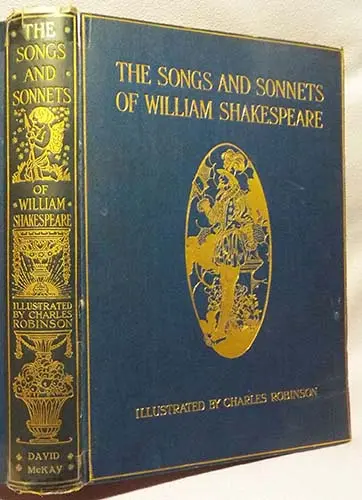
The 1915 edition, published by Duckworth & Co. in London, was a handsome production befitting its subject. The volume contained twelve full-color plates, each mounted on heavy paper and protected by captioned tissue guards, alongside numerous black-and-white illustrations and decorative elements woven throughout the text. The binding was in cloth with gilt stamping, often featuring a design by Robinson on the front cover that set the tone for the poetic journey within.
What distinguishes Robinson’s approach to Shakespeare’s poetry is his restraint. The sonnets—with their meditations on love, beauty, aging, and the power of verse to transcend time—do not lend themselves to grand theatrical illustration. Robinson understood this. His illustrations are intimate, subtle, and deeply sensitive to the mood of each poem. A young woman gazes into a mirror, contemplating the ravages of time. A lover reaches toward a beloved figure who seems to shimmer between presence and absence. A rose blooms, a candle flickers, a shadow falls across an empty room.
Robinson’s palette in these illustrations is soft and evocative—pale pinks, muted golds, gentle blues, and touches of warm rose that suggest both the richness of Elizabethan poetry and the fleeting beauty of its subjects. His figures, rendered in the elegant, elongated style characteristic of his work, possess a quiet dignity and a subtle emotional depth. They are not characters from a play but figures from a dream—half-real, half-imagined, perfectly suited to the sonnets’ blend of passion and contemplation.
The inclusion of the songs from Shakespeare’s plays—“It was a lover and his lass,” “Under the greenwood tree,” “When daffodils begin to peer”—allowed Robinson to engage with the more pastoral, lighter side of Shakespeare’s lyric poetry. These illustrations are brighter, more playful, filled with the vitality of the natural world. Yet even here, Robinson’s touch remains delicate, his compositions balanced between decoration and emotional resonance.
The book’s production reflected the care with which it was conceived. The quality of the paper, the richness of the color reproduction, and the careful mounting of plates behind tissue guards all spoke to a belief that poetry—even in a mass-market edition—deserved to be presented with artistry. It was a book designed for the drawing-room rather than the nursery, a volume to be lingered over rather than merely read.
Today, Robinson’s Songs and Sonnets is a cherished collectible. First editions in good condition, with clean plates and intact bindings, are increasingly scarce. For collectors and admirers of Golden Age illustration, it represents a high point in Robinson’s career—a work where his delicate, lyrical style found perfect alignment with some of the most beautiful poetry in the English language.
In the pages of this book, Shakespeare’s sonnets—those timeless meditations on love and loss—find a visual counterpart of extraordinary sensitivity. Charles Robinson’s illustrations do not explain the poems or illustrate them literally. Instead, they create a mood, a space, an atmosphere in which the words can resonate more deeply. They remind us that the art of illustration, at its best, is not about adding to a text but about illuminating it—casting light, like a candle in a dark room, on the beauty that was there all along.
Recommended for Collectors
- Shakespeare’s Sonnets (1905) illustrated by Gilbert James – For another Golden Age take on Shakespeare’s poetry
- A Midsummer-Night’s Dream (1908) illustrated by Arthur Rackham – A dreamlike vision of Shakespeare’s play
- The Poems of Spenser (1906) illustrated by Jessie M. King – A complementary pairing of poetry and art
Other books illustrated by Charles Robinson available in our gallery: The Secret Garden, The Big Book of Fairy Tales, Bee, Princess of the Dwarfs, Margaret’s Book, The Happy Prince, Our Sentimental Garden.
Art Gallery: Charles Robinson – Songs and Sonnets of William Shakespeare 1915