A Poetic Collaboration: Jessie M. King’s Poems of Spenser
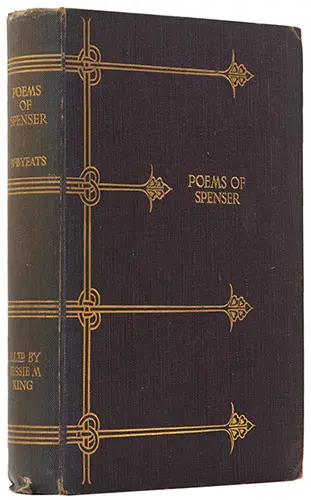
There are books that transcend their status as mere objects, becoming instead windows into a particular moment of artistic convergence. The 1906 edition of Edmund Spenser’s Poems of Spenser, selected and introduced by the great W. B. Yeats and illustrated by Jessie M. King, is one such treasure. Published as part of the Golden Poets series by T. C. & E. C. Jack of Edinburgh, this volume represents a remarkable meeting of three distinct artistic sensibilities—Elizabethan, Irish Revivalist, and Glasgow Style—all united within a single, beautifully crafted book .
Jessie Marion King (1875–1949) was, by 1906, already established as one of the most distinctive illustrators of her generation. A central figure among the Glasgow Girls and a former student of the Glasgow School of Art, she had developed a style that defied easy categorization . Her work blended the sinuous lines of Art Nouveau with the intricate precision of Aubrey Beardsley, yet possessed a softer, more dreamlike quality that was entirely her own. She famously declared, “I would not copy designs, but insisted on drawing out of my head,” and her illustrations for this volume embody that philosophy .
The book itself is a handsome production—brown cloth decorated in orange and gilt, with an Art Nouveau floral pattern gracing both spine and front board . The top edge is gilded, a hallmark of fine binding from the period, while the remaining edges are left untrimmed in the Arts and Crafts tradition . Within its pages, the reader finds eight full-page color plates by King, rendered in a palette that includes subtle touches of pink and gold, alongside a frontispiece portrait of Spenser and decorated title page by A. S. Hartrick .
What makes this edition particularly significant is the presence of Yeats, whose introduction frames Spenser’s poetry for a new century. The Irish poet, then at the height of his own creative powers, understood Spenser as a kindred spirit—a poet whose “genius was pictorial,” who “seemed always to feel through the eyes, imagining everything in pictures” . These words resonate deeply with King’s visual approach. Her illustrations do not merely decorate the text; they interpret it, finding in Spenser’s allegorical landscapes and courtly figures a world that echoes her own preoccupations with romance, legend, and the liminal space between reality and dream.
King’s plates for this volume reveal her mature style at its most assured. Her figures possess an elegant, elongated grace, their flowing garments rendered in meticulous pen-and-ink lines that reveal her training in book decoration. There is a quiet intimacy to her work—a sense that these are not illustrations of grand public gestures but glimpses into private moments of contemplation. She was particularly drawn to Spenser’s pastoral themes and his explorations of love and virtue, subjects that aligned with her own artistic interests .
The structure of the volume, with its thematic sections—Happy and Unhappy Love, Courtiers and Great Men, Gardens of Delight—allowed King to explore the full emotional range of Spenser’s poetry . Her images move from scenes of courtly elegance to moments of melancholy reflection, capturing both the splendor and the poignancy of the Elizabethan age. In doing so, she created a dialogue between past and present, between Spenser’s Renaissance world and the burgeoning modernity of the early twentieth century.
Today, Poems of Spenser stands as a testament to a moment when the illustrated book was elevated to a collaborative art form. It brings together three remarkable figures—Spenser, Yeats, and King—each responding to the others across centuries, united by a shared belief in the power of the imagination to transform the world into something beautiful and enduring. For collectors and lovers of the illustrated book, it remains a cherished volume, a jewel of the Golden Age that continues to enchant more than a century after its publication.
For devotees of this edition, these kindred works may enchant:
• The High History of the Holy Graal (1908) illustrated by King – her Arthurian masterpiece
• Defence of Guenevere and other Poems by William Morris – illustrated by King – showing her earlier style
• The Faerie Queene (1897) illustrated by Walter Crane – for contrasting Victorian interpretation
Other Jessie M. King illustrated works available in our illustrations gallery: The Defence of Guenevere, A House of Pomegranates, The High History of the Holy Graal, Seven Happy Days, The Mummy’s Bedtime Story Book, Habitation Forcee.
Art Gallery: Jessie M. King – Poems of Spenser 1906
![Jessie M. King - Poems of Spenser [jessie-king-spenser01] (art, illustrations)](https://www.nocloo.com/wp-content/plugins/justified-image-grid/timthumb.php?src=https%3A%2F%2Fwww.nocloo.com%2Fart%2Fjmking-spenser%2Fjessie-king-spenser01.jpg&h=280&q=90&f=.jpg "Jessie M. King - Illustrations for Poems of Spenser 1906")
![Jessie M. King - Poems of Spenser [jessie-king-spenser02] (art, illustrations)](https://www.nocloo.com/wp-content/plugins/justified-image-grid/timthumb.php?src=https%3A%2F%2Fwww.nocloo.com%2Fart%2Fjmking-spenser%2Fjessie-king-spenser02.jpg&h=280&q=90&f=.jpg "Jessie M. King - Illustrations for Poems of Spenser 1906")
![Jessie M. King - Poems of Spenser [jessie-king-spenser03] (art, illustrations)](https://www.nocloo.com/wp-content/plugins/justified-image-grid/timthumb.php?src=https%3A%2F%2Fwww.nocloo.com%2Fart%2Fjmking-spenser%2Fjessie-king-spenser03.jpg&h=280&q=90&f=.jpg "Jessie M. King - Illustrations for Poems of Spenser 1906")
![Jessie M. King - Poems of Spenser [jessie-king-spenser04] (art, illustrations)](https://www.nocloo.com/wp-content/plugins/justified-image-grid/timthumb.php?src=https%3A%2F%2Fwww.nocloo.com%2Fart%2Fjmking-spenser%2Fjessie-king-spenser04.jpg&h=280&q=90&f=.jpg "Jessie M. King - Illustrations for Poems of Spenser 1906")
![Jessie M. King - Poems of Spenser [jessie-king-spenser05] (art, illustrations)](https://www.nocloo.com/wp-content/plugins/justified-image-grid/timthumb.php?src=https%3A%2F%2Fwww.nocloo.com%2Fart%2Fjmking-spenser%2Fjessie-king-spenser05.jpg&h=280&q=90&f=.jpg "Jessie M. King - Illustrations for Poems of Spenser 1906")
![Jessie M. King - Poems of Spenser [jessie-king-spenser06] (art, illustrations)](https://www.nocloo.com/wp-content/plugins/justified-image-grid/timthumb.php?src=https%3A%2F%2Fwww.nocloo.com%2Fart%2Fjmking-spenser%2Fjessie-king-spenser06.jpg&h=280&q=90&f=.jpg "Jessie M. King - Illustrations for Poems of Spenser 1906")
![Jessie M. King - Poems of Spenser [jessie-king-spenser07] (art, illustrations)](https://www.nocloo.com/wp-content/plugins/justified-image-grid/timthumb.php?src=https%3A%2F%2Fwww.nocloo.com%2Fart%2Fjmking-spenser%2Fjessie-king-spenser07.jpg&h=280&q=90&f=.jpg "Jessie M. King - Illustrations for Poems of Spenser 1906")
![Jessie M. King - Poems of Spenser [jessie-king-spenser08] (art, illustrations)](https://www.nocloo.com/wp-content/plugins/justified-image-grid/timthumb.php?src=https%3A%2F%2Fwww.nocloo.com%2Fart%2Fjmking-spenser%2Fjessie-king-spenser08.jpg&h=280&q=90&f=.jpg "Jessie M. King - Illustrations for Poems of Spenser 1906")