A Pre-Raphaelite Vision: Jessie M. King’s The Defence of Guenevere
In the history of illustrated books, certain volumes achieve a perfect marriage of text and image—a convergence so harmonious that the work of artist and author becomes inseparable in the reader’s imagination. Jessie M. King’s 1904 edition of William Morris’s The Defence of Guenevere and Other Poems is such a work. It stands as a masterpiece of the Glasgow Style, a testament to the enduring influence of the Pre-Raphaelite movement, and a jewel of the Golden Age of Illustration.
William Morris (1834–1896) was a central figure in the Pre-Raphaelite circle, a poet, artist, and social reformer whose vision of medieval romance and craftsmanship shaped Victorian culture. The Defence of Guenevere, his first published collection of poetry, appeared in 1858 and established his reputation. The title poem, a dramatic monologue spoken by the legendary queen as she stands trial for adultery, is a masterpiece of psychological complexity—a work that challenges conventional moral judgments and invites sympathy for a figure often condemned.
Jessie Marion King (1875–1949) was, by 1904, emerging as a leading figure in the Glasgow Style, Scotland’s contribution to the Art Nouveau movement. Trained at the Glasgow School of Art under the visionary director Francis Newbery, she had developed a style characterized by sinuous lines, intricate patterning, and a deep engagement with the world of legend and romance. The Morris commission would become one of the defining achievements of her early career.
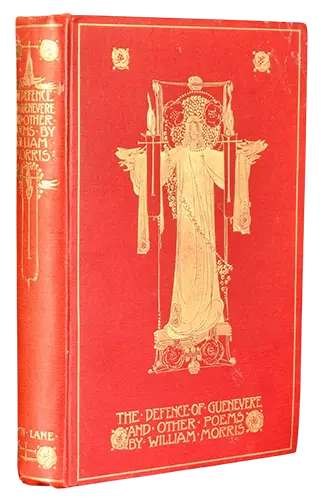
The 1904 edition, published by John Lane at the Bodley Head in London, was a handsome production. The binding was in red cloth with gilt stamping, featuring a design by King on the front cover that set the tone for the medieval romance within. Inside, readers discovered a series of full-page black-and-white illustrations,, alongside decorative borders, initials, and marginal drawings that transformed every page into a unified work of art.
What distinguishes King’s illustrations for Morris’s poems is her ability to capture the medieval spirit while infusing it with the decorative elegance of Art Nouveau. Her Guenevere is a figure of complex dignity—beautiful, proud, vulnerable, her face reflecting the weight of the accusation she faces. The court scenes are rendered with an attention to pattern and texture that recalls medieval manuscript illumination; the landscapes evoke the world of the Arthurian romances, with their castles, forests, and distant hills.
The illustrations for “The Defence of Guenevere” are rendered in rich, warm tones that capture the drama of the queen’s trial; the illustrations for the more lyrical poems, such as “The Tune of Seven Towers,” employ cooler, more ethereal colors that evoke their dreamlike quality.
The decorative elements are equally remarkable. King’s borders weave around the text with the organic flow of climbing vines, incorporating figures from the poems and motifs from medieval art. The initials are elaborately illuminated, each a miniature work of art that rewards sustained attention. The total effect is one of immersion—a book that envelops the reader in the world of Morris’s poems from the first page to the last.
The critical response to King’s The Defence of Guenevere was enthusiastic. Reviewers praised her “delicate and fanciful” style and her ability to capture “the spirit of medieval romance.” The book established her reputation as one of the leading illustrators of her generation and led to commissions for works by Shakespeare, Hawthorne, and other literary masters.
Today, the 1904 edition is highly prized by collectors. First editions in good condition, with their cloth bindings intact and their plates clean, are increasingly scarce. For those fortunate enough to own a copy, the book offers a rare experience: a journey into the world of William Morris’s medieval imagination, guided by an artist who understood that the greatest poetry deserves the greatest art.
In the pages of this book, Guenevere still stands before her judges; the knights still ride through the forests of Arthurian legend; the towers still echo with forgotten songs. Jessie M. King gave Morris’s poems a visual language of extraordinary beauty—a reminder that the collaboration between poet and illustrator, when it achieves its highest form, can create something that neither could achieve alone.
Recommended for collectors:
- The High History of the Holy Graal (1903), illustrated by Jessie M. King – A richly illustrated Arthurian romance with King’s signature style.
- A House of Pomegranates (1914), by Oscar Wilde, illustrated by Jessie M. King – An ornate edition of Wilde’s fairy tales featuring King’s ethereal designs.
- Goblin Market (1933), illustrated by Arthur Rackham – A poetic fantasy with atmospheric illustrations and emotional intensity akin to Morris’s themes.
Other Jessie M. King illustrated works available in our gallery: The Mummy’s Bedtime Story Book, A House of Pomegranates, The High History of the Holy Graal, Seven Happy Days, Poems of Spenser, Habitation Forcee.
Art Gallery: Jessie M. King – The Defence of Guenevere and Other Poems 1904
![Jessie M. King - The Defence of Guenevere and Other Poems [jmking-guenevere01] (art, illustrations)](https://www.nocloo.com/wp-content/plugins/justified-image-grid/timthumb.php?src=https%3A%2F%2Fwww.nocloo.com%2Fart%2Fjmking-guenevere%2Fjmking-guenevere01.jpg&h=280&q=90&f=.jpg "Jessie M. King - Illustrations for The Defence of Guenevere and Other Poems 1904")
![Jessie M. King - The Defence of Guenevere and Other Poems [jmking-guenevere02] (art, illustrations)](https://www.nocloo.com/wp-content/plugins/justified-image-grid/timthumb.php?src=https%3A%2F%2Fwww.nocloo.com%2Fart%2Fjmking-guenevere%2Fjmking-guenevere02.jpg&h=280&q=90&f=.jpg "Jessie M. King - Illustrations for The Defence of Guenevere and Other Poems 1904")
![Jessie M. King - The Defence of Guenevere and Other Poems [jmking-guenevere03] (art, illustrations)](https://www.nocloo.com/wp-content/plugins/justified-image-grid/timthumb.php?src=https%3A%2F%2Fwww.nocloo.com%2Fart%2Fjmking-guenevere%2Fjmking-guenevere03.jpg&h=280&q=90&f=.jpg "Jessie M. King - Illustrations for The Defence of Guenevere and Other Poems 1904")
![Jessie M. King - The Defence of Guenevere and Other Poems [jmking-guenevere04] (art, illustrations)](https://www.nocloo.com/wp-content/plugins/justified-image-grid/timthumb.php?src=https%3A%2F%2Fwww.nocloo.com%2Fart%2Fjmking-guenevere%2Fjmking-guenevere04.jpg&h=280&q=90&f=.jpg "Jessie M. King - Illustrations for The Defence of Guenevere and Other Poems 1904")
![Jessie M. King - The Defence of Guenevere and Other Poems [jmking-guenevere05] (art, illustrations)](https://www.nocloo.com/wp-content/plugins/justified-image-grid/timthumb.php?src=https%3A%2F%2Fwww.nocloo.com%2Fart%2Fjmking-guenevere%2Fjmking-guenevere05.jpg&h=280&q=90&f=.jpg "Jessie M. King - Illustrations for The Defence of Guenevere and Other Poems 1904")
![Jessie M. King - The Defence of Guenevere and Other Poems [jmking-guenevere06] (art, illustrations)](https://www.nocloo.com/wp-content/plugins/justified-image-grid/timthumb.php?src=https%3A%2F%2Fwww.nocloo.com%2Fart%2Fjmking-guenevere%2Fjmking-guenevere06.jpg&h=280&q=90&f=.jpg "Jessie M. King - Illustrations for The Defence of Guenevere and Other Poems 1904")
![Jessie M. King - The Defence of Guenevere and Other Poems [jmking-guenevere07] (art, illustrations)](https://www.nocloo.com/wp-content/plugins/justified-image-grid/timthumb.php?src=https%3A%2F%2Fwww.nocloo.com%2Fart%2Fjmking-guenevere%2Fjmking-guenevere07.jpg&h=280&q=90&f=.jpg "Jessie M. King - Illustrations for The Defence of Guenevere and Other Poems 1904")
![Jessie M. King - The Defence of Guenevere and Other Poems [jmking-guenevere08] (art, illustrations)](https://www.nocloo.com/wp-content/plugins/justified-image-grid/timthumb.php?src=https%3A%2F%2Fwww.nocloo.com%2Fart%2Fjmking-guenevere%2Fjmking-guenevere08.jpg&h=280&q=90&f=.jpg "Jessie M. King - Illustrations for The Defence of Guenevere and Other Poems 1904")
![Jessie M. King - The Defence of Guenevere and Other Poems [jmking-guenevere09] (art, illustrations)](https://www.nocloo.com/wp-content/plugins/justified-image-grid/timthumb.php?src=https%3A%2F%2Fwww.nocloo.com%2Fart%2Fjmking-guenevere%2Fjmking-guenevere09.jpg&h=280&q=90&f=.jpg "Jessie M. King - Illustrations for The Defence of Guenevere and Other Poems 1904")
![Jessie M. King - The Defence of Guenevere and Other Poems [jmking-guenevere10] (art, illustrations)](https://www.nocloo.com/wp-content/plugins/justified-image-grid/timthumb.php?src=https%3A%2F%2Fwww.nocloo.com%2Fart%2Fjmking-guenevere%2Fjmking-guenevere10.jpg&h=280&q=90&f=.jpg "Jessie M. King - Illustrations for The Defence of Guenevere and Other Poems 1904")
![Jessie M. King - The Defence of Guenevere and Other Poems [jmking-guenevere11] (art, illustrations)](https://www.nocloo.com/wp-content/plugins/justified-image-grid/timthumb.php?src=https%3A%2F%2Fwww.nocloo.com%2Fart%2Fjmking-guenevere%2Fjmking-guenevere11.jpg&h=280&q=90&f=.jpg "Jessie M. King - Illustrations for The Defence of Guenevere and Other Poems 1904")
![Jessie M. King - The Defence of Guenevere and Other Poems [jmking-guenevere12] (art, illustrations)](https://www.nocloo.com/wp-content/plugins/justified-image-grid/timthumb.php?src=https%3A%2F%2Fwww.nocloo.com%2Fart%2Fjmking-guenevere%2Fjmking-guenevere12.jpg&h=280&q=90&f=.jpg "Jessie M. King - Illustrations for The Defence of Guenevere and Other Poems 1904")
![Jessie M. King - The Defence of Guenevere and Other Poems [jmking-guenevere13] (art, illustrations)](https://www.nocloo.com/wp-content/plugins/justified-image-grid/timthumb.php?src=https%3A%2F%2Fwww.nocloo.com%2Fart%2Fjmking-guenevere%2Fjmking-guenevere13.jpg&h=280&q=90&f=.jpg "Jessie M. King - Illustrations for The Defence of Guenevere and Other Poems 1904")
![Jessie M. King - The Defence of Guenevere and Other Poems [jmking-guenevere14] (art, illustrations)](https://www.nocloo.com/wp-content/plugins/justified-image-grid/timthumb.php?src=https%3A%2F%2Fwww.nocloo.com%2Fart%2Fjmking-guenevere%2Fjmking-guenevere14.jpg&h=280&q=90&f=.jpg "Jessie M. King - Illustrations for The Defence of Guenevere and Other Poems 1904")
![Jessie M. King - The Defence of Guenevere and Other Poems [jmking-guenevere15] (art, illustrations)](https://www.nocloo.com/wp-content/plugins/justified-image-grid/timthumb.php?src=https%3A%2F%2Fwww.nocloo.com%2Fart%2Fjmking-guenevere%2Fjmking-guenevere15.jpg&h=280&q=90&f=.jpg "Jessie M. King - Illustrations for The Defence of Guenevere and Other Poems 1904")
![Jessie M. King - The Defence of Guenevere and Other Poems [jmking-guenevere16] (art, illustrations)](https://www.nocloo.com/wp-content/plugins/justified-image-grid/timthumb.php?src=https%3A%2F%2Fwww.nocloo.com%2Fart%2Fjmking-guenevere%2Fjmking-guenevere16.jpg&h=280&q=90&f=.jpg "Jessie M. King - Illustrations for The Defence of Guenevere and Other Poems 1904")
![Jessie M. King - The Defence of Guenevere and Other Poems [jmking-guenevere17] (art, illustrations)](https://www.nocloo.com/wp-content/plugins/justified-image-grid/timthumb.php?src=https%3A%2F%2Fwww.nocloo.com%2Fart%2Fjmking-guenevere%2Fjmking-guenevere17.jpg&h=280&q=90&f=.jpg "Jessie M. King - Illustrations for The Defence of Guenevere and Other Poems 1904")
![Jessie M. King - The Defence of Guenevere and Other Poems [jmking-guenevere18] (art, illustrations)](https://www.nocloo.com/wp-content/plugins/justified-image-grid/timthumb.php?src=https%3A%2F%2Fwww.nocloo.com%2Fart%2Fjmking-guenevere%2Fjmking-guenevere18.jpg&h=280&q=90&f=.jpg "Jessie M. King - Illustrations for The Defence of Guenevere and Other Poems 1904")
![Jessie M. King - The Defence of Guenevere and Other Poems [jmking-guenevere19] (art, illustrations)](https://www.nocloo.com/wp-content/plugins/justified-image-grid/timthumb.php?src=https%3A%2F%2Fwww.nocloo.com%2Fart%2Fjmking-guenevere%2Fjmking-guenevere19.jpg&h=280&q=90&f=.jpg "Jessie M. King - Illustrations for The Defence of Guenevere and Other Poems 1904")
![Jessie M. King - The Defence of Guenevere and Other Poems [jmking-guenevere20] (art, illustrations)](https://www.nocloo.com/wp-content/plugins/justified-image-grid/timthumb.php?src=https%3A%2F%2Fwww.nocloo.com%2Fart%2Fjmking-guenevere%2Fjmking-guenevere20.jpg&h=280&q=90&f=.jpg "Jessie M. King - Illustrations for The Defence of Guenevere and Other Poems 1904")
![Jessie M. King - The Defence of Guenevere and Other Poems [jmking-guenevere21] (art, illustrations)](https://www.nocloo.com/wp-content/plugins/justified-image-grid/timthumb.php?src=https%3A%2F%2Fwww.nocloo.com%2Fart%2Fjmking-guenevere%2Fjmking-guenevere21.jpg&h=280&q=90&f=.jpg "Jessie M. King - Illustrations for The Defence of Guenevere and Other Poems 1904")
![Jessie M. King - The Defence of Guenevere and Other Poems [jmking-guenevere22] (art, illustrations)](https://www.nocloo.com/wp-content/plugins/justified-image-grid/timthumb.php?src=https%3A%2F%2Fwww.nocloo.com%2Fart%2Fjmking-guenevere%2Fjmking-guenevere22.jpg&h=280&q=90&f=.jpg "Jessie M. King - Illustrations for The Defence of Guenevere and Other Poems 1904")
![Jessie M. King - The Defence of Guenevere and Other Poems [jmking-guenevere23] (art, illustrations)](https://www.nocloo.com/wp-content/plugins/justified-image-grid/timthumb.php?src=https%3A%2F%2Fwww.nocloo.com%2Fart%2Fjmking-guenevere%2Fjmking-guenevere23.jpg&h=280&q=90&f=.jpg "Jessie M. King - Illustrations for The Defence of Guenevere and Other Poems 1904")
![Jessie M. King - The Defence of Guenevere and Other Poems [jmking-guenevere24] (art, illustrations)](https://www.nocloo.com/wp-content/plugins/justified-image-grid/timthumb.php?src=https%3A%2F%2Fwww.nocloo.com%2Fart%2Fjmking-guenevere%2Fjmking-guenevere24.jpg&h=280&q=90&f=.jpg "Jessie M. King - Illustrations for The Defence of Guenevere and Other Poems 1904")
![Jessie M. King - The Defence of Guenevere and Other Poems [jmking-guenevere25] (art, illustrations)](https://www.nocloo.com/wp-content/plugins/justified-image-grid/timthumb.php?src=https%3A%2F%2Fwww.nocloo.com%2Fart%2Fjmking-guenevere%2Fjmking-guenevere25.jpg&h=280&q=90&f=.jpg "Jessie M. King - Illustrations for The Defence of Guenevere and Other Poems 1904")
![Jessie M. King - The Defence of Guenevere and Other Poems [jmking-guenevere26] (art, illustrations)](https://www.nocloo.com/wp-content/plugins/justified-image-grid/timthumb.php?src=https%3A%2F%2Fwww.nocloo.com%2Fart%2Fjmking-guenevere%2Fjmking-guenevere26.jpg&h=280&q=90&f=.jpg "Jessie M. King - Illustrations for The Defence of Guenevere and Other Poems 1904")
![Jessie M. King - The Defence of Guenevere and Other Poems [jmking-guenevere27] (art, illustrations)](https://www.nocloo.com/wp-content/plugins/justified-image-grid/timthumb.php?src=https%3A%2F%2Fwww.nocloo.com%2Fart%2Fjmking-guenevere%2Fjmking-guenevere27.jpg&h=280&q=90&f=.jpg "Jessie M. King - Illustrations for The Defence of Guenevere and Other Poems 1904")
![Jessie M. King - The Defence of Guenevere and Other Poems [jmking-guenevere28] (art, illustrations)](https://www.nocloo.com/wp-content/plugins/justified-image-grid/timthumb.php?src=https%3A%2F%2Fwww.nocloo.com%2Fart%2Fjmking-guenevere%2Fjmking-guenevere28.jpg&h=280&q=90&f=.jpg "Jessie M. King - Illustrations for The Defence of Guenevere and Other Poems 1904")