Dreamland and Fairy Folk: Jessie M. King’s The Mummy’s Bedtime Story Book
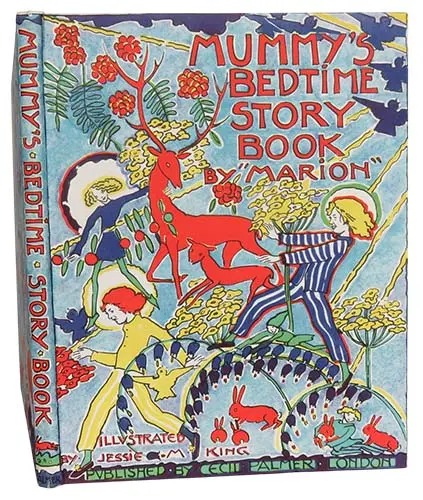
In the late 1920s, when the Golden Age of Illustration was giving way to new artistic movements, Jessie M. King—one of the Glasgow Style’s most distinctive artists—created a book that captured the quiet magic of the nursery. The Mummy’s Bedtime Story Book, published in 1929 by Cecil Palmer in London, represents a gentler side of King’s artistry, a volume designed not for the collector’s shelf but for the intimate ritual of mother and child sharing stories before sleep .
The book’s authorship carries a charming mystery. It was credited simply to “Marion”—King’s own middle name—leading generations of collectors and biographers to wonder if the artist herself had written the tales . Only in the 1990s was the true author revealed: Marion Donaldson Gemmell, daughter of a Scottish shipping magnate, who had written these gentle stories for her own children . Yet the attribution to “Marion” feels fitting, as if the book emerged from the same dreamlike world that King conjured with her pen.
The 1929 first edition was notable for its ambitious production. It was the largest format of any of King’s illustrated books, a substantial quarto measuring approximately 11 by 9 inches, bound in bright pictorial boards with a design by King that invited young readers into its pages . Inside, readers discovered a wealth of color: a colored frontispiece, a colored title page, eleven full-page color illustrations, and—most remarkably—color decorations on every text page . The book was printed by photo-offset, a technique that allowed King’s delicate work to be reproduced with fidelity while keeping the volume affordable for families .
The twelve stories within are short, soothing, and designed for quiet moments between mother and child . Titles like “Peter and Mary,” “The Tiresome Rabbit,” “Jack Frost,” “The Country of Let’s Pretend,” and “Where Babies Come From” hint at the book’s gentle imagination . In the final tale, a little girl asks her nurse where babies come from; the nurse replies, “You ask the fairies in Dreamland to-night, and perhaps they will take you to see!” . It is a perfect encapsulation of the book’s spirit: questions answered not with facts but with fairyland.
King’s illustrations in this volume reflect her mature style, more restrained than the elaborate pen-and-ink work of her early career yet still unmistakably hers . Her signature elements appear throughout: flowing gowns, fairy-tale creatures, angels and fairies, children with wide eyes, and her characteristic use of dots and floral motifs . The color palette is soft yet luminous, the compositions intimate, the figures graceful. Each illustration creates a space where the boundaries between the everyday and the enchanted dissolve.
The book’s timing is significant. King had dedicated it “to her own babies and their Daddy”—her daughter Merle and her husband, the artist E.A. Taylor . By 1929, the family had settled in Kirkcudbright, where King continued to work in book illustration, ceramics, and batik. The Mummy’s Bedtime Story Book appeared during a period when her style was evolving from the elaborate Art Nouveau of her early works toward something more accessible—yet no less magical.
Today, the book is highly collectible and increasingly scarce. The fragile paper-covered boards and the delicate nature of the color plates meant that many copies were loved to pieces in nurseries. The original glassine dust wrappers, printed “5/- Net,” are exceptionally rare . For those fortunate enough to own a copy in fine condition, The Mummy’s Bedtime Story Book offers a glimpse into a vanished world—a time when bedtime stories were an art form, and when one of Scotland’s greatest illustrators turned her talents to the most intimate of genres: the tales that send children to sleep with dreams of fairyland.
In its pages, Jack Frost still paints the windows, the two imps still cause their mischief, and the fairies still guide children to Dreamland. Jessie M. King’s gentle masterpiece endures—a reminder that the best bedtime stories, like the best art, are those that make the world feel a little more magical before sleep.
Recommended for collectors:
- The High History of the Holy Graal (1903), illustrated by Jessie M. King – A mystical Arthurian epic brought to life through King’s ornamental style.
- The Defence of Guenevere and Other Poems (1904), by William Morris, illustrated by Jessie M. King – A lyrical and romantic poetry collection with powerful illustrations.
- The Dream Garden (1918), illustrated by Florence Harrison – Lushly decorated fairy tales and verses, perfect for fans of stylized early 20th-century illustration.
Other Jessie M. King illustrated works available in our gallery: The Defence of Guenevere, A House of Pomegranates, The High History of the Holy Graal, Seven Happy Days, Poems of Spenser, Habitation Forcee.
Art Gallery: Jessie M. King – The Mummy’s Bedtime Story Book 1929
![Jessie M. King - The Mummy's Bedtime Story Book [jmking-mummy01] (art, illustrations)](https://www.nocloo.com/wp-content/plugins/justified-image-grid/timthumb.php?src=https%3A%2F%2Fwww.nocloo.com%2Fart%2Fjmking-mummy%2Fjmking-mummy01.jpg&h=280&q=90&f=.jpg "Jessie M. King - Illustrations for The Mummy's Bedtime Story Book 1929")
![Jessie M. King - The Mummy's Bedtime Story Book [jmking-mummy02] (art, illustrations)](https://www.nocloo.com/wp-content/plugins/justified-image-grid/timthumb.php?src=https%3A%2F%2Fwww.nocloo.com%2Fart%2Fjmking-mummy%2Fjmking-mummy02.jpg&h=280&q=90&f=.jpg "Jessie M. King - Illustrations for The Mummy's Bedtime Story Book 1929")
![Jessie M. King - The Mummy's Bedtime Story Book [jmking-mummy03] (art, illustrations)](https://www.nocloo.com/wp-content/plugins/justified-image-grid/timthumb.php?src=https%3A%2F%2Fwww.nocloo.com%2Fart%2Fjmking-mummy%2Fjmking-mummy03.jpg&h=280&q=90&f=.jpg "Jessie M. King - Illustrations for The Mummy's Bedtime Story Book 1929")
![Jessie M. King - The Mummy's Bedtime Story Book [jmking-mummy04] (art, illustrations)](https://www.nocloo.com/wp-content/plugins/justified-image-grid/timthumb.php?src=https%3A%2F%2Fwww.nocloo.com%2Fart%2Fjmking-mummy%2Fjmking-mummy04.jpg&h=280&q=90&f=.jpg "Jessie M. King - Illustrations for The Mummy's Bedtime Story Book 1929")
![Jessie M. King - The Mummy's Bedtime Story Book [jmking-mummy05] (art, illustrations)](https://www.nocloo.com/wp-content/plugins/justified-image-grid/timthumb.php?src=https%3A%2F%2Fwww.nocloo.com%2Fart%2Fjmking-mummy%2Fjmking-mummy05.jpg&h=280&q=90&f=.jpg "Jessie M. King - Illustrations for The Mummy's Bedtime Story Book 1929")
![Jessie M. King - The Mummy's Bedtime Story Book [jmking-mummy06] (art, illustrations)](https://www.nocloo.com/wp-content/plugins/justified-image-grid/timthumb.php?src=https%3A%2F%2Fwww.nocloo.com%2Fart%2Fjmking-mummy%2Fjmking-mummy06.jpg&h=280&q=90&f=.jpg "Jessie M. King - Illustrations for The Mummy's Bedtime Story Book 1929")
![Jessie M. King - The Mummy's Bedtime Story Book [jmking-mummy07] (art, illustrations)](https://www.nocloo.com/wp-content/plugins/justified-image-grid/timthumb.php?src=https%3A%2F%2Fwww.nocloo.com%2Fart%2Fjmking-mummy%2Fjmking-mummy07.jpg&h=280&q=90&f=.jpg "Jessie M. King - Illustrations for The Mummy's Bedtime Story Book 1929")
![Jessie M. King - The Mummy's Bedtime Story Book [jmking-mummy08] (art, illustrations)](https://www.nocloo.com/wp-content/plugins/justified-image-grid/timthumb.php?src=https%3A%2F%2Fwww.nocloo.com%2Fart%2Fjmking-mummy%2Fjmking-mummy08.jpg&h=280&q=90&f=.jpg "Jessie M. King - Illustrations for The Mummy's Bedtime Story Book 1929")
![Jessie M. King - The Mummy's Bedtime Story Book [jmking-mummy09] (art, illustrations)](https://www.nocloo.com/wp-content/plugins/justified-image-grid/timthumb.php?src=https%3A%2F%2Fwww.nocloo.com%2Fart%2Fjmking-mummy%2Fjmking-mummy09.jpg&h=280&q=90&f=.jpg "Jessie M. King - Illustrations for The Mummy's Bedtime Story Book 1929")
![Jessie M. King - The Mummy's Bedtime Story Book [jmking-mummy10] (art, illustrations)](https://www.nocloo.com/wp-content/plugins/justified-image-grid/timthumb.php?src=https%3A%2F%2Fwww.nocloo.com%2Fart%2Fjmking-mummy%2Fjmking-mummy10.jpg&h=280&q=90&f=.jpg "Jessie M. King - Illustrations for The Mummy's Bedtime Story Book 1929")
![Jessie M. King - The Mummy's Bedtime Story Book [jmking-mummy11] (art, illustrations)](https://www.nocloo.com/wp-content/plugins/justified-image-grid/timthumb.php?src=https%3A%2F%2Fwww.nocloo.com%2Fart%2Fjmking-mummy%2Fjmking-mummy11.jpg&h=280&q=90&f=.jpg "Jessie M. King - Illustrations for The Mummy's Bedtime Story Book 1929")
![Jessie M. King - The Mummy's Bedtime Story Book [jmking-mummy12] (art, illustrations)](https://www.nocloo.com/wp-content/plugins/justified-image-grid/timthumb.php?src=https%3A%2F%2Fwww.nocloo.com%2Fart%2Fjmking-mummy%2Fjmking-mummy12.jpg&h=280&q=90&f=.jpg "Jessie M. King - Illustrations for The Mummy's Bedtime Story Book 1929")
![Jessie M. King - The Mummy's Bedtime Story Book [jmking-mummy13] (art, illustrations)](https://www.nocloo.com/wp-content/plugins/justified-image-grid/timthumb.php?src=https%3A%2F%2Fwww.nocloo.com%2Fart%2Fjmking-mummy%2Fjmking-mummy13.jpg&h=280&q=90&f=.jpg "Jessie M. King - Illustrations for The Mummy's Bedtime Story Book 1929")
![Jessie M. King - The Mummy's Bedtime Story Book [jmking-mummy14] (art, illustrations)](https://www.nocloo.com/wp-content/plugins/justified-image-grid/timthumb.php?src=https%3A%2F%2Fwww.nocloo.com%2Fart%2Fjmking-mummy%2Fjmking-mummy14.jpg&h=280&q=90&f=.jpg "Jessie M. King - Illustrations for The Mummy's Bedtime Story Book 1929")