There are certain collaborations between author and artist that prove so successful they demand revisiting. Jessie M. King’s illustrated edition of Oscar Wilde’s A House of Pomegranates, published in 1914, represents such a return—a reimagining of a work she had first illustrated eight years earlier, rendered now with the confidence and maturity of an artist at the height of her powers.
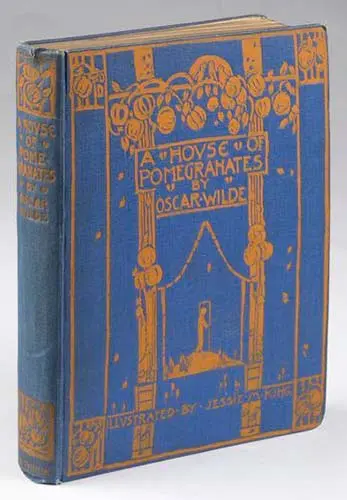
The volume was a handsome quarto, measuring approximately 28 centimeters in height, bound in red or blue cloth with gilt decorations. The cover featured a design by King—a stylized pomegranate motif that hinted at the riches within. The endpapers were decorated with King’s intricate patterns. The text was printed on quality paper, and throughout its pages, King’s illustrations appeared in a profusion that exceeded the earlier edition.
The four tales of A House of Pomegranates—“The Young King,” “The Birthday of the Infanta,” “The Fisherman and His Soul,” and “The Star-Child”—each received King’s full attention. Her illustrations for “The Fisherman and His Soul” are particularly notable, capturing the tale’s blend of longing, sacrifice, and the haunting beauty of the sea. Her rendering of the mermaid who steals the fisherman’s heart is a study in ethereal grace, her figure half-emerging from waves rendered in King’s sinuous line.
King’s decorative work in the 1914 edition is elaborate , with sixteen full-page color plates. The total effect is one of immersion—a book that envelops the reader in a world of beauty from cover to cover.
The 1914 A House of Pomegranates appeared at a significant moment. The Golden Age of Illustration was nearing its peak, and King’s work held its own alongside that of her more famous contemporaries, Arthur Rackham and Edmund Dulac. Yet her vision remained distinct: more delicate, more intimately tied to the decorative traditions of the Arts and Crafts movement, and deeply informed by the Glasgow Style that had shaped her early career.
Today, the 1914 edition is highly prized by collectors. For those fortunate enough to own a copy, the book offers a double pleasure: the chance to encounter Wilde’s masterful tales in a setting of exceptional beauty, and the opportunity to trace the evolution of one of the twentieth century’s most distinctive illustrators.
In its pages, Wilde’s worlds come alive through King’s eyes: the young king dreaming of suffering, the infanta watching her dwarf dance, the fisherman trading his soul for love. It is a collaboration that transcends time, a book that remains, more than a century after its publication, a house of pomegranates indeed—filled with treasures waiting to be discovered.
Recommended for Collectors
- A House of Pomegranates (1891) illustrated by Charles Ricketts – Wilde’s original edition with Ricketts’ symbolic art
- The Green Fairy Book (1892), edited by Andrew Lang, illustrated by H. J. Ford – A classic fairy tale anthology with magical stories and detailed line drawings.
- The Happy Prince and Other Tales (1913) illustrated by Charles Robinson – For another Wilde fairy-tale collection
- The High History of the Holy Graal (1903) illustrated by Jessie M. King – Another of her Arthurian-inspired works
Other Jessie M. King illustrated works available in our gallery: The Defence of Guenevere, The Mummy’s Bedtime Story, The High History of the Holy Graal, Seven Happy Days, Poems of Spenser, Habitation Forcee.
Art Gallery: Jessie M. King – A House of Pomegranates 1914
![Jessie M. King - A House of Pomegranates [jessie-king-pomegranates01] (art, illustrations)](https://www.nocloo.com/wp-content/plugins/justified-image-grid/timthumb.php?src=https%3A%2F%2Fwww.nocloo.com%2Fart%2Fjmking-wilde%2Fjessie-king-pomegranates01.jpg&h=280&q=90&f=.jpg)
![Jessie M. King - A House of Pomegranates [jessie-king-pomegranates02] (art, illustrations)](https://www.nocloo.com/wp-content/plugins/justified-image-grid/timthumb.php?src=https%3A%2F%2Fwww.nocloo.com%2Fart%2Fjmking-wilde%2Fjessie-king-pomegranates02.jpg&h=280&q=90&f=.jpg)
![Jessie M. King - A House of Pomegranates [jessie-king-pomegranates03] (art, illustrations)](https://www.nocloo.com/wp-content/plugins/justified-image-grid/timthumb.php?src=https%3A%2F%2Fwww.nocloo.com%2Fart%2Fjmking-wilde%2Fjessie-king-pomegranates03.jpg&h=280&q=90&f=.jpg)
![Jessie M. King - A House of Pomegranates [jessie-king-pomegranates04] (art, illustrations)](https://www.nocloo.com/wp-content/plugins/justified-image-grid/timthumb.php?src=https%3A%2F%2Fwww.nocloo.com%2Fart%2Fjmking-wilde%2Fjessie-king-pomegranates04.jpg&h=280&q=90&f=.jpg)
![Jessie M. King - A House of Pomegranates [jessie-king-pomegranates05] (art, illustrations)](https://www.nocloo.com/wp-content/plugins/justified-image-grid/timthumb.php?src=https%3A%2F%2Fwww.nocloo.com%2Fart%2Fjmking-wilde%2Fjessie-king-pomegranates05.jpg&h=280&q=90&f=.jpg)
![Jessie M. King - A House of Pomegranates [jessie-king-pomegranates06] (art, illustrations)](https://www.nocloo.com/wp-content/plugins/justified-image-grid/timthumb.php?src=https%3A%2F%2Fwww.nocloo.com%2Fart%2Fjmking-wilde%2Fjessie-king-pomegranates06.jpg&h=280&q=90&f=.jpg)
![Jessie M. King - A House of Pomegranates [jessie-king-pomegranates07] (art, illustrations)](https://www.nocloo.com/wp-content/plugins/justified-image-grid/timthumb.php?src=https%3A%2F%2Fwww.nocloo.com%2Fart%2Fjmking-wilde%2Fjessie-king-pomegranates07.jpg&h=280&q=90&f=.jpg)
![Jessie M. King - A House of Pomegranates [jessie-king-pomegranates08] (art, illustrations)](https://www.nocloo.com/wp-content/plugins/justified-image-grid/timthumb.php?src=https%3A%2F%2Fwww.nocloo.com%2Fart%2Fjmking-wilde%2Fjessie-king-pomegranates08.jpg&h=280&q=90&f=.jpg)
![Jessie M. King - A House of Pomegranates [jessie-king-pomegranates09] (art, illustrations)](https://www.nocloo.com/wp-content/plugins/justified-image-grid/timthumb.php?src=https%3A%2F%2Fwww.nocloo.com%2Fart%2Fjmking-wilde%2Fjessie-king-pomegranates09.jpg&h=280&q=90&f=.jpg)
![Jessie M. King - A House of Pomegranates [jessie-king-pomegranates10] (art, illustrations)](https://www.nocloo.com/wp-content/plugins/justified-image-grid/timthumb.php?src=https%3A%2F%2Fwww.nocloo.com%2Fart%2Fjmking-wilde%2Fjessie-king-pomegranates10.jpg&h=280&q=90&f=.jpg)
![Jessie M. King - A House of Pomegranates [jessie-king-pomegranates11] (art, illustrations)](https://www.nocloo.com/wp-content/plugins/justified-image-grid/timthumb.php?src=https%3A%2F%2Fwww.nocloo.com%2Fart%2Fjmking-wilde%2Fjessie-king-pomegranates11.jpg&h=280&q=90&f=.jpg)
![Jessie M. King - A House of Pomegranates [jessie-king-pomegranates12] (art, illustrations)](https://www.nocloo.com/wp-content/plugins/justified-image-grid/timthumb.php?src=https%3A%2F%2Fwww.nocloo.com%2Fart%2Fjmking-wilde%2Fjessie-king-pomegranates12.jpg&h=280&q=90&f=.jpg)
![Jessie M. King - A House of Pomegranates [jessie-king-pomegranates13] (art, illustrations)](https://www.nocloo.com/wp-content/plugins/justified-image-grid/timthumb.php?src=https%3A%2F%2Fwww.nocloo.com%2Fart%2Fjmking-wilde%2Fjessie-king-pomegranates13.jpg&h=280&q=90&f=.jpg)
![Jessie M. King - A House of Pomegranates [jessie-king-pomegranates14] (art, illustrations)](https://www.nocloo.com/wp-content/plugins/justified-image-grid/timthumb.php?src=https%3A%2F%2Fwww.nocloo.com%2Fart%2Fjmking-wilde%2Fjessie-king-pomegranates14.jpg&h=280&q=90&f=.jpg)
![Jessie M. King - A House of Pomegranates [jessie-king-pomegranates15] (art, illustrations)](https://www.nocloo.com/wp-content/plugins/justified-image-grid/timthumb.php?src=https%3A%2F%2Fwww.nocloo.com%2Fart%2Fjmking-wilde%2Fjessie-king-pomegranates15.jpg&h=280&q=90&f=.jpg)
![Jessie M. King - A House of Pomegranates [jessie-king-pomegranates16] (art, illustrations)](https://www.nocloo.com/wp-content/plugins/justified-image-grid/timthumb.php?src=https%3A%2F%2Fwww.nocloo.com%2Fart%2Fjmking-wilde%2Fjessie-king-pomegranates16.jpg&h=280&q=90&f=.jpg)
![Jessie M. King - A House of Pomegranates [jessie-king-pomegranates17] (art, illustrations)](https://www.nocloo.com/wp-content/plugins/justified-image-grid/timthumb.php?src=https%3A%2F%2Fwww.nocloo.com%2Fart%2Fjmking-wilde%2Fjessie-king-pomegranates17.jpg&h=280&q=90&f=.jpg)