The Soul of Compassion: Charles Robinson’s The Happy Prince
There are illustrated books that capture the whimsy of fairy tales, and then there are those that capture their soul. Charles Robinson’s 1913 edition of Oscar Wilde’s The Happy Prince belongs to the latter category. It is a work of profound sensitivity—a visual interpretation of one of literature’s most moving tales that matches the story’s melancholy, its beauty, and its deep humanity with equal grace.
Charles Robinson (1870–1937) was a central figure in the Golden Age of Illustration, part of a remarkable artistic family that included his brothers Thomas and William Heath Robinson. His style was characterized by delicate line work, a keen sense of composition, and an extraordinary ability to convey emotion through the subtlest of gestures. He had illustrated numerous classics—from A Child’s Garden of Verses to The Secret Garden—but his work on The Happy Prince stands among his finest achievements.
Oscar Wilde’s tale, first published in 1888, tells the story of a gilded statue who watches over a city from his pedestal, and the swallow who becomes his companion. Together, they bring comfort to the poor and suffering, stripping the prince of his gold and jewels until he stands bare and blind. It is a story of compassion, sacrifice, and the true nature of beauty—a fairy tale that, like all of Wilde’s best work, carries the weight of wisdom beneath its surface charm.
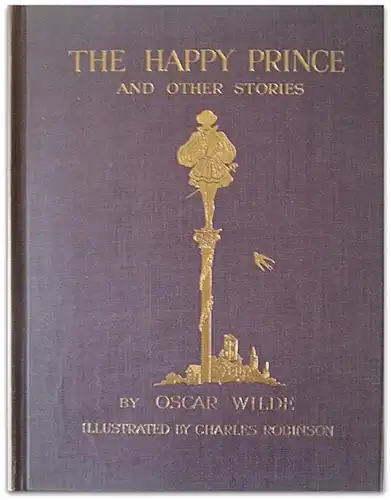
The 1913 edition, published by Duckworth & Co. in London, was a handsome production typical of the era. The volume contained twelve full-color plates protected by captioned tissue guards, alongside numerous black-and-white illustrations woven throughout the text. The binding was in cloth with gilt stamping, often featuring a design by Robinson on the front cover that set the tone for the emotional journey within.
What distinguishes Robinson’s illustrations for The Happy Prince is their emotional nuance. His palette is restrained yet resonant—soft grays, muted blues, gentle golds, and touches of warm rose that evoke both the grandeur of the prince’s original state and the quiet beauty of his acts of compassion. The city scenes are rendered with a delicate realism, capturing the bustling life below the statue’s pedestal, while the scenes of the prince and swallow together possess an intimate, almost sacred quality.
Robinson’s figures are rendered with his characteristic elegance. The prince, in his gilded splendor, possesses a quiet dignity; the swallow is drawn with an extraordinary attention to the beauty of its form, its feathers rendered in delicate lines that convey both fragility and grace. Yet it is in the scenes of sacrifice—the prince giving away his sapphire eyes, the swallow choosing to stay despite the approaching winter—that Robinson’s genius truly shines. His illustrations capture not merely the events of the story but their emotional resonance, the weight of each choice rendered visible.
The story’s famous conclusion—the broken statue and the dead bird found in the city square, declared worthless by the authorities before being claimed by angels as the two most precious things in the city—receives particularly poignant treatment. Robinson’s final plates convey the profound irony at the heart of Wilde’s tale: that true value lies not in outward beauty but in acts of love, however humble.
Today, Robinson’s The Happy Prince is a prized collectible. First editions in good condition, with clean plates and intact bindings, are increasingly scarce. For collectors and admirers of Golden Age illustration, it represents a high point in Robinson’s career—a volume where his delicate style found perfect alignment with a text of extraordinary emotional depth.
In the pantheon of illustrated Happy Prince editions, Robinson’s remains one of the most beloved. His illustrations do not merely accompany Wilde’s text; they illuminate it, finding in its pages a visual language of compassion that speaks as powerfully today as it did over a century ago. For those who encounter it, the book offers a reminder of the story’s central truth: that the most beautiful things in the world are not made of gold and jewels, but of kindness, sacrifice, and the quiet bonds that connect us across the divide of difference.
Recommended for Collectors
- A House of Pomegranates (1914) by Oscar Wilde, illustrated by Jessie M. King – Another Wilde fairy tale collection with Art Nouveau flair
- The Blue Fairy Book (1889) by Andrew Lang, illustrated by H.J. Ford – For classic Victorian fairy-tale artistry
- The Little Prince (1943) by Antoine de Saint-Exupéry – A later spiritual cousin to Wilde’s tale of love and loss
Other books illustrated by Charles Robinson available in our gallery: The Secret Garden, The Big Book of Fairy Tales, Bee, Princess of the Dwarfs, Margaret’s Book, Our Sentimental Garden, Songs and Sonnets.
Art Gallery: Charles Robinson – The Happy Prince 1913