A Nostalgic Retreat: Charles Robinson’s Our Sentimental Garden
In the years just before the First World War, there flourished a particular genre of illustrated book that celebrated the quiet pleasures of English country life—the garden, the cottage, the changing seasons, the gentle rhythms of a world that seemed, in retrospect, to be passing. Our Sentimental Garden, published in 1914, is one of the finest examples of this genre, and Charles Robinson’s illustrations for the volume capture its nostalgic charm with all the delicacy and grace that made him one of the era’s most beloved artists.
The text of Our Sentimental Garden was written by the English novelist and poet Agnes Castle (née Sweetman, 1859–1922), who often collaborated with her husband, Egerton Castle, on historical romances . For this volume, she wrote under her own name, producing a series of lyrical essays on the pleasures of gardening—the planning, the planting, the tending, the harvesting—each meditation infused with a gentle, reflective humor. The book is not a practical guide but a celebration, a series of love letters to the English garden in all its moods.
Charles Robinson (1870–1937) was, by 1914, at the height of his career. A member of the remarkable Robinson family—his brothers Thomas and William Heath were also celebrated illustrators—he had made his name with A Child’s Garden of Verses (1896), his own Alice’s Adventures in Wonderland (1907), and the recently published The Secret Garden (1911). His style, characterized by delicate line work, a subtle decorative sensibility, and a gift for capturing mood through the smallest gestures, was perfectly suited to the nostalgic charm of Castle’s text.
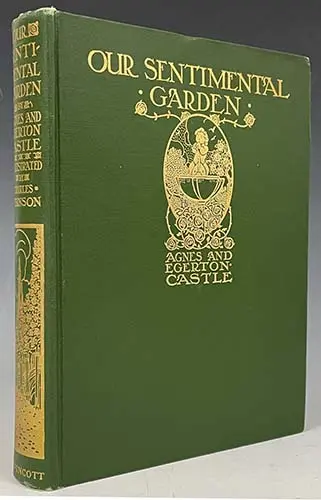
The 1914 edition, published by John Lane at the Bodley Head in London, was a handsome production. The volume contained eight full-page color plates alongside numerous black-and-white illustrations and decorative elements woven throughout the text. The binding was in green cloth with gilt stamping, featuring a design by Robinson on the front cover that set the tone for the garden reveries within.
What distinguishes Robinson’s illustrations for Our Sentimental Garden is their warmth and intimacy. His palette is soft and inviting—gentle greens, warm golds, touches of pink and blue that evoke the quiet beauty of the English garden in all seasons. His figures, rendered with the elegant, elongated grace characteristic of his work, are not the grand ladies and gentlemen of formal portraiture but ordinary people engaged in the simple pleasures of gardening: planting, weeding, pausing to admire a rose, resting on a bench at twilight.
The color plates are among the most charming Robinson ever produced. Each image is a small meditation on contentment, on the quiet joys of tending a piece of earth and watching it flourish.
The black-and-white illustrations are equally delightful. Robinson’s line work is extraordinarily fine, creating textures and patterns that reward sustained attention. Decorative borders of leaves and flowers frame the text; headpieces depict garden tools, seed packets, and the changing seasons; marginal drawings of birds, bees, and butterflies dance along the edges of the pages. The total effect is one of immersion—a book that invites the reader to step into a garden of the imagination and linger there.
The 1914 edition appeared on the eve of the First World War, a moment when the world it depicted—the world of English country houses, leisurely gardening, and sentimental reflection—was about to be irrevocably changed. Perhaps that is why Our Sentimental Garden resonates so deeply today: it captures a world on the edge of transformation, a way of life that would soon seem, in retrospect, like a garden glimpsed through a haze of memory.
Today, first editions of Our Sentimental Garden are prized by collectors. For those fortunate enough to own one, the book offers a retreat—a place to pause, to breathe, to remember that even in a world of noise and haste, there are still gardens waiting to be tended, and still artists like Charles Robinson who can show us their beauty.
In the pages of this book, the roses still bloom, the gardeners still pause at twilight, and the seasons still turn in their eternal cycle. Charles Robinson gave Agnes Castle’s sentimental garden a visual language of extraordinary charm—a reminder that the best gardens, like the best books, are places we can return to again and again, and always find something new.
Recommended for Collectors:
- The Spring of Joy (1917) by Mary Webb – A lyrical garden and nature book with introspective prose and an elegant aesthetic.
- A Child’s Garden of Verses (1905) – Charles Robinson’s delicate illustrations beautifully echo Stevenson’s timeless poems.
- The Secret Garden (1911) – Charles Robinson’s edition brings visual warmth to Burnett’s classic tale of renewal.
Other books illustrated by Charles Robinson available in our gallery: The Secret Garden, The Big Book of Fairy Tales, Bee, Princess of the Dwarfs, Margaret’s Book, The Happy Prince, Our Sentimental Garden, Songs and Sonnets.
Art Gallery: Charles Robinson – Our Sentimental Garden 1914