A Fairy Tale Enchanted: Charles Robinson’s Bee, Princess of the Dwarfs
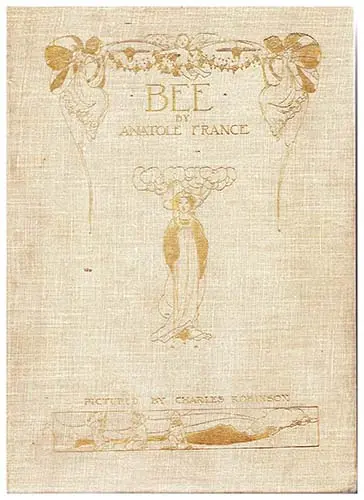
In the golden age of fairy-tale illustration, certain artists possessed a particular gift for capturing the delicate boundary between the human world and the realm of enchantment. Charles Robinson was such an artist, and his 1912 edition of Anatole France’s Bee, Princess of the Dwarfs stands as one of his most exquisite achievements—a volume that transforms a classic French fairy tale into a visual dream of ethereal beauty.
Anatole France (1844–1924), the great French novelist and Nobel laureate, had written Bee (originally Les Amours de la Fée) in 1881. The story tells of a young princess named Bee and her devoted companion, George, who are separated when a dwarf king falls in love with Bee and carries her away to his underground kingdom. George embarks on a quest to rescue her, encountering magical creatures and enduring trials along the way. It is a tale of love, loyalty, and the transcendent power of devotion—themes that France handled with his characteristic wit and grace.
Charles Robinson (1870–1937) was one of the most versatile illustrators of the Edwardian era, a member of the remarkable artistic family that included his brothers Thomas and William Heath Robinson. His style was characterized by delicate line work, a subtle sense of color, and an extraordinary ability to convey emotion through the subtlest of gestures. He had illustrated numerous classics—from A Child’s Garden of Verses to The Happy Prince—and the France commission would become one of the highlights of his career.
The 1912 edition, published by John Lane at the Bodley Head in London, was a handsome production typical of the era’s finest illustrated books. The volume contained twelve tipped-in color plates protected by captioned tissue guards, alongside numerous black-and-white illustrations and decorative elements woven throughout the text. The binding was in white cloth with gilt stamping, featuring a design by Robinson on the front cover that set the tone for the enchantment within.
What distinguishes Robinson’s illustrations for Bee is their ethereal quality. His palette is soft and luminous—pale golds, misty blues, gentle greens, and touches of rose—creating an atmosphere that seems to shimmer between the real and the imagined. The dwarf kingdom, rendered in muted earth tones and warm browns, contrasts beautifully with the cool blues and silvers of the fairy realm, establishing a visual language that reflects the story’s journey between worlds.
Robinson’s figures possess the elegant, elongated grace characteristic of his work. Bee herself is rendered with a quiet dignity, her expressions conveying both the vulnerability of her captivity and the strength of her spirit. George, the steadfast hero, is drawn with a gentle masculinity that captures his devotion. The dwarfs, under Robinson’s hand, are not the grotesque creatures of other traditions but a race of ancient, dignified beings—small in stature but great in their capacity for love and jealousy.
The black-and-white illustrations are equally remarkable. Robinson’s line work is extraordinarily fine, creating textures and patterns that reward sustained attention. The forest scenes, the underground caverns, the fairy courts—each setting is rendered with a precision that brings the world of the story to life. Decorative borders and marginal drawings weave throughout the text, transforming each page into a cohesive visual experience.
The 1912 edition of Bee appeared during a period of intense creativity for Robinson. His work for the France tale coincided with his celebrated editions of A Child’s Garden of Verses and The Happy Prince, establishing him as one of the most sought-after illustrators of his generation. The critical response was enthusiastic, and the book quickly became a collector’s treasure.
Today, first editions of Robinson’s Bee are prized by collectors of Golden Age illustration. The fragile binding, the tipped-in plates, and the delicate nature of the illustrations make surviving copies in fine condition increasingly scarce. For those fortunate enough to own one, the book offers a journey into an enchanted world—a realm of dwarfs and fairies, of devoted lovers and magical transformations, rendered with a beauty that captures the very essence of fairy tale.
In the pages of this book, Bee still waits in her underground palace; George still journeys through the enchanted forest; and the love that binds them transcends the boundaries of the human and the otherworldly. Charles Robinson gave Anatole France’s masterpiece a visual language of extraordinary delicacy—a world of enchantment that continues to captivate, more than a century later.
For collectors:
- A Child’s Garden of Verses by Robert Louis Stevenson, illustrated by Charles Robinson (1895) – Robinson’s breakthrough work that defined his career
- Undine (1909), illustrated by Arthur Rackham – A magical water-spirit tale with moody, intricate images from one of the era’s greatest illustrators.
- The Secret Garden by Frances Hodgson Burnett, illustrated by Charles Robinson (1911) – Showcases his mature style in a beloved children’s classic
- The Happy Prince and Other Tales by Oscar Wilde, illustrated by Charles Robinson (1913) – A beautiful pairing of Wilde’s fairy tales with Robinson’s delicate artwork
Other books illustrated by Charles Robinson available in our gallery: The Secret Garden, The Big Book of Fairy Tales, Margaret’s Book, The Happy Prince, Our Sentimental Garden, Songs and Sonnets.
Art Gallery: Charles Robinson – Bee, Princess of the Dwarfs 1912