A Forgotten Jewel: Charles Buckles Falls’ The Goldenrod Fairy Book
In the early years of the twentieth century, a remarkable series of illustrated fairy-tale anthologies emerged from the press of Dodd, Mead & Company in New York. Among them, the 1903 edition of The Goldenrod Fairy Book, translated and selected by Esther Singleton and illustrated by the young Charles Buckles Falls, stands as a testament to the artistry of the American Arts and Crafts movement—a volume of extraordinary beauty that deserves to be remembered alongside the more famous fairy books of Andrew Lang .
Esther Singleton (1865–1930) was a prolific American author, editor, and translator whose career spanned literature, music criticism, and art history . For The Goldenrod Fairy Book, she gathered tales from across the globe—from the Brothers Grimm and Hans Christian Andersen to the Arabian Nights, from Madame d’Aulnoy and Charles Perrault to the folk traditions of Russia, Italy, China, Ireland, and Spain . The result was a truly international collection, presented in fresh English translations that made these stories accessible to American readers of the era .
But it is the illustrations that elevate this volume from a simple anthology to a work of art. Charles Buckles Falls (1874–1960) was a young artist on the cusp of a remarkable career . Born in Fort Wayne, Indiana, he had moved to Chicago in his early twenties, working as an architect’s assistant and a sketch artist for the Chicago Tribune before relocating to New York City around 1900 . In New York, he struggled initially, until he met the influential artist and author Joseph Pennell . By 1903, when The Goldenrod Fairy Book was published, Falls was establishing his reputation, and this commission would become one of his most significant early works .
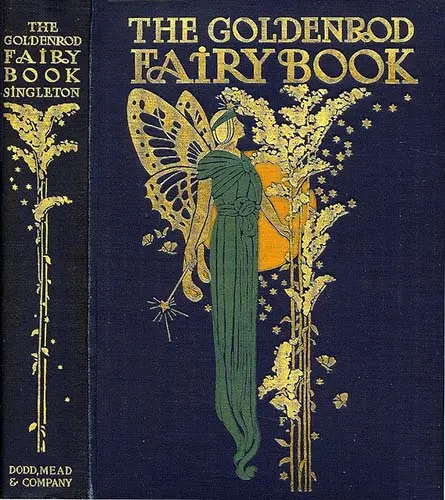
The book was published by Dodd, Mead & Company and printed at the Burr Printing House in New York . It was a handsome quarto volume, measuring approximately 22 centimeters in height, bound in blue pictorial cloth stamped in gilt, green, and orange . The cover itself featured an embossed illustration of a fairy with goldenrod, rendered in the distinctive Art Nouveau style that would come to define Falls’ early work . Inside, readers discovered sixteen full-page color plates, each tipped in on heavy paper, alongside a wealth of decorative elements that transformed every page into a visual experience .
What distinguishes Falls’ work in this volume is its extraordinary attention to design. The text is printed within elaborate pictorial borders, rendered in color and running throughout the book . These borders—featuring stylized flowers, vines, and fairy motifs—create a cohesive visual environment that envelops the reader in an enchanted world . The endpapers, illustrated with a delicate fairy design, continue this immersive experience from the moment the book is opened .
Falls’ style at this period reflected the influence of Art Nouveau, with its sinuous lines, flattened perspectives, and decorative elegance . His color palette is warm and inviting—soft golds, gentle greens, and touches of orange and rose that complement the goldenrod theme . His fairies possess an ethereal grace, his knights a romantic dignity, his witches a grotesque charm that never descends into true menace . One notable illustration depicts a “lion with horns”—a creature from the pages of medieval bestiaries—while another captures a knight in armor rendered with Falls’ characteristic attention to pattern and line .
The physical production of the book reflected the highest standards of the era. The color plates were printed using techniques that preserved the subtlety of Falls’ watercolors, and the decorative borders were integrated seamlessly with the text . A first edition copy in the collection of the Museum of Osteopathic Medicine reveals the care with which these books were produced—and, given its fragile condition a century later, how beloved they were by their young readers . Pencil markings, loose pages, and worn bindings testify to generations of children who pored over these tales .
Today, The Goldenrod Fairy Book is a rare and prized collectible. First editions in good condition are increasingly scarce. For collectors of Golden Age illustration, the book represents a significant achievement—a work that stands alongside the publications of more famous contemporaries like Arthur Rackham and Edmund Dulac, yet possesses a distinctly American character.
Charles Buckles Falls would go on to a distinguished career as an illustrator, poster artist, and book designer. He became known for his World War I posters, including the celebrated Books Wanted, and for his beloved The ABC Book of 1923, which showcased his skill with woodblock printing and bold color . But The Goldenrod Fairy Book remains a high point—a volume where his Art Nouveau sensibility, his decorative genius, and his love of fairy tales converged in a work of enduring beauty.
In its pages, the fairy tales of the world find a home rendered with warmth, elegance, and a distinctly American vision. It is a book that invites us to linger—over its borders, its plates, its stories—and to remember a time when even a children’s book could be a work of art.
Recommended for Collectors
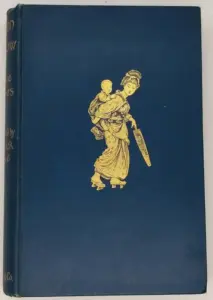
- Green Willow and Other Japanese Fairy Tales (1910) illustrated by Warwick Goble – For another early 20th-century fairy tale collection with lush Art Nouveau styling
Art Gallery: Charles Buckles Falls – The Goldenrod Fairy Book 1903
![Charles B. Falls - Goldenrod Fairy Tales [falls-goldenrod01] (art, illustrations)](https://www.nocloo.com/wp-content/plugins/justified-image-grid/timthumb.php?src=https%3A%2F%2Fwww.nocloo.com%2Fart%2Ffalls-goldenrod%2Ffalls-goldenrod01.jpg&h=280&q=90&f=.jpg "Charles Buckles Falls - Illustrations for The Goldenrod Fairy Book 1903")
![Charles B. Falls - Goldenrod Fairy Tales [falls-goldenrod02] (art, illustrations)](https://www.nocloo.com/wp-content/plugins/justified-image-grid/timthumb.php?src=https%3A%2F%2Fwww.nocloo.com%2Fart%2Ffalls-goldenrod%2Ffalls-goldenrod02.jpg&h=280&q=90&f=.jpg "Charles Buckles Falls - Illustrations for The Goldenrod Fairy Book 1903")
![Charles B. Falls - Goldenrod Fairy Tales [falls-goldenrod03] (art, illustrations)](https://www.nocloo.com/wp-content/plugins/justified-image-grid/timthumb.php?src=https%3A%2F%2Fwww.nocloo.com%2Fart%2Ffalls-goldenrod%2Ffalls-goldenrod03.jpg&h=280&q=90&f=.jpg "Charles Buckles Falls - Illustrations for The Goldenrod Fairy Book 1903")
![Charles B. Falls - Goldenrod Fairy Tales [falls-goldenrod04] (art, illustrations)](https://www.nocloo.com/wp-content/plugins/justified-image-grid/timthumb.php?src=https%3A%2F%2Fwww.nocloo.com%2Fart%2Ffalls-goldenrod%2Ffalls-goldenrod04.jpg&h=280&q=90&f=.jpg "Charles Buckles Falls - Illustrations for The Goldenrod Fairy Book 1903")
![Charles B. Falls - Goldenrod Fairy Tales [falls-goldenrod05] (art, illustrations)](https://www.nocloo.com/wp-content/plugins/justified-image-grid/timthumb.php?src=https%3A%2F%2Fwww.nocloo.com%2Fart%2Ffalls-goldenrod%2Ffalls-goldenrod05.jpg&h=280&q=90&f=.jpg "Charles Buckles Falls - Illustrations for The Goldenrod Fairy Book 1903")
![Charles B. Falls - Goldenrod Fairy Tales [falls-goldenrod06] (art, illustrations)](https://www.nocloo.com/wp-content/plugins/justified-image-grid/timthumb.php?src=https%3A%2F%2Fwww.nocloo.com%2Fart%2Ffalls-goldenrod%2Ffalls-goldenrod06.jpg&h=280&q=90&f=.jpg "Charles Buckles Falls - Illustrations for The Goldenrod Fairy Book 1903")
![Charles B. Falls - Goldenrod Fairy Tales [falls-goldenrod07] (art, illustrations)](https://www.nocloo.com/wp-content/plugins/justified-image-grid/timthumb.php?src=https%3A%2F%2Fwww.nocloo.com%2Fart%2Ffalls-goldenrod%2Ffalls-goldenrod07.jpg&h=280&q=90&f=.jpg "Charles Buckles Falls - Illustrations for The Goldenrod Fairy Book 1903")
![Charles B. Falls - Goldenrod Fairy Tales [falls-goldenrod08] (art, illustrations)](https://www.nocloo.com/wp-content/plugins/justified-image-grid/timthumb.php?src=https%3A%2F%2Fwww.nocloo.com%2Fart%2Ffalls-goldenrod%2Ffalls-goldenrod08.jpg&h=280&q=90&f=.jpg "Charles Buckles Falls - Illustrations for The Goldenrod Fairy Book 1903")
![Charles B. Falls - Goldenrod Fairy Tales [falls-goldenrod09] (art, illustrations)](https://www.nocloo.com/wp-content/plugins/justified-image-grid/timthumb.php?src=https%3A%2F%2Fwww.nocloo.com%2Fart%2Ffalls-goldenrod%2Ffalls-goldenrod09.jpg&h=280&q=90&f=.jpg "Charles Buckles Falls - Illustrations for The Goldenrod Fairy Book 1903")
![Charles B. Falls - Goldenrod Fairy Tales [falls-goldenrod10] (art, illustrations)](https://www.nocloo.com/wp-content/plugins/justified-image-grid/timthumb.php?src=https%3A%2F%2Fwww.nocloo.com%2Fart%2Ffalls-goldenrod%2Ffalls-goldenrod10.jpg&h=280&q=90&f=.jpg "Charles Buckles Falls - Illustrations for The Goldenrod Fairy Book 1903")
![Charles B. Falls - Goldenrod Fairy Tales [falls-goldenrod11] (art, illustrations)](https://www.nocloo.com/wp-content/plugins/justified-image-grid/timthumb.php?src=https%3A%2F%2Fwww.nocloo.com%2Fart%2Ffalls-goldenrod%2Ffalls-goldenrod11.jpg&h=280&q=90&f=.jpg "Charles Buckles Falls - Illustrations for The Goldenrod Fairy Book 1903")
![Charles B. Falls - Goldenrod Fairy Tales [falls-goldenrod12] (art, illustrations)](https://www.nocloo.com/wp-content/plugins/justified-image-grid/timthumb.php?src=https%3A%2F%2Fwww.nocloo.com%2Fart%2Ffalls-goldenrod%2Ffalls-goldenrod12.jpg&h=280&q=90&f=.jpg "Charles Buckles Falls - Illustrations for The Goldenrod Fairy Book 1903")
![Charles B. Falls - Goldenrod Fairy Tales [falls-goldenrod13] (art, illustrations)](https://www.nocloo.com/wp-content/plugins/justified-image-grid/timthumb.php?src=https%3A%2F%2Fwww.nocloo.com%2Fart%2Ffalls-goldenrod%2Ffalls-goldenrod13.jpg&h=280&q=90&f=.jpg "Charles Buckles Falls - Illustrations for The Goldenrod Fairy Book 1903")
![Charles B. Falls - Goldenrod Fairy Tales [falls-goldenrod14] (art, illustrations)](https://www.nocloo.com/wp-content/plugins/justified-image-grid/timthumb.php?src=https%3A%2F%2Fwww.nocloo.com%2Fart%2Ffalls-goldenrod%2Ffalls-goldenrod14.jpg&h=280&q=90&f=.jpg "Charles Buckles Falls - Illustrations for The Goldenrod Fairy Book 1903")
![Charles B. Falls - Goldenrod Fairy Tales [falls-goldenrod15] (art, illustrations)](https://www.nocloo.com/wp-content/plugins/justified-image-grid/timthumb.php?src=https%3A%2F%2Fwww.nocloo.com%2Fart%2Ffalls-goldenrod%2Ffalls-goldenrod15.jpg&h=280&q=90&f=.jpg "Charles Buckles Falls - Illustrations for The Goldenrod Fairy Book 1903")
![Charles B. Falls - Goldenrod Fairy Tales [falls-goldenrod16] (art, illustrations)](https://www.nocloo.com/wp-content/plugins/justified-image-grid/timthumb.php?src=https%3A%2F%2Fwww.nocloo.com%2Fart%2Ffalls-goldenrod%2Ffalls-goldenrod16.jpg&h=280&q=90&f=.jpg "Charles Buckles Falls - Illustrations for The Goldenrod Fairy Book 1903")