Cormac McCarthy: A Literary Titan of the American Wilderness

Cormac McCarthy (born Charles McCarthy Jr. on July 20, 1933, in Providence, Rhode Island; died June 13, 2023, in Santa Fe, New Mexico) stands as one of the most distinctive and influential American novelists of the late 20th and early 21st centuries. Renowned for his stark prose, existential themes, and unflinching depictions of violence and human nature, McCarthy forged a literary legacy that redefined the possibilities of American fiction. Though often associated with the American Southwest—particularly through his Border Trilogy and No Country for Old Men—his vision transcended regionalism, probing universal questions of morality, fate, and the fragility of civilization.
McCarthy grew up in Knoxville, Tennessee, after his family relocated there in 1937 when his father became a lawyer for the Tennessee Valley Authority. The third of six children in a prosperous Catholic family, his life was a curious blend of privilege and intellectual rebellion. In 1951, he enrolled at the University of Tennessee but grew restless, dropping out to join the U.S. Air Force. His four-year stint, including two in Alaska where he hosted a radio show, provided a taste of a world beyond the South. He returned to the university in 1957, publishing his first short stories, but left again before graduating, a pattern that signaled his lifelong aversion to formal academic confines and his commitment to a autodidact’s path.
McCarthy’s literary apprenticeship began with the publication of The Orchard Keeper in 1965. The book, discovered by a Random House editor thanks to the unlikely intervention of McCarthy’s day-laboring friend, announced a major, if difficult, new voice. It bore the heavy influence of William Faulkner—dense, complex, and steeped in the decaying grandeur of the rural South. This Southern phase continued with Outer Dark (1968) and Child of God (1973), the latter a chilling descent into the mind of a necrophiliac outcast that demonstrated McCarthy’s willingness to explore the absolute extremes of human degradation without moral commentary.
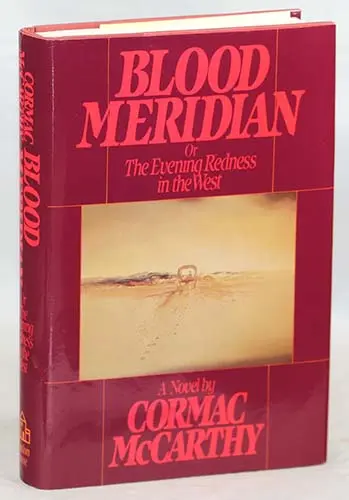
Life during these decades was one of determined poverty. He lived in barns and mill houses, eschewing regular employment for his art. A 1981 MacArthur Fellowship, the so-called “genius grant,” provided crucial financial stability, freeing him to write what would become his first widely recognized masterpiece, Blood Meridian, or The Evening Redness in the West (1985). A historical novel based on the Glanton gang of scalp hunters along the U.S.-Mexico border in the 1850s, it is a book of almost unimaginable violence, rendered with the grandeur of an epic poem. Its central philosophical force, the monstrous and erudite Judge Holden, stands as one of literature’s most terrifying and compelling villains. Though not an immediate commercial success, Blood Meridian is now universally regarded as a landmark of 20th-century literature, a book that dismantles the myth of the American West to reveal the skull beneath the skin.
A pivotal shift occurred when McCarthy, with the support of the MacArthur grant, moved to El Paso, Texas. The desert Southwest became his new spiritual and artistic canvas. This move catalyzed his most celebrated work: The Border Trilogy. Comprising All the Pretty Horses (1992), The Crossing (1994), and Cities of the Plain (1998), these novels are elegiac tales of young cowboys navigating a vanishing world. While still marked by brutality, they are infused with a poignant romanticism and a profound sorrow for a way of life being extinguished by modernity. All the Pretty Horses became a surprise bestseller and won the National Book Award, catapulting the reclusive 60-year-old author into an unaccustomed and largely unwelcome spotlight.
His late-career magnum opus, No Country for Old Men (2005), is a stark, philosophical thriller that reads like a direct confrontation with the new, mechanized evil of the late 20th century. The relentless Anton Chigurh, with his captive bolt pistol and his philosophy of cosmic chance, is a force of nature as implacable as any in Blood Meridian. The novel’s true heart, however, is the weary, moral Sheriff Ed Tom Bell, whose ruminations frame a world he can no longer comprehend or control. The Coen Brothers’ acclaimed film adaptation brought McCarthy’s vision to an even wider audience.
Then, at the age of 73, he published The Road (2006). A post-apocalyptic tale of a father and son traversing a scorched, ashen America, the novel is stripped of all the baroque language of his earlier work, achieving a devastating, elemental purity. It is a harrowing story of survival that ultimately becomes a profound and moving meditation on love, goodness, and “carrying the fire” in a world devoid of both. The Road won the Pulitzer Prize for Fiction and cemented his status as a literary icon.
McCarthy was famously private, granting only a handful of interviews in his life. He lived simply, his primary companions being scientists he befriended at the Santa Fe Institute, where he was a longtime fellow. This engagement with hard science—physics, mathematics, biology—informed the deep, almost geological time scale of his work, where human struggles are but a fleeting moment in a vast, uncaring cosmos. He continued to write and publish into his late eighties, producing the dual novels The Passenger and Stella Maris in 2022, which delved into the world of theoretical physics and the nature of consciousness.
Cormac McCarthy died of natural causes at his home in Santa Fe, New Mexico, on June 13, 2023. He left behind a legacy as one of America’s greatest and most uncompromising novelists. His work does not offer comfort or easy answers. Instead, it confronts the reader with the fundamental questions of existence, good and evil, and the nature of a world where, as a character in No Country for Old Men says, “you never know what worse luck your bad luck has saved you from.” In his unblinking examination of the darkness, he somehow, against all odds, illuminated what it means to be human.
Cormac McCarthy – First Editions Identification Guide
A Complete Bibliography of Cormac McCarthy: Novels, Rare Books
| Year | Title | Publisher | Identification Points |
|---|---|---|---|
| 1965 | The Orchard Keeper | Random House, NY, [1965] | First Edition. Dark teal cloth, brick red boards. Top stain green. "First Printing" stated on copyright page. DJ price $4.95 with flap code "5/65". The second printing, released three years later in 1968, reused the same jacket design but all copies were price clipped. |
| 1968 | Outer Dark | Random House, NY, [1968] | First edition. Light blue cloth, dark gray boards. Top stain black. "First printing" stated on copyright page. DJ price $4.95. |
| 1973 | Child of God | Random House, NY, [1973] | First Edition. Navy blue cloth, red boards. "First Edition" stated on copyright page. DJ price $5.95. |
| 1979 | Suttree | Random House, NY, [1979] | First Edition. Black cloth, pale yellow boards. "First Edition" stated on copyright page. DJ price $12.95. |
| 1985 | Blood Meridian | Random House, NY, [1985] | First Edition. Dark red cloth, red boards. "First Edition" stated with code "2 4 6 8 9 7 5 3" on copyright page. DJ price $17.95 |
| 1992 | All the Pretty Horses | Knopf, NY, 1992 | First Edition. Black cloth, light black boards. "First Edition" stated on copyright page and no mention of subsequent printings. DJ price $21.00. Two states: a) With 4 blurbs on the rear panel, many considered it a "1st state" or perhaps trial DJ, rare. A) With 5 blurbs on the rear panel. Which was issued on release. |
| 1994 | The Crossing | Knopf, NY, 1994 | First Edition. Black cloth, light black boards. "First Edition" stated on copyright page and no mention of subsequent printings. DJ price $23.00. |
| 1998 | Cities of the Plain | Knopf, NY, 1998 | First Edition. Black cloth, light black boards. "First Edition" stated on copyright page and no mention of subsequent printings. DJ price $24.00. ALSO: Limited edition of 300 numbered copies and 50 deluxe copies signed by the author. This was issued after the trade edition, therefore it's not a true first. |
| 2005 | No Country for Old Men | Knopf, NY, 2005 | First Edition. Black boards. "First Edition" stated on copyright page and no mention of subsequent printings. DJ price $24.95 |
| 2006 | The Road | Knopf, NY, 2006 | First Edition. Black cloth, orange boards. "First Edition" stated on copyright page and no mention of subsequent printings. DJ price $24.00. |
Cormac McCarthy – First Edition Dust Jackets Identification Guide
Gallery of First edition Dust Jackets