Douglas Adams – The Hitchhiker’s Guide to the Galaxy
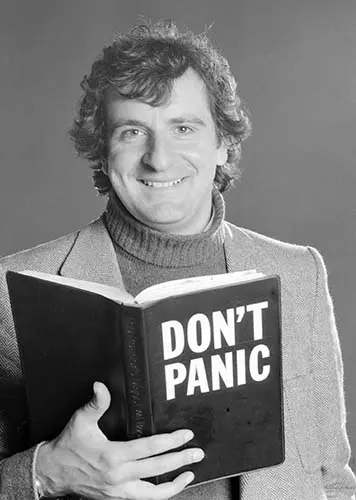
Douglas Adams (1952-2001) was a master of intellectual comedy, a visionary satirist, and a storyteller who fundamentally reshaped the landscape of science fiction. His bibliography, though not vast, is a testament to a unique mind that blended scientific curiosity with absurdist wit, creating works that continue to resonate with millions. More than just a list of titles, Adams’s oeuvre represents a coherent philosophy—a universe where the mundane is inexplicable, the cosmic is ridiculous, and the answer to everything is profoundly missing.
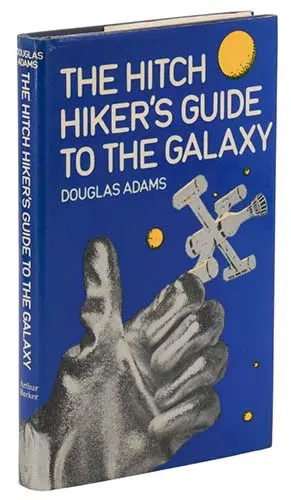
The quintessential Adams experience is, without question, the five-book “trilogy” that begins with The Hitchhiker’s Guide to the Galaxy (1979). What started as a BBC radio series was novelized into a book that became an instant classic. The story of Arthur Dent, the last human survivor after Earth is demolished for a hyperspace bypass, and his alien guide Ford Prefect, is a perfect storm of philosophical inquiry and slapstick comedy. Adams’s genius lay in using the infinite canvas of space to hold a mirror to human foibles. Bureaucracy is embodied by the Vogons, whose poetry is used as a form of torture. The search for meaning is satirized in the quest for the Ultimate Answer to Life, the Universe, and Everything, which turns out to be the nonsensical “42.”
The series continues with The Restaurant at the End of the Universe (1980), which introduces the concepts of probability-driving and cosmic hedonism; Life, the Universe and Everything (1982), where the cosmic cricket match is a highlight of his satirical prowess; So Long, and Thanks for All the Fish (1984), a surprisingly romantic and Earth-bound installment; and concludes with Mostly Harmless (1992), a notably darker and more pessimistic finale that Adams later expressed some regret over, feeling he had let his characters down. The series is a masterclass in world-building, populated by paranoid androids, two-headed presidents, and mice who are pan-dimensional beings. The “Guide” itself, with its entries like the entry on the Babel Fish which neatly disproves the existence of God, is a literary device that allows Adams to pepper the narrative with his trademark digressive wit and sharp observations.
The Earthly Detective: The Dirk Gently Series
While Hitchhiker’s roamed the cosmos, Adams’s other major series, the Dirk Gently novels, brought the weirdness home. Dirk Gently’s Holistic Detective Agency (1987) and The Long Dark Tea-Time of the Soul (1988) are brilliant fusions of detective fiction, fantasy, and science fiction. The central conceit is the “fundamental interconnectedness of all things,” a philosophy that allows the eponymous detective to solve cases by understanding the cosmic web of coincidence rather than relying on mere clues.
The first novel involves a time-traveling Cambridge professor, an electric monk who believes things for you, and a ghost, all tied together by the mystery of a missing cat. It brilliantly reworks elements from Adams’s own unproduced Doctor Who scripts, “Shada.” The second novel elevates the Norse gods to beleaguered celebrities living in modern London, grappling with rocket-powered elevators to Asgard and corporate intrigue. Dirk Gently is a fantastic creation—a lazy, pompous, but ultimately brilliant con man whose methods are as infuriating as they are effective. These novels showcase Adams’s ability to construct intricate, puzzle-box plots grounded in a recognizable, albeit deeply strange, world. Their influence is keenly felt in modern “weird fiction” and shows like Doctor Who, which Adams himself wrote for in the late 1970s.
Non-Fiction and Other Observations
Adams was not solely a fiction writer. His fascination with the real world, particularly biology and technology, produced two notable works of non-fiction. Last Chance to See (1990), co-written with zoologist Mark Carwardine, is a poignant, funny, and deeply moving travelogue documenting their journeys to find endangered species like the Kakapo parrot and the Yangtze River dolphin. The book reveals a different side of Adams—his awe and profound concern for the natural world. His wit is still present, but it serves a greater purpose: to make the tragedy of extinction accessible and emotionally resonant. It stands as a powerful and prescient environmental text.
Similarly, The Salmon of Doubt (2002) is a posthumous collection that offers a kaleidoscopic view of his mind. It includes essays on technology (he was an early adopter and evangelist), musings on religion, and personal reflections. Most tantalizingly, it contains chapters from an unfinished novel, which might have been a third Dirk Gently book or a new Hitchhiker’s story. The collection is a bittersweet reminder of the voice that was lost, showcasing the breadth of his interests, from his love of The Beatles to his frustrations with American dental floss.
Collaborations and Influence
Adams’s bibliography also includes collaborations, such as The Meaning of Liff (1983) and The Deeper Meaning of Liff (1990), written with John Lloyd. These books are dictionaries re-purposing British place names to define those experiences and objects for which no word exists (e.g., “Sidcup: The plastic packet on the side of a sink for storing used teabags”). He also co-wrote the computer game Starship Titanic, which spun off a novel, Douglas Adams’s Starship Titanic (1997), written by Terry Jones based on Adams’s concepts.
The influence of Douglas Adams’s bibliography is immeasurable. He paved the way for a generation of writers like Neil Gaiman and Terry Pratchett, who blended genres with intelligence and humour. His concepts have entered the cultural lexicon, from “Don’t Panic” to the number 42. His work remains in print, is adapted into major films, TV series, and stage plays, and continues to be discovered by new readers.
Douglas Adams’s bibliography is a compact but potent collection. From the galactic anarchy of The Hitchhiker’s Guide to the holistic detective work of Dirk Gently and the sobering reality of Last Chance to See, his work is unified by a singular voice: one that was endlessly curious, hilariously perceptive, and deeply human, even when its subjects were anything but. He taught us that the universe is not only stranger than we imagine, but stranger than we can imagine, and that the most appropriate response to this fact is not terror, but a well-timed cup of tea and a good laugh.
Douglas Adams – First Editions Identification Guide
A Bibliography of Douglas Adams: Novels, Rare Books
| Year | Title | Publisher | Identification Points |
|---|---|---|---|
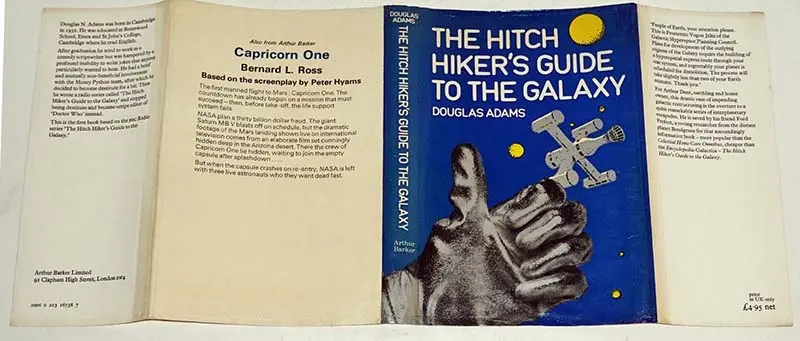
| 1979 | Hitchhiker’s Guide to the Galaxy | Arthur Barber Limited London, [1979] | First Edition. Blue cloth, gilt lettering on spine. "Copyright © Douglas Adams 1979" stated on copyright page. No other date. DJ priced £4.95 on bottom front flap. Ad for "Capricorn One" on rear panel. Later state DJs has no price, blank blue panel on rear of DJ or publisher's address on rear panel. ALSO: First UK paperback. Pan Books, [1979]. Pictorial wrappers. "First published 1979 by Pan Books Ltd." on copyright page. Price 80p on rear panel. ALSO: First US edition. Harmony Books | New York. Number line line “10 9 8 7 6 5 4 3 2 1” and “First American edition published 1980 by Harmony books" on copyright page. DJ price $6.95. |
| 1980 | The Restaurant At The End Of The Universe | Pan Books, London, [1980] | First Edition. Pictorial wrappers. "First published 1980 by Pan books Ltd." stated on copyright page. Price 95p. ALSO: First US edition. Harmony Books/NY [1980]. "10 9 8 7 6 5 4 3 2 1/First Edition" stated on copyright page. Blue cloth, black sides. DJ price $7.95. |
| 1982 | Life, the Universe & Everything | Pan Books, London, [1982] | First Edition. Pan Books, London. Pictorial wrappers. "First published 1982 by Pan books Ltd." stated on copyright page. Price £1.50. ALSO: First US edition. Harmony Books/NY [1982]. "10 9 8 7 6 5 4 3 2 1 "/First Edition" stated on copyright page. Black boards. DJ price $9.95. |
| 1984 | So Long, and Thanks for All the Fish | Pan Books, London, [1984] | First Edition. Black boards. "9 8 7 6 5 4 3 2 1" stated on copyright page. DJ price £6.90. ALSO: First US edition. Harmony Books/NY [1982]. "10 9 8 7 6 5 4 3 2 1 "/First Edition" stated on copyright page. Black boards. DJ price $12.95. |
| 1987 | Dirk Gently's Holistic Detective Agency | William Heinemann, London, [1987] | First Edition. Blue cloth"First published 1987" stated on copyright page. No other dates. DJ price £9.95. ALSO: First US edition. Simon & Schuster, NY, 1987. "10 9 8 7 6 5 4 3 2 1" stated on copyright page. DJ price $14.95. |
| 1988 | The Long Dark Tea-Time of the Soul | WIlliam Heinemann, London, [1988] | First edition. "First published 1988" stated on copyright page, no other dates. DJ price £10.95. ALSO: First US edition. Simon & Schuster, NY, [1988]. "1 3 5 7 9 10 8 6 4 2" stated on copyright page. DJ price $17.95. |
| 1992 | Mostly Harmless | William Heinemann, London, [1992] | First Edition. Black boards. "First published 1992" stated on copyright page, no other dates. DJ price £12.95. ALSO: First US edition. Harmony Books/NY. "10 9 8 7 6 5 4 3 2 1/First Edition" stated on copyright page. DJ price $20.00. |