A Naturalist’s Arabian Nights: Edward J. Detmold’s Masterpiece
In the constellation of illustrated editions of The Arabian Nights that appeared during the Golden Age, few shine with the singular brilliance of Edward J. Detmold’s 1924 volume. Published by Hodder & Stoughton in London, this edition stands apart—not merely for its beauty, but for its distinctive point of view. Detmold approached the tales of Scheherazade not as an Orientalist painter seeking exotic spectacle, but as a naturalist, bringing the same precision and wonder to his renderings of rocs and serpents that he brought to the birds and beasts of his celebrated animal illustrations.
Edward Julius Detmold (1883–1957) had already established his reputation with his 1909 edition of The Fables of Aesop, a work that revealed his extraordinary gift for rendering animals with scientific accuracy and artistic sensitivity. That volume, created in the wake of his twin brother Charles’s death, had established Detmold as a major force in illustration. The Arabian Nights commission, undertaken more than a decade later, would become one of the crowning achievements of his career.
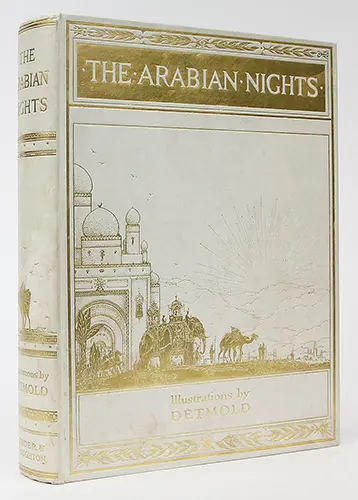
The 1924 edition was a lavish production typical of the era’s finest illustrated books. The volume contained twelve full-page color plates, each mounted on heavy paper and protected by captioned tissue guards, alongside numerous black-and-white illustrations and decorative elements woven throughout the text. The binding was in white cloth with gilt stamping, featuring a design by Detmold on the front cover that hinted at the wonders within. The book was issued in both trade and limited editions, the latter signed by the artist.
What distinguishes Detmold’s Arabian Nights is his approach to the fantastic elements of the tales. Where other illustrators emphasized the human drama—the sultans, the princesses, the merchants and fishermen—Detmold lavished his attention on the creatures of the stories. His roc, carrying Sinbad from the Valley of Diamonds, is rendered with the anatomical precision of a scientific illustration and the majesty of a mythological beast. His serpents coil with sinuous grace; his winged horses seem capable of actual flight; his genies emerge from their brass vessels with the solidity of living beings.
Detmold’s palette in this volume is rich and atmospheric. The desert scenes are bathed in warm golds and ochres; the sea voyages are rendered in deep blues and greens; the subterranean chambers glow with the light of hidden lamps. His technique, developed over years of practice, combined watercolor with subtle glazing to achieve a luminosity that makes his illustrations seem to glow from within.
The human figures in Detmold’s Arabian Nights, while skillfully rendered, often serve as foils for the natural world. Sinbad is dwarfed by the landscape of the roc’s nest; Aladdin stands small before the towering genie; the fisherman contemplates the vastness of the sea from which he has drawn his mysterious catch. This perspective—the human as a small part of a larger, more powerful natural order—was characteristic of Detmold’s work and gave his illustrations a distinctive philosophical weight.
The selection of tales for this edition included many of the most beloved stories: “Sinbad the Sailor,” “Aladdin and the Wonderful Lamp,” “Ali Baba and the Forty Thieves,” and “The Fisherman and the Genie,” among others. Each received Detmold’s full attention, and each yielded images that rank among the most memorable in the history of Arabian Nights illustration.
Today, Detmold’s Arabian Nights is a prized collectible. First editions in good condition—with the twelve color plates intact and the gilt cloth binding preserved—are increasingly scarce. For collectors and admirers of Golden Age illustration, the volume represents a high point in Detmold’s career, a work where his twin passions for natural history and artistic beauty found their fullest expression.
In the pages of this book, Sinbad still sails the Seven Seas; Aladdin still rubs his lamp; the roc still guards its valley of diamonds. But they do so through the eyes of an artist who saw the natural world as the greatest wonder of all. Edward Detmold gave the Arabian Nights a vision of beauty that is both exotic and familiar, both fantastical and grounded in the observable world. It is a vision that endures, more than a century later, as one of the great achievements of the illustrated book.
Recommended for Collectors:
- East of the Sun and West of the Moon (1914) – Kay Nielsen’s lavish fairy tale art matches the mystical tone of The Arabian Nights.
- The Fables of Æsop (1909) – Detmold’s intricate illustrations highlight the moral charm of classic animal fables.
- The Jungle Book (1903) – A striking early edition with vivid animal imagery by the Detmold twins.
Art Gallery: Edward Julius Detmold – The Arabian Nights 1924