A Naturalist’s Vision: Edward J. Detmold’s The Fables of Aesop
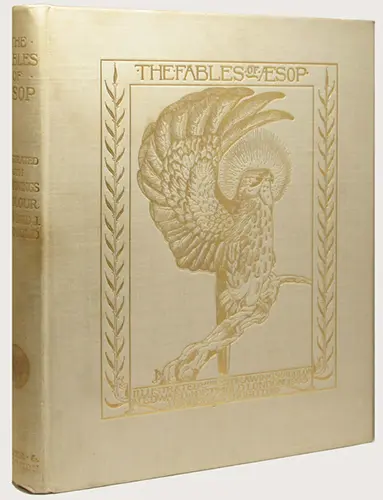
In the crowded field of Aesop illustration, certain editions stand apart—not merely for their beauty, but for their singular point of view. Edward Julius Detmold’s 1909 edition of The Fables of Aesop is such a work. It brings to the ancient tales a naturalist’s precision, an artist’s imagination, and a vision of the animal kingdom that has never been surpassed.
Edward Julius Detmold (1883–1957) was a British artist whose twin passions were art and the natural world. Along with his twin brother Charles, he had exhibited at the Royal Academy while still a teenager, his etchings and watercolors demonstrating an extraordinary gift for rendering animals with scientific accuracy and artistic sensitivity. Charles’s death in 1908, at the age of twenty-five, was a devastating blow, but Edward carried forward the artistic vision they had shared. The Aesop commission, undertaken shortly after his brother’s death, became a work of profound personal significance.
The 1909 edition, published by Hodder & Stoughton in London, was a lavish production that announced Detmold’s arrival as a major force in illustration. The volume contained twenty-five color plates, each mounted on heavy paper and protected by captioned tissue guards, alongside numerous black-and-white illustrations and decorative elements woven throughout the text. The binding was in cloth with gilt stamping, and the book was issued in both trade and limited editions—the latter signed by the artist and bound in vellum.
What distinguishes Detmold’s Aesop is his approach to the animal subjects. Where other illustrators anthropomorphized the creatures of the fables, dressing them in human clothes and staging them in human settings, Detmold rendered them with the precision of a natural history painter. His lions, foxes, wolves, and hares are not actors in costume but living creatures, observed with extraordinary care. The fur of his wolf is rendered strand by strand; the feathers of his eagle gleam with iridescence; the musculature of his lion is drawn with anatomical precision.
Yet these are not mere scientific illustrations. Detmold’s animals possess a dignity, a presence, that elevates them to the realm of art. His compositions are dramatic, often placing his creatures against expansive landscapes that emphasize their place in the natural order. The color plates are rich in tone—deep browns, soft greens, touches of gold and blue—creating an atmosphere that feels both ancient and timeless. Each fable becomes not merely a moral lesson but a meditation on the natural world, on the beauty and ferocity that coexist in every creature.
The fables themselves, a selection of Aesop’s most beloved tales, are given full room to breathe. “The Fox and the Grapes,” “The Hare and the Tortoise,” “The Wolf in Sheep’s Clothing,” “The Lion and the Mouse”—each receives Detmold’s full attention, and each yields a plate of extraordinary beauty. The image of the fox gazing up at the grapes, rendered with a mix of longing and disdain, captures the essence of the fable in a single, unforgettable composition.
The critical reception of Detmold’s Aesop was immediate and enthusiastic. Reviewers praised his “extraordinary knowledge of animal life” and his ability to invest each illustration with “the dignity of a masterpiece.” The book sold well and quickly became a collector’s treasure. It established Detmold’s reputation and led to commissions for editions of The Arabian Nights, The Jungle Book, and other classics.
Today, the 1909 Aesop’s Fables is among the most prized of all illustrated books. First editions in good condition, with clean plates and intact bindings, are increasingly scarce and command high prices at auction. For collectors and admirers of Golden Age illustration, it represents a singular achievement—a work where scientific observation and artistic imagination meet in perfect balance.
In the pages of this book, Aesop’s animals live again. The fox, the hare, the lion, the mouse—each rendered with a beauty that honors the creatures themselves, not merely the lessons they teach. Edward Detmold gave the fables a dignity they had rarely received, and in doing so, created a volume that remains, more than a century later, a masterpiece of the illustrated book.
Recommended for Collectors
- The Jungle Book (1908) illustrated by the Detmold brothers – For another showcase of their wildlife artistry
- Aesop’s Fables (1912) illustrated by Charles Folkard – A more whimsical, Golden Age interpretation
- The Fables of La Fontaine (1874) illustrated by Gustave Doré – For another classic fable collection with dramatic art
- The Arabian Nights (1924), illustrated by Edward J. Detmold – Exotic and magical tales with rich, fantastical illustrations.
Art Gallery: Edward Julius Detmold – The Fables of Aesop 1909