The Message in the Hollow Oak is the twelfth volume in the Nancy Drew Mystery Stories series. It was written by Mildred Benson under the pseudonym Carolyn Keene and first published in 1935.
Summary (original edition)
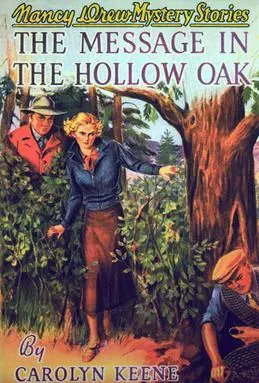
In The Message in the Hollow Oak , a lightning-struck oak tree with a secret hollow becomes the focal point of a treasure hunt spanning continents and generations in this gripping Depression-era mystery. The story begins when Nancy’s archaeologist father returns from Syria with a cryptic warning about “the oak that remembers”—a clue connected to a French explorer’s lost treasure buried centuries ago in the Illinois wilderness.
Nancy’s investigation leads to the sprawling Camp Merriweather, where the landmark oak stands on disputed land between feuding families. She discovers the tree’s hollow conceals more than rotting acorns: colonial-era cipher wheels, Depression-era hobo symbols carved into the bark, and evidence that someone has been systematically searching the cavity under cover of darkness. As Nancy deciphers clues hidden in 18th-century surveying marks and the tree’s own growth rings, she uncovers a live-wire land scheme exploiting Dust Bowl refugees—with the treasure legend being used to scare squatters off oil-rich property.
The 1935 original thrums with period authenticity—Nancy analyzes soil samples to prove fraudulent land claims, recognizes how counterfeit relief vouchers finance the criminals’ operations, and nearly drowns when saboteurs redirect a creek to flood her campsite. Unlike later revisions, this version retains the poignant subplot about Nancy protecting displaced farmers, including a heartrending scene where a starving child mistakes her flashlight beam for the “ghost light” said to guard the treasure. The hollow oak itself emerges as a silent witness to history, its scarred trunk bearing marks of ax attacks, surveyor’s spikes, and generations of desperate hope.
This novel stands out for its layered commentary on American land hunger—from colonial gold seekers to Depression-era opportunists. The climax, where Nancy must distinguish real treasure maps from plant-forged duplicates during a torrential storm that threatens to fell the ancient oak, remains one of the series’ most ecologically conscious moments.
Nancy Drew #12 –The Message in the Hollow Oak First Edition Book Identification Guide
Only the first few printings of the first/second year are shown. Printings codes are based on the Farrah Guide, 12th printing. Please refer to the guide for later printings.
Note: Glossy+: Glossy frontis + 3 glossy internals.
| Printing | Frontis | Copyright Page | Rear Book Ads |
|---|---|---|---|
| 1935A-1 | Glossy+ | Nancy Drew #1-12 | Nancy Drew #1-10/Dana Girls #1-3 |
| 1935B-2 | Glossy+ | Nancy Drew #1-12 | Nancy Drew #1-10/Melody Lane #1-3 |
| 1935C-3 | Glossy+ | Nancy Drew #1-12 | Nancy Drew #1-10/Melody Lane #1-5 |
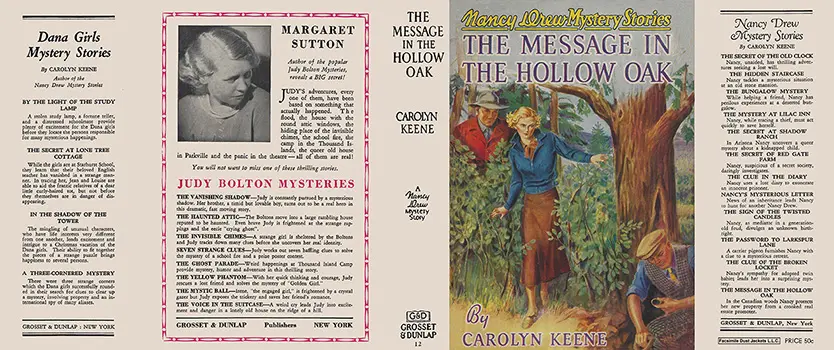
Nancy Drew # –The Message in the Hollow Oak First Edition Dust Jacket Guide
| Printing | Price | Front Flap | Rear Panel | Rear Flap | Format |
|---|---|---|---|---|---|
| 1935A-1 | 50c | Nancy Drew #1-12 | Judy Bolton #1-8 | Dana Girls #1-4 | 3 |
| 1935B-2 | 50c | Nancy Drew #1-12 | Judy Bolton #1-8 | Dana Girls #1-4 | 3 |
| 1935C-3 | 50c | Nancy Drew #1-12 | Judy Bolton #1-9 | Dana Girls #1-5 | 3 |
Reference:
- Farah’s Guide to Nancy Drew, 12th printing