Twin Knights Enchanted: Florence Mary Anderson’s Valentine and Orson
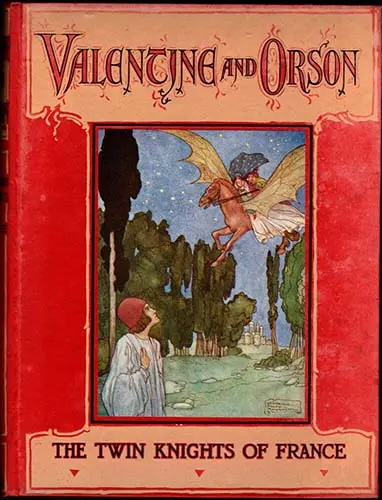
In the final year of the First World War, a remarkable book emerged from the press of Simpkin, Marshall, Hamilton, Kent & Co. in London—a volume that offered readers an escape into a world of medieval romance, brotherly devotion, and fairy-tale wonder. Valentine and Orson: The Twin Knights of France, retold by S.R. Littlewood and illustrated by Florence Mary Anderson, represents a high point in the career of an artist whose delicate, fairy-inspired work had charmed readers throughout the 1910s.
Florence Mary Anderson (1874–1930) was an English artist whose career flourished between 1914 and 1930 . She also illustrated under her maiden name, Molly MacArthur, and her work was deeply influenced by the British school of Fairy Art—a genre of painting and illustration featuring fairies and fairy-tale settings, often with extreme attention to detail . Though she wrote some books herself, it is as an illustrator of children’s books and annuals, in watercolor and black and white, that Anderson is chiefly remembered . Her first major commission had been for Lady Margaret Sackville’s The Dream Pedlar in 1914, and she received substantial commissions throughout the decade that followed, establishing a reputation for work of exceptional delicacy and charm.
Valentine and Orson was one of Anderson’s significant commissions of 1919. The story itself was an ancient romance, retold for young readers by Samuel Robinson Littlewood, a journalist and author . The tale tells of twin brothers abandoned in the woods as infants: Valentine, raised as a knight at the court of King Pepin, and Orson, raised by a she-bear and growing up wild in the forest. Their eventual reunion, the revelation of their royal lineage, and their joint adventures form the heart of this classic narrative of nature versus nurture, brotherly love, and knightly virtue .
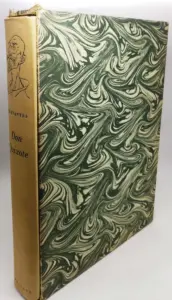
The 1919 edition was a handsome production. Bound in the publisher’s original cloth binding, the front board featured a pictorial onlay—a small illustration mounted onto the cover—that invited young readers into the story. The volume measured approximately 10.5 by 8 inches, a substantial quarto format that allowed Anderson’s illustrations to command the page. Inside, readers discovered a wealth of visual treasures: a color frontispiece and seven further full-color plates, alongside decorative elements woven throughout the text . The endpapers were illustrated as well, creating a cohesive visual experience from cover to cover.
What distinguishes Anderson’s illustrations for Valentine and Orson is their delicate, fairy-inspired sensibility. Her watercolors are rendered in soft, luminous tones—pale golds, gentle greens, rosy pinks, and touches of deeper color for the knights’ heraldry. Her figures possess an elegant, idealized grace, yet there is also a warmth to them, a tenderness that captures the emotional heart of the story. The twin knights are rendered with a quiet dignity; the forests through which they wander are places of enchantment rather than menace; the moments of reunion and recognition are handled with a sensitivity that elevates the romance .
Anderson’s work during this period reflected the influence of the Fairy Art movement, which had flourished in Victorian Britain as a form of escapism. Her illustrations invite readers into a world where the boundaries between the human and the enchanted are thin, where knights encounter magical creatures, and where the forest itself seems alive with wonder . This sensibility was perfectly suited to Valentine and Orson, a tale that moves between the civilized world of King Pepin’s court and the wild realm of the woods where Orson grows up among beasts.
Today, first editions of Valentine and Orson: The Twin Knights of France are scarce and prized by collectors. For those fortunate enough to own a copy, the volume offers a glimpse into a vanished era of bookmaking—a time when even a children’s tale could be transformed, through the art of illustration, into a treasure.
In the pages of this book, the twin knights still ride through enchanted forests, still reunite after years of separation, still prove that brotherly love transcends the boundaries of nature and nurture. Florence Mary Anderson gave this ancient romance a visual language of extraordinary delicacy—a reminder that the greatest fairy-tale art, like the tales themselves, has the power to enchant across the centuries.
For collectors:
• Stories of King Arthur by Beatrice Clay, illustrated by Florence Mary Anderson (1920) – Shows her Arthurian illustration style
• The High History of the Holy Graal illustrated by Jessie M. King (1903) – A comparable medieval romance with Art Nouveau illustrations
• A Book of Myths by Jean Lang, illustrated by Helen Stratton (1914) – Features similar Pre-Raphaelite-inspired mythological illustrations
Art Gallery: Florence Mary Anderson – Valentine and Orson: The Twin Knights of France 1919