The Alchemy of Art Deco: George Barbier’s The Romance of Perfume
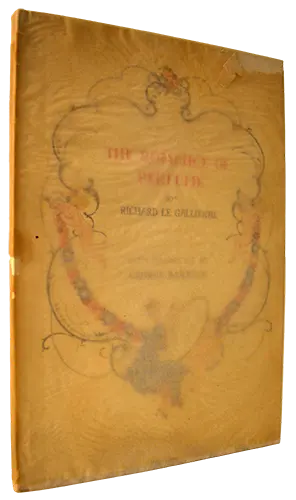
There are books that serve as time capsules—volumes that capture not only a story but the very spirit of an era. George Barbier’s 1928 masterpiece, The Romance of Perfume, is precisely such a treasure. Published to commemorate the opening of the American perfumer Richard Hudnut’s first Parisian boutique at 20 rue de la Paix, this slender volume stands as one of the most exquisite examples of Art Deco book illustration, a collaboration between the era’s most celebrated fashion artist and a poet who understood that perfume was, above all, a matter of the imagination .
George Barbier (1882–1932) was the undisputed master of Art Deco elegance. A central figure in the Parisian fashion world, he created illustrations for the legendary Gazette du Bon Ton, Vogue, and La Vie Parisienne, defining the visual language of 1920s style . His work was characterized by a distinctive, stylized line, flattened perspectives, and a palette of jewel-like colors that captured the sophistication of the Jazz Age. As the critic Edmond Jaloux observed, “It will just take a few drawings of Barbier to revive the taste and spirit of our time” .
The text for The Romance of Perfume was provided by Richard Le Gallienne (1866–1947), an English poet and essayist whose lyrical prose celebrated the cultural and ceremonial uses of fragrance throughout history. From the rituals of ancient Egypt to the courts of Renaissance Europe, Le Gallienne traced the intimate connection between perfume and human civilization .
The book itself was a triumph of fine printing. Published simultaneously in New York and Paris by Richard Hudnut, it was printed at the press of William Edwin Rudge in January 1928 . The typeface was a modern adaptation of a sixteenth-century design by Robert Granjon, lending the text a Renaissance elegance that complemented Barbier’s contemporary imagery . The paper was a special antique rag stock, and the illustrations were reproduced using the Smithsonian process—a technique that mimicked the richness of pochoir, the hand-stenciled method favored by fashion publishers of the period .
The volume features ten color compositions by Barbier: a cover illustration, a title page vignette, and eight full-page plates . Each image is a gem of Art Deco sensibility. One plate depicts ancient Greece, with a graceful woman surrounded by vessels of perfume, her form silhouetted against the Mediterranean sun . Another shows a calligraphic title page adorned with a naked woman genie emerging from a perfume bottle—an allegory of the mysterious, transformative power of scent .
Barbier’s style is instantly recognizable. His figures possess an elongated, statuesque grace, their costumes rendered with meticulous attention to pattern and texture. The compositions are flattened yet dynamic, drawing upon influences from Persian miniatures, Greek vase painting, and the theatrical designs of the Ballets Russes. There is a sense of arrested movement, of timeless elegance—as if each figure has paused, mid-gesture, in a world of eternal beauty.
The book was issued as a slim octavo volume, bound in white paper-covered boards with a striking color illustration by Barbier on the front cover . The top edge was often left uncut, a nod to the Arts and Crafts tradition, and a pamphlet entitled At 20 Rue de la Paix—describing the new Hudnut salon and illustrated with four additional color views—was loosely inserted in a pocket at the rear .
Today, first editions of The Romance of Perfume are prized by collectors. The delicate white binding and the fragile pocketed pamphlet make surviving copies in fine condition increasingly scarce . Those with the original slipcase—often missing—are especially coveted .
But the book’s true value lies in its evocation of a vanished world. In Barbier’s illustrations, the glamour of 1920s Paris comes alive: the sophistication, the luxury, the belief that beauty was an art form to be cultivated. Le Gallienne’s text reminds us that perfume is never merely fragrance but memory, desire, and romance distilled into liquid form.
More than a commercial publication, The Romance of Perfume stands as a testament to the heights that book illustration could achieve in the Art Deco era. In its pages, George Barbier created not merely advertisements but art—visions of elegance that continue to captivate, nearly a century later, with their grace, their sophistication, and their timeless allure. As one contemporary noted, Barbier was “the most sought-after costume designer in Paris, recognized as the theatrical artist who better than any other had captured the mood of the age” . In The Romance of Perfume, that mood—and the magic of scent itself—lives on.
Recommended for Collectors
- Fashion Plates by George Barbier (1920s) – For more of his iconic Art Deco designs
- Les Choses de Paul Poiret (1911) illustrated by Paul Iribe – A complementary luxury-themed Art Deco gem
- The Perfume Lover (2012) by Denyse Beaulieu – A modern literary homage to fragrance
Art Gallery: George Barbier – The Romance of Perfume 1928