A Secessionist Fairy Tale: Heinrich Lefler’s Die Prinzessin
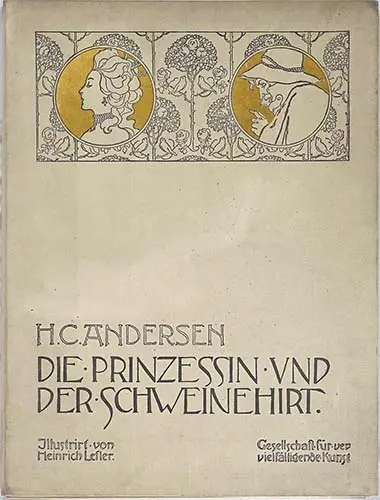
There are books that mark turning points—moments when the art of illustration shifts course, embracing new sensibilities and breaking from tradition. Heinrich Lefler’s 1897 edition of Die Prinzessin und der Schweinehirt (The Princess and the Swineherd) is such a work. Widely regarded today as the first example of modern book art in Austria, this exquisite portfolio stands at the dawn of the Viennese Secession and the Jugendstil movement, a harbinger of the artistic revolution that would sweep Central Europe at the turn of the century .
Heinrich Lefler (1863–1919) was an Austrian painter, graphic artist, and stage designer whose career spanned the most transformative decades of Viennese art . Trained at the Academy of Fine Arts Vienna and later in Munich, he became a founding member of the Hagenbund in 1900 and worked alongside his brother-in-law, Joseph Urban, on stage designs for the Vienna State Opera . Yet before the Secession, before the grand opera sets and the founding of artist collectives, Lefler created this modest but revolutionary work—his first foray into book illustration .
The 1897 Die Prinzessin was not a conventional bound book but a portfolio, published by the Gesellschaft für vervielfältigende Kunst in Vienna . It contained a color-illustrated title page and twelve numbered color plates, each mounted on loose leaves, housed in a cream cloth portfolio with a blind-embossed pictorial cover highlighted in gold . The folio format measured an impressive 41 by 30.5 centimeters—a large, luxurious object designed not for nursery shelves but for discerning collectors .
What makes this edition so significant is its radical departure from tradition. Lefler drew inspiration from English and French illustrators of the period, but his synthesis was entirely his own . His illustrations feature delicate watercolors with a subtle, sophisticated use of gold and silver highlights—a technique that gave the images a luminous, jewel-like quality . The compositions are characterized by their square format, often set against spatially unmodulated backgrounds that emphasize decorative pattern over naturalistic depth . This flattening of perspective, this embrace of two-dimensional elegance, was a hallmark of the new aesthetic that would soon define the Secession.
Lefler’s engagement with the book’s design extended beyond the illustrations. The text itself was hand-lettered by the artist, its ornamental flourishes echoing the decorative qualities of the images . Text and illustration became intimately connected, each reinforcing the other’s aesthetic choices—a total work of art in the spirit of William Morris but rendered with a distinctly Viennese elegance.
The story Lefler chose to illustrate was Hans Christian Andersen’s The Princess and the Swineherd—a tale of a prince disguised as a humble swineherd who teaches a haughty princess a lesson about true value . It was a fitting subject for an artist on the cusp of a movement that would challenge the artistic establishment, embracing new forms and rejecting conventional hierarchies. In Lefler’s hands, the fairy tale became something more: a vehicle for artistic innovation, a demonstration that even a children’s story could be elevated to high art.
The 1897 edition was expensive and produced in a limited run, reaching only a small circle of enthusiasts . Today, surviving copies are exceedingly rare and highly prized. The portfolio’s delicate binding and loose plates have made it vulnerable to wear, and copies in fine condition command prices in the thousands of euros . The MAK (Museum of Applied Arts) in Vienna holds a bibliophile copy in its collection, recognizing the work as a landmark of Austrian book art .
Lefler would go on to collaborate with Joseph Urban on illustrated editions of Grimms’ fairy tales and other works, further developing the style first explored in Die Prinzessin . Yet this early portfolio remains a touchstone—a glimpse of a new aesthetic emerging, of a Vienna on the verge of artistic revolution. In its delicate watercolors and shimmering gold highlights, in its flattened perspectives and decorative elegance, Die Prinzessin captures the spirit of its moment: a fairy tale rendered not in the style of the past but in the bold, beautiful language of the future.
Recommended for Collectors
- Dornröschen (Sleeping Beauty) illustrated by Lefler – Another fairy-tale classic in his signature style
- Hans Andersen’s Fairy Tales (1916) illustrated by Harry Clarke – For a darker, more Gothic take on Andersen
- Hansel and Gretel, illustrated by Kay Nielsen – A fairy tale with Art Nouveau flair
Art Gallery: Heinrich Lefler – Die Prinzessin 1897
![Heinrich Lefler - Die Prinzessin [lefler-prinzessin01] (art, illustrations)](https://www.nocloo.com/wp-content/plugins/justified-image-grid/timthumb.php?src=https%3A%2F%2Fwww.nocloo.com%2Fart%2Flefler-prinzessin%2Flefler-prinzessin01.jpg&h=280&q=90&f=.jpg)
![Heinrich Lefler - Die Prinzessin [lefler-prinzessin02] (art, illustrations)](https://www.nocloo.com/wp-content/plugins/justified-image-grid/timthumb.php?src=https%3A%2F%2Fwww.nocloo.com%2Fart%2Flefler-prinzessin%2Flefler-prinzessin02.jpg&h=280&q=90&f=.jpg)
![Heinrich Lefler - Die Prinzessin [lefler-prinzessin03] (art, illustrations)](https://www.nocloo.com/wp-content/plugins/justified-image-grid/timthumb.php?src=https%3A%2F%2Fwww.nocloo.com%2Fart%2Flefler-prinzessin%2Flefler-prinzessin03.jpg&h=280&q=90&f=.jpg)
![Heinrich Lefler - Die Prinzessin [lefler-prinzessin04] (art, illustrations)](https://www.nocloo.com/wp-content/plugins/justified-image-grid/timthumb.php?src=https%3A%2F%2Fwww.nocloo.com%2Fart%2Flefler-prinzessin%2Flefler-prinzessin04.jpg&h=280&q=90&f=.jpg)
![Heinrich Lefler - Die Prinzessin [lefler-prinzessin05] (art, illustrations)](https://www.nocloo.com/wp-content/plugins/justified-image-grid/timthumb.php?src=https%3A%2F%2Fwww.nocloo.com%2Fart%2Flefler-prinzessin%2Flefler-prinzessin05.jpg&h=280&q=90&f=.jpg)
![Heinrich Lefler - Die Prinzessin [lefler-prinzessin06] (art, illustrations)](https://www.nocloo.com/wp-content/plugins/justified-image-grid/timthumb.php?src=https%3A%2F%2Fwww.nocloo.com%2Fart%2Flefler-prinzessin%2Flefler-prinzessin06.jpg&h=280&q=90&f=.jpg)
![Heinrich Lefler - Die Prinzessin [lefler-prinzessin07] (art, illustrations)](https://www.nocloo.com/wp-content/plugins/justified-image-grid/timthumb.php?src=https%3A%2F%2Fwww.nocloo.com%2Fart%2Flefler-prinzessin%2Flefler-prinzessin07.jpg&h=280&q=90&f=.jpg)
![Heinrich Lefler - Die Prinzessin [lefler-prinzessin08] (art, illustrations)](https://www.nocloo.com/wp-content/plugins/justified-image-grid/timthumb.php?src=https%3A%2F%2Fwww.nocloo.com%2Fart%2Flefler-prinzessin%2Flefler-prinzessin08.jpg&h=280&q=90&f=.jpg)
![Heinrich Lefler - Die Prinzessin [lefler-prinzessin09] (art, illustrations)](https://www.nocloo.com/wp-content/plugins/justified-image-grid/timthumb.php?src=https%3A%2F%2Fwww.nocloo.com%2Fart%2Flefler-prinzessin%2Flefler-prinzessin09.jpg&h=280&q=90&f=.jpg)
![Heinrich Lefler - Die Prinzessin [lefler-prinzessin10] (art, illustrations)](https://www.nocloo.com/wp-content/plugins/justified-image-grid/timthumb.php?src=https%3A%2F%2Fwww.nocloo.com%2Fart%2Flefler-prinzessin%2Flefler-prinzessin10.jpg&h=280&q=90&f=.jpg)
![Heinrich Lefler - Die Prinzessin [lefler-prinzessin11] (art, illustrations)](https://www.nocloo.com/wp-content/plugins/justified-image-grid/timthumb.php?src=https%3A%2F%2Fwww.nocloo.com%2Fart%2Flefler-prinzessin%2Flefler-prinzessin11.jpg&h=280&q=90&f=.jpg)
![Heinrich Lefler - Die Prinzessin [lefler-prinzessin12] (art, illustrations)](https://www.nocloo.com/wp-content/plugins/justified-image-grid/timthumb.php?src=https%3A%2F%2Fwww.nocloo.com%2Fart%2Flefler-prinzessin%2Flefler-prinzessin12.jpg&h=280&q=90&f=.jpg)
![Heinrich Lefler - Die Prinzessin [lefler-prinzessin13] (art, illustrations)](https://www.nocloo.com/wp-content/plugins/justified-image-grid/timthumb.php?src=https%3A%2F%2Fwww.nocloo.com%2Fart%2Flefler-prinzessin%2Flefler-prinzessin13.jpg&h=280&q=90&f=.jpg)
![Heinrich Lefler - Die Prinzessin [lefler-prinzessin14] (art, illustrations)](https://www.nocloo.com/wp-content/plugins/justified-image-grid/timthumb.php?src=https%3A%2F%2Fwww.nocloo.com%2Fart%2Flefler-prinzessin%2Flefler-prinzessin14.jpg&h=280&q=90&f=.jpg)