The Password to Larkspur Lane is the tenth volume in the Nancy Drew Mystery Stories series. It was first published in 1933 under the pseudonym Carolyn Keene. The actual author was ghostwriter Walter Karig in his third and final Nancy Drew novel and his final appearance for the Stratemeyer Syndicate. Due to Karig passing away in 1956, this book and his other two Nancy Drews, as of January 1, 2007, have passed into the public domain in Canada and other countries with a life-plus-50 policy.
Summary (original edition)
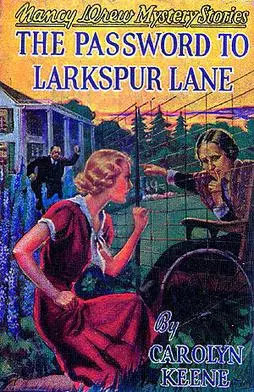
In The Password to Larkspur Lane, a wounded carrier pigeon with a cryptic message clutched in its talons launches Nancy Drew into one of her most complex cases, where a quiet suburban lane conceals a sophisticated medical kidnapping ring. The story begins when the bloodstained bird lands on Nancy’s windowsill, its leg bearing a torn scrap of paper with the words “Larkspur Lane” and a series of baffling numbers.
The investigation leads to an exclusive neighborhood where perfectly manicured hedges hide disturbing secrets—a doctor’s bag abandoned in a rose thicket, strange midnight deliveries of medical equipment, and elderly patients disappearing from local nursing homes only to reappear with no memory of their absence. Nancy discovers the numbers correspond to prescription codes, the “password” is changed daily using a hidden pharmacy ledger, and the unassuming blue house at the lane’s end operates as a clandestine hospital for wealthy hostages.
The 1933 original pulses with Depression-era desperation—Nancy follows clues hidden in soup kitchen records, recognizes how fake charity drives scout potential victims, and infiltrates the gang by posing as a medical student. Unlike later revisions, this version retains harrowing scenes where Nancy is locked in a makeshift operating room filling with anesthetic gas, and the heartbreaking moment when she finds a missing heiress reduced to a frightened amnesiac by forced sedation. Larkspur Lane itself becomes a brilliant metaphor—its lovely name belying the poison (like the flowering plant) concealed beneath the surface.
This novel stands out for its prescient commentary on healthcare exploitation, wrapped in a classic country-house mystery. The password system—based on actual 1930s prescription shorthand—showcases Nancy’s ability to master specialized knowledge, while the avian clue (later changed to a radio message in revisions) preserves the original’s elegant interplay between rural and modern crime-solving methods.
Nancy Drew #10 –The Password to Larkspur Lane First Edition Book Identification Guide
Only the first few printings of the first/second year are included. Printings codes are based on the Farrah Guide, 12th printing. Please refer to the guide for later printings.
Note: Glossy+: Glossy frontis + 3 glossy internals.
| Printing | Frontis | Copyright Page | Rear Book Ads |
|---|---|---|---|
| 1933A-1 | Glossy+ | First Printing, Sep 1933 | None |
| 1933B-2 | Glossy+ | Nancy Drew #1-10 | None |
| 1933C-3 | Glossy+ | Nancy Drew #1-10 | None |
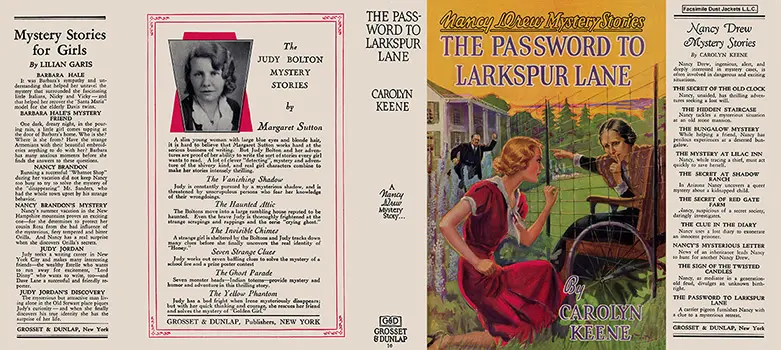
Nancy Drew #10 –The Password to Larkspur Lane First Edition Dust Jacket Identification Guide
ao: Among other titles.
| Printing | Front Flap | Rear Cover | Rear Flap | Reverse/Inside | Format |
|---|---|---|---|---|---|
| 1933A-1 | Nancy Drew #1-10 | Judy Bolton #1-6 | Mystery Stories(6) | Nancy Drew #1-9 ao | 3 |
| 1933B-2 | Nancy Drew #1-10 | Judy Bolton #1-6 | Mystery Stories(6) | Nancy Drew #1-9 ao | 3 |
| 1933C-3 | Nancy Drew #1-10 | Judy Bolton #1-6 | Mystery Stories(6) | 3 |
Reference:
- Farah’s Guide to Nancy Drew, 12th printing