Grampa in Oz: A Generational Quest for Lost Royalty
Grampa in Oz was published in 1924 by Reilly & Lee Co. in Chicago as the eighteenth book in the Oz series and the fourth written by Ruth Plumly Thompson, who succeeded L. Frank Baum as Royal Historian of Oz after his death in 1919. The first edition featured a brick-red binding with a full-color pictorial label on the front board and black stamping on the spine. John R. Neill provided twelve color plates and numerous black-and-white illustrations throughout the 254-page volume.
The book introduced the character of Grampa, a retired fairy gentleman, and his grandson, along with the villainous Razor-Wolf of the Frozen North. The work entered the public domain in the United States in 2020. A paperback reprint edition was published by Del Rey / Random House in 1985, followed by a facsimile hardcover from the International Wizard of Oz Club in 1989. The book has since seen additional reprints from various publishers following its public domain status.
Summary
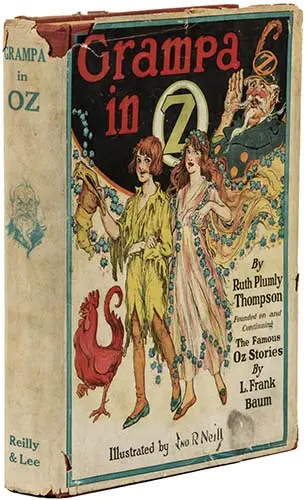
The story revolves around Silas Grump, universally known as “Grampa,” a stern and ill-tempered guardian who prides himself on common sense and detests foolishness, fantasy, and disobedience. He is responsible for a young boy named Peter, whose curiosity and imagination constantly clash with Grampa’s rigid discipline. This dynamic immediately contrasts with earlier Oz books, in which children such as Dorothy Gale, Trot, or Betsy Bobbin are portrayed as natural allies of magic and wonder. Grampa, by contrast, represents the adult world’s resistance to imagination, making him an unusual protagonist within the Oz canon.
Grampa’s reluctant journey to Oz begins when Peter vanishes, having been drawn into the magical land. As in several previous books—most notably The Road to Oz and The Emerald City of Oz—the transition from the ordinary world to Oz occurs through mysterious and whimsical means, reinforcing the idea that Oz exists just beyond the boundaries of everyday reality. Once in Oz, Grampa encounters many long-established characters, including the Scarecrow, the Tin Woodman, and the Cowardly Lion, all rulers and heroes whose personalities were firmly defined in Baum’s original novels. Their calm acceptance of Oz’s wonders stands in sharp contrast to Grampa’s grumbling disbelief, highlighting how thoroughly Oz has become a stable, civilized kingdom over the course of the earlier books.
The novel also continues Thompson’s practice, seen in earlier entries like The Cowardly Lion of Oz and Kabumpo in Oz, of blending new characters and settings with familiar figures. Grampa’s travels take him through unusual regions filled with strange creatures and humorous dangers, expanding the geography of Oz while maintaining continuity with its established moral framework. Magic in Oz is no longer chaotic or threatening, as it sometimes was in Baum’s earliest books; instead, it serves as a backdrop against which characters learn personal lessons.
In relation to the previous Oz books, Grampa in Oz reinforces one of the series’ most enduring themes: transformation through self-discovery rather than external magic. Just as the Scarecrow learned he was already wise and the Tin Woodman learned he already had a heart, Grampa gradually realizes that his harshness and cynicism are limitations of his own making. His experiences in Oz force him to reassess his views on children, imagination, and kindness.
By the conclusion of the story, Grampa emerges changed—still opinionated, but more understanding and compassionate. As the eighteenth book in the series, Grampa in Oz exemplifies Ruth Plumly Thompson’s ability to honor Baum’s legacy while introducing characters whose personal growth reflects the evolving sensibilities of the Oz saga.
Grampa in Oz – First Edition Identification Guide
Please refer to the gallery for detailed images of binding(s) and dust jackets.
| Year | Title | Publisher | First edition/printing identification points |
|---|---|---|---|
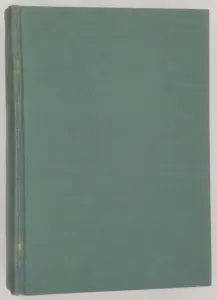
| 1924 | Grampa in Oz | Reilly & Lee Co., [1924] | First edition. Illustrated by John R. Neill, 271 pages. Textual points: The book is printed on heavy paper stock and measures approximately 1 7/16 inches thick. The four pages (each with a blank verso) of advertisements at the end of the book were included without change in subsequent printings for many years. Pictorial self-endpapers in black and white.* Color plates: 12 full-color inserts, bound in (there is no color frontispiece: a black-and-white picture which is part of the text sheets faces the title page) facing pages 28, 45,76, 93, 124, 141, 172, 189, 220, 237, 252, [269]. Stock coated only on the printed side. Binding: light brick-red cloth, with pictorial paper label in colors. Spine imprint: “Reilly | & Lee”. Size of leaf: 9 by 6 5/8 inches. An issue with the imprint of the Copp, Clark Co., Limited, of Toronto on the title page and spine is known. It is otherwise identical with the American first state.
Later printings are on thinner paper stock and differ somewhat in binding colors. Copies have been seen in light and dark brick-red cloth (each about 1 5/16 inches thick) with plates coated only on the printed side; in dark brick-red cloth (1 3/16 inches thick) with various combinations of plates coated on only the printed side and on both sides, and in brick-red cloth lighter than the first-state binding (11/8 inches thick) with all plates coated on both sides. Around 1935, the color plates were discontinued, but for a brief time copies were issued with only 2 color plates. |
Grampa in Oz – First Edition Dust Jacket Identification Guide
First edition binding(s) and various dust jacket printings.


References:
- Wikipedia
- Bibliographia Oziana – Haff, Greeme, Martin. 2002