A Golden Journey: Thomas Mackenzie’s The Story of Hassan of Bagdad
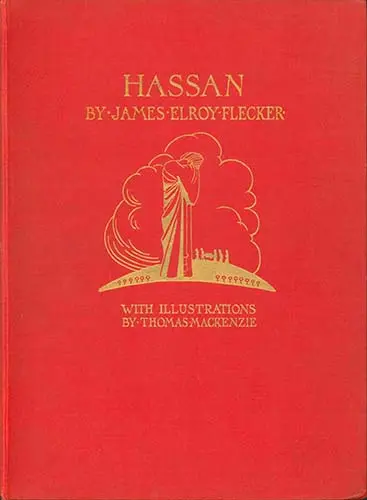
In the annals of illustrated books, certain volumes capture not only the imagination but also the spirit of an age. Thomas Mackenzie’s 1924 edition of James Elroy Flecker’s The Story of Hassan of Bagdad is one such treasure—a work that stands at the intersection of literary modernism, Orientalist fantasy, and the dying embers of the Golden Age of Illustration .
James Elroy Flecker (1884–1915) was a poet and playwright whose untimely death at thirty-one robbed English literature of one of its most promising voices . His verse drama Hassan, completed in 1914 but first performed in 1923, is his masterpiece—a lush, exotic tale set in medieval Bagdad, weaving themes of love, betrayal, ambition, and the haunting beauty of the journey to Samarkand . The play’s most famous lines, spoken by the character Rafi, have echoed through literary history: “For lust of knowing what should not be known, we take the Golden Road to Samarkand” .
The first illustrated edition of Hassan appeared in 1924, published by William Heinemann in London . This was the edition that brought Flecker’s vision to life in color and line, and the artist entrusted with this task was Thomas Mackenzie (1887–1944), a British illustrator whose work deserves far greater recognition .
Mackenzie’s career, though relatively brief, produced some of the most exquisite book illustrations of the 1920s . He was known for his decorative style, his attention to pattern, and his ability to evoke the opulent atmosphere of the Near East—skills perfectly suited to Flecker’s Bagdad . For the 1924 Hassan, he created twelve color plates, each mounted on heavy paper and protected by captioned tissue guards, alongside a frontispiece, decorative title page, and numerous headpieces and tailpieces woven throughout the text .
The physical production of the book was lavish. The quarto volume, measuring approximately 26 centimeters in height, was bound in red cloth, with Mackenzie’s own decorative designs stamped in gilt on the spine and upper board . The endpapers, printed in orange with a Mackenzie design, created a unified visual experience from cover to cover . The text was printed in black and blue, with section decorations that echoed the Eastern motifs of the plates . The first edition was issued in a limited run, and copies in fine condition today are prized by collectors .
What distinguishes Mackenzie’s illustrations is their synthesis of Art Deco elegance with the decorative traditions of Persian miniature painting. His palette is rich and luminous—deep blues, warm golds, burnished reds, and touches of emerald green—colors that evoke the bazaars and palaces of Flecker’s imagination . His figures possess an elongated, almost statuesque grace, their costumes rendered with meticulous attention to pattern and texture . The compositions are often flattened, emphasizing decorative design over naturalistic depth, yet they retain a sense of theatrical drama that mirrors the play’s origins .
The twelve plates capture the key moments of Flecker’s narrative: the lovers Hassan and Yasmin in the gardens of Bagdad, the cruel Caliph’s court, the journey across the desert, and the haunting final approach to Samarkand. Each image is a jewel, rewarding sustained attention with its intricate details and atmospheric richness . The captioned tissue guards, each preceding a plate, provide context while preserving the integrity of the image beneath .
The 1924 edition also holds significance as the first illustrated edition of a work that had already gained considerable literary prestige . Flecker’s Hassan had been championed by figures like T.E. Lawrence (“Lawrence of Arabia”) and had established itself as a landmark of early twentieth-century English drama . The addition of Mackenzie’s illustrations elevated it further, creating a volume that appealed to collectors and literary enthusiasts alike .
Today, the first illustrated edition of Hassan is a scarce and coveted treasure. Bibliographic references, such as Mercer 20, confirm its status among collectors of modern first editions . Copies in good condition, with the plates intact and the red cloth binding preserved, are increasingly difficult to find and command significant prices at antiquarian booksellers .
In the pages of this book, Flecker’s poetry meets Mackenzie’s art, and the result is a work of enduring beauty. The golden road to Samarkand, that mythical journey for knowledge and wonder, finds its visual counterpart in these luminous illustrations. For those who encounter it, Thomas Mackenzie’s Hassan remains a reminder of a moment when book illustration reached toward the sublime—and, for a brief, brilliant time, achieved it.
Recommended for Collectors
- The Golden Journey to Samarkand (1913) by James Elroy Flecker – The original poetry collection that inspired the play
- Stories from the Arabian Nights (1907) illustrated by Edmund Dulac – For a complementary Orientalist vision
- The Rubáiyát of Omar Khayyám (1909) illustrated by Willy Pogany – Another lush interpretation of Persian poetry
- The Rubáiyát of Omar Khayyám (1913), illustrated by René Bull – A sensuous and philosophical Persian classic with rich Orientalist artwork.
Art Gallery: Thomas MacKenzie – The Story of Hassan of Bagdad 1924
![Thomas Mackenzie - Story of Hassan of Bagdad [mackenzie-hassan01] (art, illustrations)](https://www.nocloo.com/wp-content/plugins/justified-image-grid/timthumb.php?src=https%3A%2F%2Fwww.nocloo.com%2Fart%2Fmackenzie-hassan%2Fmackenzie-hassan01.jpg&h=280&q=90&f=.jpg "Thomas MacKenzie - Illustrations for The Story of Hassan of Bagdad 1924")
![Thomas Mackenzie - Story of Hassan of Bagdad [mackenzie-hassan02] (art, illustrations)](https://www.nocloo.com/wp-content/plugins/justified-image-grid/timthumb.php?src=https%3A%2F%2Fwww.nocloo.com%2Fart%2Fmackenzie-hassan%2Fmackenzie-hassan02.jpg&h=280&q=90&f=.jpg "Thomas MacKenzie - Illustrations for The Story of Hassan of Bagdad 1924")
![Thomas Mackenzie - Story of Hassan of Bagdad [mackenzie-hassan03] (art, illustrations)](https://www.nocloo.com/wp-content/plugins/justified-image-grid/timthumb.php?src=https%3A%2F%2Fwww.nocloo.com%2Fart%2Fmackenzie-hassan%2Fmackenzie-hassan03.jpg&h=280&q=90&f=.jpg "Thomas MacKenzie - Illustrations for The Story of Hassan of Bagdad 1924")
![Thomas Mackenzie - Story of Hassan of Bagdad [mackenzie-hassan04] (art, illustrations)](https://www.nocloo.com/wp-content/plugins/justified-image-grid/timthumb.php?src=https%3A%2F%2Fwww.nocloo.com%2Fart%2Fmackenzie-hassan%2Fmackenzie-hassan04.jpg&h=280&q=90&f=.jpg "Thomas MacKenzie - Illustrations for The Story of Hassan of Bagdad 1924")
![Thomas Mackenzie - Story of Hassan of Bagdad [mackenzie-hassan05] (art, illustrations)](https://www.nocloo.com/wp-content/plugins/justified-image-grid/timthumb.php?src=https%3A%2F%2Fwww.nocloo.com%2Fart%2Fmackenzie-hassan%2Fmackenzie-hassan05.jpg&h=280&q=90&f=.jpg "Thomas MacKenzie - Illustrations for The Story of Hassan of Bagdad 1924")
![Thomas Mackenzie - Story of Hassan of Bagdad [mackenzie-hassan06] (art, illustrations)](https://www.nocloo.com/wp-content/plugins/justified-image-grid/timthumb.php?src=https%3A%2F%2Fwww.nocloo.com%2Fart%2Fmackenzie-hassan%2Fmackenzie-hassan06.jpg&h=280&q=90&f=.jpg "Thomas MacKenzie - Illustrations for The Story of Hassan of Bagdad 1924")
![Thomas Mackenzie - Story of Hassan of Bagdad [mackenzie-hassan07] (art, illustrations)](https://www.nocloo.com/wp-content/plugins/justified-image-grid/timthumb.php?src=https%3A%2F%2Fwww.nocloo.com%2Fart%2Fmackenzie-hassan%2Fmackenzie-hassan07.jpg&h=280&q=90&f=.jpg "Thomas MacKenzie - Illustrations for The Story of Hassan of Bagdad 1924")
![Thomas Mackenzie - Story of Hassan of Bagdad [mackenzie-hassan08] (art, illustrations)](https://www.nocloo.com/wp-content/plugins/justified-image-grid/timthumb.php?src=https%3A%2F%2Fwww.nocloo.com%2Fart%2Fmackenzie-hassan%2Fmackenzie-hassan08.jpg&h=280&q=90&f=.jpg "Thomas MacKenzie - Illustrations for The Story of Hassan of Bagdad 1924")
![Thomas Mackenzie - Story of Hassan of Bagdad [mackenzie-hassan09] (art, illustrations)](https://www.nocloo.com/wp-content/plugins/justified-image-grid/timthumb.php?src=https%3A%2F%2Fwww.nocloo.com%2Fart%2Fmackenzie-hassan%2Fmackenzie-hassan09.jpg&h=280&q=90&f=.jpg "Thomas MacKenzie - Illustrations for The Story of Hassan of Bagdad 1924")
![Thomas Mackenzie - Story of Hassan of Bagdad [mackenzie-hassan10] (art, illustrations)](https://www.nocloo.com/wp-content/plugins/justified-image-grid/timthumb.php?src=https%3A%2F%2Fwww.nocloo.com%2Fart%2Fmackenzie-hassan%2Fmackenzie-hassan10.jpg&h=280&q=90&f=.jpg "Thomas MacKenzie - Illustrations for The Story of Hassan of Bagdad 1924")
![Thomas Mackenzie - Story of Hassan of Bagdad [mackenzie-hassan11] (art, illustrations)](https://www.nocloo.com/wp-content/plugins/justified-image-grid/timthumb.php?src=https%3A%2F%2Fwww.nocloo.com%2Fart%2Fmackenzie-hassan%2Fmackenzie-hassan11.jpg&h=280&q=90&f=.jpg "Thomas MacKenzie - Illustrations for The Story of Hassan of Bagdad 1924")
![Thomas Mackenzie - Story of Hassan of Bagdad [mackenzie-hassan12] (art, illustrations)](https://www.nocloo.com/wp-content/plugins/justified-image-grid/timthumb.php?src=https%3A%2F%2Fwww.nocloo.com%2Fart%2Fmackenzie-hassan%2Fmackenzie-hassan12.jpg&h=280&q=90&f=.jpg "Thomas MacKenzie - Illustrations for The Story of Hassan of Bagdad 1924")