From 1954 to 1978 Grosset & Dunlap published another Edward Stratemeyer series of Tom Swift books. This set was called The New Tom Swift Jr. Adventures and was “by Victor Appleton II.” In the stories, Tom Jr. is the son of the original Tom Swift; the author is presumably the son of the original Victor Appleton, as this was still in the era when the identities of Stratemeyer ghostwriters were well kept secrets. The original outlines for the Tom Swift Jr. books are supposed to have been created by Edward Stratemeyer’s daughter Harriet and Syndicate writers filled in the details. In the second Tom Swift series the plots concentrate on Tom’s fantastic inventions and his explorations all over the earth and into outer space. The titles of the books in the series show what sort of inventions Tom came up with. His best friend Bud Barclay, who dated Tom’s sister Sandy, accompanied Tom on his adventures. Another character who went along on these expeditions is the comical Texan Chow Winkler, the cook.
The American Space Program of the 1950s and 1960s no doubt inspired the adventures that Tom Swift Jr. had. Tom got to the moon in 1958; real astronauts had to wait another eleven years. It is amazing that the Tom Swift Jr. series ended shortly after the American Moon Landing, as there should have been great interest at the time in a high quality boys’ series about space exploration, like the new Tom Swift one.
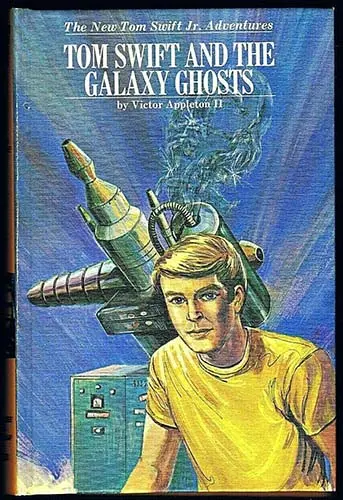
James Duncan Lawrence was the author of most of the Tom Swift Jr. books. He wrote twenty-four of the thirty-three titles. Graham Kaye painted the pictures for the first seventeen books that came with dust jackets and several other artists did them for the picture cover books that followed. The logo picture of Tom Jr. on the spine of the books is Kaye’s work.
After the Tom Swift Jr. series of hardback books ended in 1971, Grosset & Dunlap attempted to continue it with the publication of a set of paperback books in 1972 and another paperback set in 1977. Grosset & Dunlap published the paperback books under a company division called Tempo, which also printed other series books, such as Judy Bolton, Cherry Ames, and Connie Blair, to prolong them in an economical way. These Tempo books attempted to play down the “Jr.” clement of Tom Swift’s name. All the paperback Tom Swift Jr. books are printed with the same plates as the original hardback books.
There were also foreign editions of the Tom Swift Jr. series. Among them were volumes from France, Denmark, and Iceland, translated into these respective languages.
Tom Swift Jr. Book Formats (First Editions Identification Guide)
Grosset & Dunlap
I. 1954 – 1961, including first printings #1 — #17
- Volumes #1- #17
- Blue tweed composition binding
- Blue and white eps showing Tom in his lab
- Frontis and eight to eleven black and white line drawings
- Full color Dust jacket (see Ghostwriter/Illustrator for illustrators)
II. 1961
- Volumes #1- #18, including first printing #18
- Blue spine picture cover; composition binding
- #18 has wrap spine picture, like wrap spine Dust jackets Illustrations same as Format I
III. 1962 — 1971, including first printing #19 — #33
- Volumes #1 – #33
- Yellow-orange spine picture cover; composition binding, as Format II
Tom Swift Jr. Series Books List
Year Volume/Title Ghostwriter Illusttrator Pages 1954 1. Tom Swift and His Flying Lab William Dougherty Graham Kaye 208 1954 2. Tom Swift and His Jetmarine John Almquist Graham Kaye 208 1954 3. Tom Swift and His Rocket Ship John Almquist Graham Kaye 208 1954 4. Tom Swift and His Giant Robot Richard Sklar Graham Kaye 211 1954 5. Tom Swift and His Atomic Earth Blaster James Lawrence Graham Kaye 210 1955 6. Tom Swift and His Outpost in Space James Lawrence Graham Kaye 210 1956 7. Tom Swift and His Diving Seacopter James Lawrence Graham Kaye 214 1956 8. Tom Swift In the Caves of Nuclear Fire Thomas Mulvey Graham Kaye 214 1956 9. Tom Swift on The Phantom Satellite James Lawrence Graham Kaye 214 1957 10. Tom Swift and His Ultrasonic Cycloplane James Lawrence Graham Kaye 182 1958 11. Tom Swift and His Deep-Sea Hydrodome James Lawrence Graham Kaye 184 1958 12. Tom Swift in The Race to the Moon James Lawrence Graham Kaye 180 1958 13. Tom Swift and His Space Solartron James Lawrence Graham Kaye 183 1959 14. Tom Swift and His Electronic Retroscope James Lawrence Graham Kaye 184 1960 15. Tom Swift and His Spectromarine Selector James Lawrence Graham Kaye 184 1960 16. Tom Swift and the Cosmic Astronauts James Lawrence Graham Kaye 184 1961 17. Tom Swift and The Visitor from Planet X James Lawrence Graham Kaye 184 1961 18. Tom Swift and the Electronic Hydrolung James Lawrence Charles Brey 188 1962 19. Tom Swift and His Triphibian Atomcar James Lawrence Charles Brey 188 1962 20. Tom Swift and His Megascope Space Prober James Lawrence Charles Brey 176 1963 21. Tom Swift and The Asteroid Pirates James Lawrence Charles Brey 178 1963 22. Tom Swift and His Repelatron Skyway James Lawrence Charles Brey 179 1964 23. Tom Swift and His Aquatomic Tracker James Lawrence Charles Brey 178 1965 24. Tom Swift and His 3-D Telejector James Lawrence Charles Brey 177 1965 25. Tom Swift and His Polar-Ray Dynasphere James Lawrence Edward Moritz 177 1965 26. Tom Swift and His Sonic Boom Trap James Lawrence Edward Moritz 178 1966 27. Tom Swift and His Subocean Geotron James Lawrence Charles Brey 178 1966 28. Tom Swift and The Mystery Comet James Lawrence Ray Johnson 178 1967 29. Tom Swift and the Captive Planetoid James Lawrence Ray Johnson 174 1969 31. Tom Swift and His Dyna-4 Capsule Richard McKenna Ray Johnson 175 1970 32. Tom Swift and His Cosmotron Express Richard McKenna Ray Johnson 180 1971 33. Tom Swift and The Galaxy Ghosts Vincent Buranelli Bill Dolwick 180 1968 30. Tom Swift and His G-Force Inverter Thomas Mulvey Ray Johnson 175
Source: All About Collecting Boys’ Series Books. John Axe, 2002.