A Ship of Eternal Conflict: Virgil Finlay’s The Ship of Ishtar
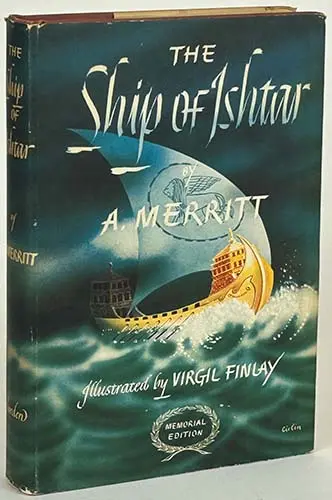
In the landscape of fantasy literature, few novels have achieved the cult status of A. Merritt’s The Ship of Ishtar, and few illustrated editions have captured the imagination quite like the 1949 Memorial Edition featuring the extraordinary art of Virgil Finlay. This volume represents a convergence of two masters—one of the pulp era’s most influential fantasy writers and one of its most revered illustrators—creating a work that remains a touchstone for collectors and admirers of speculative fiction.
Abraham Merritt (1884–1943) was a journalist and author whose fantasy novels shaped the genre in the early twentieth century . The Ship of Ishtar, first serialized in Argosy All-Story Weekly in 1924, tells the story of John Kenton, an archaeologist who receives an ancient Babylonian artifact containing a detailed model of a ship. When he touches it, he finds himself transported onto the deck of a full-sized vessel sailing an eternal sea . At one end of the ship stands Sharane, assistant priestess of the goddess Ishtar, with her female minions; at the other end stands Klaneth, assistant priest of the god Nergal, with his male warriors. For six thousand years, they have been frozen in conflict, unable to cross the invisible barrier at the ship’s midline—until Kenton arrives, and his presence destabilizes everything.
The 1949 Memorial Edition, published by Borden Publishing Company in Los Angeles, was conceived as the definitive version of Merritt’s novel. It restored the complete text from the original 1924 serial, correcting the abridgments that had appeared in the 1926 Putnam edition. The publisher commissioned Virgil Finlay (1914–1971), one of the most celebrated illustrators in the history of pulp fantasy, to create new artwork for the volume .
Finlay’s career was legendary. Known for his painstaking pen-and-ink work, he specialized in techniques such as stippling, cross-hatching, and scratchboard—methods so labor-intensive that each illustration could take days or weeks to complete . Yet despite the demands of his craft, Finlay produced more than 2,600 works of graphic art over his 35-year career, becoming one of the most influential illustrators in science fiction and fantasy . He was inducted into the Science Fiction Hall of Fame in 2012.
For The Ship of Ishtar, Finlay created five full-page black-and-white illustrations that stand among his finest work. His style was perfectly suited to Merritt’s tale of ancient gods and eternal conflict: the intricate cross-hatching creates textures of stone and shadow; the meticulous stippling evokes the shimmer of the eternal sea; the dramatic compositions capture the tension between Ishtar’s light and Nergal’s darkness. Contemporary reviewers praised his “superlative” conception and execution, noting that despite a minor error in the number of oars depicted, his illustrations were so masterful that the mistake was easily forgiven .
The 1949 edition itself was a handsome production. Bound in red cloth, it featured a striking dust jacket designed by Edgard Cirlin, with a biographical essay on Merritt by Forrest J. Ackerman on the reverse . The text was meticulously proofread, correcting chronological errors from earlier editions . It was a fitting tribute to an author who had died six years earlier, and a celebration of an artist whose work defined the visual imagination of pulp fantasy.
Today, first editions of the 1949 Memorial Ship of Ishtar are prized by collectors. The combination of Merritt’s classic text, Finlay’s peerless illustrations, and the book’s significance as the definitive version of the novel makes it a cornerstone of any fantasy collection. For those fortunate enough to own a copy, the volume offers a journey—a passage across the eternal sea, into a world where gods and mortals collide, and where Virgil Finlay’s extraordinary art brings the conflict to vivid life.
Recommended for Collectors and Fans:
- A Voyage to Arcturus by David Lindsay, illustrated by Bob Pepper or found in illustrated specialty editions – A surreal philosophical space fantasy, often compared to Merritt’s cosmic themes.
- The King of Elfland’s Daughter by Lord Dunsany, illustrated by Sime or found in deluxe editions – A poetic fantasy tale with mythic resonance and lush language, a spiritual cousin to Merritt’s lyrical style.
- The Moon Pool by A. Merritt, also illustrated in various editions – Another of Merritt’s exotic adventures, featuring a blend of lost civilizations, cosmic mystery, and richly imagined otherworlds.
Art Gallery: Virgil Finlay – The Ship of Ishtar 1949