The Book of Goblin: W.R. Titterton’s Chaos, Illustrated by Heath Robinson
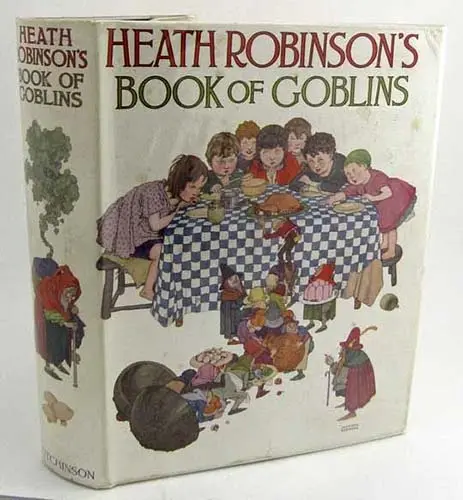
There exists a peculiar corner of English literature where nonsense logic meets mechanical madness, and at its heart sits a forgotten gem: The Book of Goblin, written by W.R. Titterton and illustrated by the incomparable William Heath Robinson. Published in 1934, this volume is a rambunctious, playful, and gloriously chaotic journey into a world ruled by mischievous little folk—goblins who care nothing for human order, reason, or politeness.
Unlike the gentle fairy tales of Victorian nurseries, The Book of Goblin is loud, rude, and wonderfully absurd. Titterton’s prose bounces along with a tongue-in-cheek energy, describing a race of creatures who live under hills and inside hollow trees, emerging only to untie shoelaces, hide spectacles, and generally make a nuisance of themselves. These are not malevolent spirits; they are anarchists of the household, tiny agents of delightful disorder. The book celebrates the small, infuriating mysteries of daily life—the missing key, the tipped-over inkpot, the inexplicable creak on the stairs—and blames them all on goblins with the utmost sincerity.
But the true star of this volume is its illustrator. Heath Robinson, a name that became synonymous in Britain with absurdly overcomplicated contraptions, was the perfect visual partner for Titterton’s chaotic vision. By the time The Book of Goblin appeared, Robinson had already established his signature style: intricate pen-and-ink drawings that combine a draftsman’s precision with a comedian’s soul. His goblins are not the cute, sparkling fairies of popular imagination. They are scrawny, pointy-nosed, long-limbed little horrors with tufts of hair and expressions of pure mischief. They look like wind-up toys designed by a lunatic engineer—all levers, pulleys, and improbable joints.
What makes The Book of Goblin endure, even as a rarity, is its celebration of imperfection. In an age of tidiness and efficiency, Titterton and Robinson remind us that the best moments in life are often the unplanned ones—the spilled milk, the lost button, the unexpected noise in the dark. Their goblins are not enemies; they are secret collaborators in the great comedy of existence. To find a copy of this book is to discover a treasure of British whimsy, a reminder that sometimes the smallest troublemakers leave the biggest smiles.
Heath Robinson Book of Goblins (1934) is a whimsical and imaginative collection of stories, fables, and folk-inspired tales centered around goblins, imps, and mischievous sprites. Though not attributed to a single author, the stories draw on European folklore traditions, creating an anthology that delights in the strange and humorous nature of the goblin world. This edition is notable not only for its fantastical content but also for the delightful illustrations by the famed British artist W. Heath Robinson.
In The Book of Goblins, Robinson’s illustrations are central to the book’s charm. His goblins are expressive, quirky, and full of character—ranging from delightfully grotesque to comically absurd. These drawings perfectly match the mischievous tone of the stories, making the book a visual and literary delight for both children and adult lovers of fairy tales and folklore.
This title is a treasure for collectors of fantastical illustration, especially those who appreciate Robinson’s unique blend of fantasy and humor.
Recommended for collectors:
- Irish Fairy Tales (1920), illustrated by Arthur Rackham – Mythical stories steeped in Celtic magic with evocative, moody illustrations.
- Grimm’s Fairy Tales (1907), illustrated by Arthur Rackham – A darker, richly illustrated collection of classic fairy lore.
- The Water-Babies (1915 edition), illustrated by W. Heath Robinson – Another showcase of Robinson’s talent in fantastical children’s literature.
W. Heath Robinson – The Book of Goblins, 1934