A Modern Chaucer: Warwick Goble’s Illustrated Masterpiece of 1912
In the early years of the twentieth century, a remarkable publishing venture sought to make Geoffrey Chaucer’s medieval masterpieces accessible to a new generation. The Complete Poetical Works of Geoffrey Chaucer, published by Macmillan in 1912 and translated into modern English by John S.P. Tatlock and Percy MacKaye, represented a bold effort to bridge the gap between the fourteenth century and the Edwardian present. And bringing this vision to life with extraordinary visual richness was the illustrator Warwick Goble, whose thirty-two color plates transformed Chaucer’s pilgrims, knights, and lovers into figures of timeless enchantment .
Warwick Goble (1862–1943) was a British illustrator whose career had been building toward this moment. Trained at the City of London School and the Westminster School of Art, he had worked for magazines like The Strand and Pearson’s and had illustrated H.G. Wells’s The War of the Worlds in 1897 . By 1909, he had become Macmillan’s resident gift book illustrator, producing acclaimed editions of The Water Babies and Green Willow and Other Japanese Fairy Tales . The Chaucer commission would become one of the crowning achievements of his career.
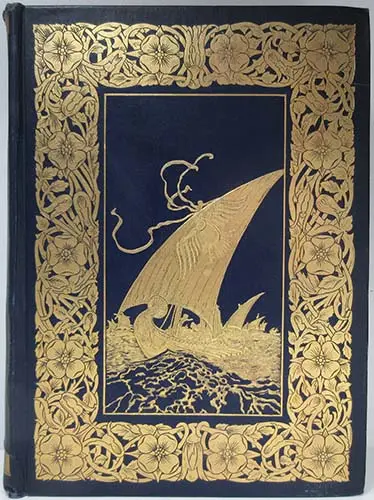
The 1912 edition was a lavish production befitting its literary significance. Bound in navy blue cloth with gilt vignette decorations on the cover and spine, top edge gilt and illustrated endpapers that set the tone from the moment the book was opened. Inside, readers discovered thirty-two color plates, each mounted on heavy paper and protected by captioned tissue guards, alongside the translated text of Chaucer’s complete poetical works—The Canterbury Tales, Troilus and Criseyde, The Book of the Duchess, The Legend of Good Women, The House of Fame, and the minor poems .
What distinguishes Goble’s illustrations for this volume is their extraordinary range. The diversity of Chaucer’s works gave the artist an opportunity to employ different styles, moving fluidly between the ethereal and the earthly, the romantic and the comic . His illustrations for The Squire’s Tale, a story of magic and chivalry set in the East, are rendered with the Orientalist sensibility that Goble had honed in his Japanese fairy-tale work—sinuous lines, rich patterns, a palette of deep blues and golds that evokes the exotic setting .
For The Canterbury Tales, Goble’s pilgrims come alive with a vividness that matches Chaucer’s own characterizations. The Knight rides forth in armor that reflects Goble’s attention to historical detail; the Wife of Bath is rendered with a boldness that captures her spirited nature; the Miller, the Prioress, the Summoner—each receives a visual interpretation that honors the original while making it accessible to modern readers. The landscapes, too, are varied: the road to Canterbury stretches across sun-dappled English countryside; the courtly scenes shimmer with the colors of medieval romance; the darker tales are rendered with an atmospheric depth that reflects their moral weight.
Goble’s technique in this volume reflects his mastery of watercolor and his sensitivity to the requirements of color reproduction. His palette is rich yet restrained—warm earth tones for the pilgrim scenes, jewel-like colors for the romantic tales, muted grays and blues for the moments of tragedy. The compositions are carefully balanced, each plate functioning both as a complete work of art and as an integral part of the narrative flow.
The critical response to Goble’s Chaucer was positive, and the book quickly found its place in libraries and collections. The volume has been described by rare book dealers as containing “wonderfully atmospheric illustrations, from ethereal glades peopled with fairy inhabitants to maritime adventure, the diversity of the pilgrim’s tales giving the artist an opportunity to employ different styles, all accompanied by his exceptional use of colour” .
Today, first editions of Goble’s Chaucer are cherished by collectors. For those fortunate enough to own a copy, the book offers a double pleasure: the chance to encounter Chaucer’s timeless works in a form that honors their literary significance, and the opportunity to experience Warwick Goble’s art at its most ambitious and accomplished.
In the pages of this book, Chaucer’s pilgrims still ride toward Canterbury; Troilus still loves Criseyde; the Knight still tells his tale of chivalry. And Warwick Goble, with his palette and his brush, gave them a visual language that bridges the centuries—a reminder that the greatest illustrated books, like the greatest poetry, have the power to speak across time, to make the old new again, and to enchant generation after generation.
Recommended for Collectors:
- The Faerie Queene by Edmund Spenser, illustrated by Walter Crane – A richly illustrated epic poem blending myth, allegory, and Elizabethan verse, ideal for lovers of classical poetry and ornate design.
- The Canterbury Tales by Geoffrey Chaucer, illustrated by W. Russell Flint – Another visual interpretation of Chaucer’s masterpiece, featuring elegant, evocative plates in a style distinct from Goble’s.
- Idylls of the King by Alfred, Lord Tennyson, illustrated by Gustave Doré or E.J. Sullivan – A grand poetic cycle with legendary and medieval themes, often presented in collectible editions with fine illustration.
- • The Kelmscott Chaucer by William Morris, illustrated by Edward Burne-Jones – Arguably the most visually stunning designed and illustrated book
For a list of illustrations by Warwick Goble available on our site. Please visit our Warwick Goble Illustrated Books Art Gallery.
Art Gallery: Warwick Goble – The Modern Reader’s Chaucer 1912
![Warwick Goble - The Modern Reader's Chaucer [goble-chaucer01] (art, illustrations)](https://www.nocloo.com/wp-content/plugins/justified-image-grid/timthumb.php?src=https%3A%2F%2Fwww.nocloo.com%2Fart%2Fgoble-chaucer%2Fgoble-chaucer01.jpg&h=280&q=90&f=.jpg "Warwick Goble - Illustrations from The Poetical Works of Geoffrey Chaucer 1912")
![Warwick Goble - The Modern Reader's Chaucer [goble-chaucer02] (art, illustrations)](https://www.nocloo.com/wp-content/plugins/justified-image-grid/timthumb.php?src=https%3A%2F%2Fwww.nocloo.com%2Fart%2Fgoble-chaucer%2Fgoble-chaucer02.jpg&h=280&q=90&f=.jpg "Warwick Goble - Illustrations from The Poetical Works of Geoffrey Chaucer 1912")
![Warwick Goble - The Modern Reader's Chaucer [goble-chaucer03] (art, illustrations)](https://www.nocloo.com/wp-content/plugins/justified-image-grid/timthumb.php?src=https%3A%2F%2Fwww.nocloo.com%2Fart%2Fgoble-chaucer%2Fgoble-chaucer03.jpg&h=280&q=90&f=.jpg "Warwick Goble - Illustrations from The Poetical Works of Geoffrey Chaucer 1912")
![Warwick Goble - The Modern Reader's Chaucer [goble-chaucer04] (art, illustrations)](https://www.nocloo.com/wp-content/plugins/justified-image-grid/timthumb.php?src=https%3A%2F%2Fwww.nocloo.com%2Fart%2Fgoble-chaucer%2Fgoble-chaucer04.jpg&h=280&q=90&f=.jpg "Warwick Goble - Illustrations from The Poetical Works of Geoffrey Chaucer 1912")
![Warwick Goble - The Modern Reader's Chaucer [goble-chaucer05] (art, illustrations)](https://www.nocloo.com/wp-content/plugins/justified-image-grid/timthumb.php?src=https%3A%2F%2Fwww.nocloo.com%2Fart%2Fgoble-chaucer%2Fgoble-chaucer05.jpg&h=280&q=90&f=.jpg "Warwick Goble - Illustrations from The Poetical Works of Geoffrey Chaucer 1912")
![Warwick Goble - The Modern Reader's Chaucer [goble-chaucer06] (art, illustrations)](https://www.nocloo.com/wp-content/plugins/justified-image-grid/timthumb.php?src=https%3A%2F%2Fwww.nocloo.com%2Fart%2Fgoble-chaucer%2Fgoble-chaucer06.jpg&h=280&q=90&f=.jpg "Warwick Goble - Illustrations from The Poetical Works of Geoffrey Chaucer 1912")
![Warwick Goble - The Modern Reader's Chaucer [goble-chaucer07] (art, illustrations)](https://www.nocloo.com/wp-content/plugins/justified-image-grid/timthumb.php?src=https%3A%2F%2Fwww.nocloo.com%2Fart%2Fgoble-chaucer%2Fgoble-chaucer07.jpg&h=280&q=90&f=.jpg "Warwick Goble - Illustrations from The Poetical Works of Geoffrey Chaucer 1912")
![Warwick Goble - The Modern Reader's Chaucer [goble-chaucer08] (art, illustrations)](https://www.nocloo.com/wp-content/plugins/justified-image-grid/timthumb.php?src=https%3A%2F%2Fwww.nocloo.com%2Fart%2Fgoble-chaucer%2Fgoble-chaucer08.jpg&h=280&q=90&f=.jpg "Warwick Goble - Illustrations from The Poetical Works of Geoffrey Chaucer 1912")
![Warwick Goble - The Modern Reader's Chaucer [goble-chaucer09] (art, illustrations)](https://www.nocloo.com/wp-content/plugins/justified-image-grid/timthumb.php?src=https%3A%2F%2Fwww.nocloo.com%2Fart%2Fgoble-chaucer%2Fgoble-chaucer09.jpg&h=280&q=90&f=.jpg "Warwick Goble - Illustrations from The Poetical Works of Geoffrey Chaucer 1912")
![Warwick Goble - The Modern Reader's Chaucer [goble-chaucer10] (art, illustrations)](https://www.nocloo.com/wp-content/plugins/justified-image-grid/timthumb.php?src=https%3A%2F%2Fwww.nocloo.com%2Fart%2Fgoble-chaucer%2Fgoble-chaucer10.jpg&h=280&q=90&f=.jpg "Warwick Goble - Illustrations from The Poetical Works of Geoffrey Chaucer 1912")
![Warwick Goble - The Modern Reader's Chaucer [goble-chaucer11] (art, illustrations)](https://www.nocloo.com/wp-content/plugins/justified-image-grid/timthumb.php?src=https%3A%2F%2Fwww.nocloo.com%2Fart%2Fgoble-chaucer%2Fgoble-chaucer11.jpg&h=280&q=90&f=.jpg "Warwick Goble - Illustrations from The Poetical Works of Geoffrey Chaucer 1912")
![Warwick Goble - The Modern Reader's Chaucer [goble-chaucer12] (art, illustrations)](https://www.nocloo.com/wp-content/plugins/justified-image-grid/timthumb.php?src=https%3A%2F%2Fwww.nocloo.com%2Fart%2Fgoble-chaucer%2Fgoble-chaucer12.jpg&h=280&q=90&f=.jpg "Warwick Goble - Illustrations from The Poetical Works of Geoffrey Chaucer 1912")
![Warwick Goble - The Modern Reader's Chaucer [goble-chaucer13] (art, illustrations)](https://www.nocloo.com/wp-content/plugins/justified-image-grid/timthumb.php?src=https%3A%2F%2Fwww.nocloo.com%2Fart%2Fgoble-chaucer%2Fgoble-chaucer13.jpg&h=280&q=90&f=.jpg "Warwick Goble - Illustrations from The Poetical Works of Geoffrey Chaucer 1912")
![Warwick Goble - The Modern Reader's Chaucer [goble-chaucer14] (art, illustrations)](https://www.nocloo.com/wp-content/plugins/justified-image-grid/timthumb.php?src=https%3A%2F%2Fwww.nocloo.com%2Fart%2Fgoble-chaucer%2Fgoble-chaucer14.jpg&h=280&q=90&f=.jpg "Warwick Goble - Illustrations from The Poetical Works of Geoffrey Chaucer 1912")
![Warwick Goble - The Modern Reader's Chaucer [goble-chaucer15] (art, illustrations)](https://www.nocloo.com/wp-content/plugins/justified-image-grid/timthumb.php?src=https%3A%2F%2Fwww.nocloo.com%2Fart%2Fgoble-chaucer%2Fgoble-chaucer15.jpg&h=280&q=90&f=.jpg "Warwick Goble - Illustrations from The Poetical Works of Geoffrey Chaucer 1912")
![Warwick Goble - The Modern Reader's Chaucer [goble-chaucer16] (art, illustrations)](https://www.nocloo.com/wp-content/plugins/justified-image-grid/timthumb.php?src=https%3A%2F%2Fwww.nocloo.com%2Fart%2Fgoble-chaucer%2Fgoble-chaucer16.jpg&h=280&q=90&f=.jpg "Warwick Goble - Illustrations from The Poetical Works of Geoffrey Chaucer 1912")
![Warwick Goble - The Modern Reader's Chaucer [goble-chaucer17] (art, illustrations)](https://www.nocloo.com/wp-content/plugins/justified-image-grid/timthumb.php?src=https%3A%2F%2Fwww.nocloo.com%2Fart%2Fgoble-chaucer%2Fgoble-chaucer17.jpg&h=280&q=90&f=.jpg "Warwick Goble - Illustrations from The Poetical Works of Geoffrey Chaucer 1912")
![Warwick Goble - The Modern Reader's Chaucer [goble-chaucer18] (art, illustrations)](https://www.nocloo.com/wp-content/plugins/justified-image-grid/timthumb.php?src=https%3A%2F%2Fwww.nocloo.com%2Fart%2Fgoble-chaucer%2Fgoble-chaucer18.jpg&h=280&q=90&f=.jpg "Warwick Goble - Illustrations from The Poetical Works of Geoffrey Chaucer 1912")
![Warwick Goble - The Modern Reader's Chaucer [goble-chaucer19] (art, illustrations)](https://www.nocloo.com/wp-content/plugins/justified-image-grid/timthumb.php?src=https%3A%2F%2Fwww.nocloo.com%2Fart%2Fgoble-chaucer%2Fgoble-chaucer19.jpg&h=280&q=90&f=.jpg "Warwick Goble - Illustrations from The Poetical Works of Geoffrey Chaucer 1912")
![Warwick Goble - The Modern Reader's Chaucer [goble-chaucer20] (art, illustrations)](https://www.nocloo.com/wp-content/plugins/justified-image-grid/timthumb.php?src=https%3A%2F%2Fwww.nocloo.com%2Fart%2Fgoble-chaucer%2Fgoble-chaucer20.jpg&h=280&q=90&f=.jpg "Warwick Goble - Illustrations from The Poetical Works of Geoffrey Chaucer 1912")
![Warwick Goble - The Modern Reader's Chaucer [goble-chaucer21] (art, illustrations)](https://www.nocloo.com/wp-content/plugins/justified-image-grid/timthumb.php?src=https%3A%2F%2Fwww.nocloo.com%2Fart%2Fgoble-chaucer%2Fgoble-chaucer21.jpg&h=280&q=90&f=.jpg "Warwick Goble - Illustrations from The Poetical Works of Geoffrey Chaucer 1912")
![Warwick Goble - The Modern Reader's Chaucer [goble-chaucer22] (art, illustrations)](https://www.nocloo.com/wp-content/plugins/justified-image-grid/timthumb.php?src=https%3A%2F%2Fwww.nocloo.com%2Fart%2Fgoble-chaucer%2Fgoble-chaucer22.jpg&h=280&q=90&f=.jpg "Warwick Goble - Illustrations from The Poetical Works of Geoffrey Chaucer 1912")
![Warwick Goble - The Modern Reader's Chaucer [goble-chaucer23] (art, illustrations)](https://www.nocloo.com/wp-content/plugins/justified-image-grid/timthumb.php?src=https%3A%2F%2Fwww.nocloo.com%2Fart%2Fgoble-chaucer%2Fgoble-chaucer23.jpg&h=280&q=90&f=.jpg "Warwick Goble - Illustrations from The Poetical Works of Geoffrey Chaucer 1912")
![Warwick Goble - The Modern Reader's Chaucer [goble-chaucer24] (art, illustrations)](https://www.nocloo.com/wp-content/plugins/justified-image-grid/timthumb.php?src=https%3A%2F%2Fwww.nocloo.com%2Fart%2Fgoble-chaucer%2Fgoble-chaucer24.jpg&h=280&q=90&f=.jpg "Warwick Goble - Illustrations from The Poetical Works of Geoffrey Chaucer 1912")
![Warwick Goble - The Modern Reader's Chaucer [goble-chaucer25] (art, illustrations)](https://www.nocloo.com/wp-content/plugins/justified-image-grid/timthumb.php?src=https%3A%2F%2Fwww.nocloo.com%2Fart%2Fgoble-chaucer%2Fgoble-chaucer25.jpg&h=280&q=90&f=.jpg "Warwick Goble - Illustrations from The Poetical Works of Geoffrey Chaucer 1912")
![Warwick Goble - The Modern Reader's Chaucer [goble-chaucer26] (art, illustrations)](https://www.nocloo.com/wp-content/plugins/justified-image-grid/timthumb.php?src=https%3A%2F%2Fwww.nocloo.com%2Fart%2Fgoble-chaucer%2Fgoble-chaucer26.jpg&h=280&q=90&f=.jpg "Warwick Goble - Illustrations from The Poetical Works of Geoffrey Chaucer 1912")
![Warwick Goble - The Modern Reader's Chaucer [goble-chaucer27] (art, illustrations)](https://www.nocloo.com/wp-content/plugins/justified-image-grid/timthumb.php?src=https%3A%2F%2Fwww.nocloo.com%2Fart%2Fgoble-chaucer%2Fgoble-chaucer27.jpg&h=280&q=90&f=.jpg "Warwick Goble - Illustrations from The Poetical Works of Geoffrey Chaucer 1912")
![Warwick Goble - The Modern Reader's Chaucer [goble-chaucer28] (art, illustrations)](https://www.nocloo.com/wp-content/plugins/justified-image-grid/timthumb.php?src=https%3A%2F%2Fwww.nocloo.com%2Fart%2Fgoble-chaucer%2Fgoble-chaucer28.jpg&h=280&q=90&f=.jpg "Warwick Goble - Illustrations from The Poetical Works of Geoffrey Chaucer 1912")
![Warwick Goble - The Modern Reader's Chaucer [goble-chaucer29] (art, illustrations)](https://www.nocloo.com/wp-content/plugins/justified-image-grid/timthumb.php?src=https%3A%2F%2Fwww.nocloo.com%2Fart%2Fgoble-chaucer%2Fgoble-chaucer29.jpg&h=280&q=90&f=.jpg "Warwick Goble - Illustrations from The Poetical Works of Geoffrey Chaucer 1912")
![Warwick Goble - The Modern Reader's Chaucer [goble-chaucer30] (art, illustrations)](https://www.nocloo.com/wp-content/plugins/justified-image-grid/timthumb.php?src=https%3A%2F%2Fwww.nocloo.com%2Fart%2Fgoble-chaucer%2Fgoble-chaucer30.jpg&h=280&q=90&f=.jpg "Warwick Goble - Illustrations from The Poetical Works of Geoffrey Chaucer 1912")
![Warwick Goble - The Modern Reader's Chaucer [goble-chaucer31] (art, illustrations)](https://www.nocloo.com/wp-content/plugins/justified-image-grid/timthumb.php?src=https%3A%2F%2Fwww.nocloo.com%2Fart%2Fgoble-chaucer%2Fgoble-chaucer31.jpg&h=280&q=90&f=.jpg "Warwick Goble - Illustrations from The Poetical Works of Geoffrey Chaucer 1912")
![Warwick Goble - The Modern Reader's Chaucer [goble-chaucer32] (art, illustrations)](https://www.nocloo.com/wp-content/plugins/justified-image-grid/timthumb.php?src=https%3A%2F%2Fwww.nocloo.com%2Fart%2Fgoble-chaucer%2Fgoble-chaucer32.jpg&h=280&q=90&f=.jpg "Warwick Goble - Illustrations from The Poetical Works of Geoffrey Chaucer 1912")