Three Visions: William Heath Robinson’s Andersen’s Fairy Tales
When we think of William Heath Robinson today, we most often think of the “gadget king”—the artist whose name became synonymous with absurdly complicated contraptions, those wonderfully whimsical machines that accomplish simple tasks through the most elaborate means imaginable . Yet before he earned that reputation, Robinson was one of the most accomplished illustrators of fairy tales of his era, and his engagement with Hans Christian Andersen’s work spanned nearly four decades and three distinct editions—each a testament to his evolving artistry.
Robinson (1872–1944) came from remarkable artistic stock. He was one of three Robinson brothers—Charles, Thomas, and William—who all became illustrators, and his ambition was initially to become a landscape painter. Fate, however, guided him toward book illustration, and his career took flight with his first major commission: an 1897 edition of Danish Fairy Tales and Legends, published by Bliss, Sands & Co. . This volume, now exceedingly rare, marked Robinson’s debut in the field that would bring him lasting fame. His early style already showed the precision and imagination that would characterize his work, though the dark, detailed illustrations of this period would evolve considerably in the years to come.
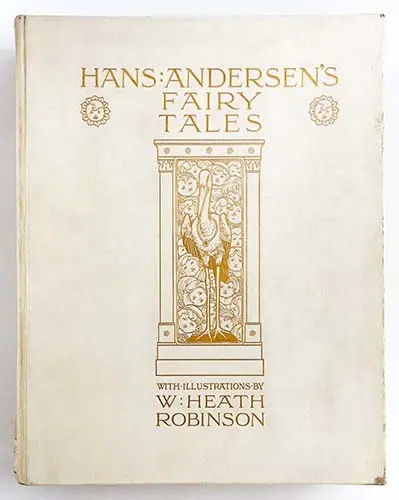
The edition that cemented Robinson’s reputation, however, appeared in 1913. Published by Constable & Co. in London, this collected edition of Hans Andersen’s Fairy Tales was a lavish production befitting the status of both author and artist . The volume contained seventeen of Andersen’s most beloved tales, including “The Snow Queen,” “The Little Mermaid,” “The Ugly Duckling,” “The Emperor’s New Clothes,” and “The Swineherd”. It was illustrated with sixteen full-page color plates, each mounted on heavy paper and protected by captioned tissue guards, along with an astonishing eighty-eight black-and-white illustrations woven throughout the text . The book was issued in both trade and limited editions—the latter comprising only one hundred signed copies bound in vellum, a testament to the publisher’s confidence in Robinson’s work.
What distinguishes Robinson’s 1913 illustrations is their range. He could render the ethereal beauty of “The Little Mermaid” with the same skill as the comic chaos of “The Flying Trunk”—the latter illustrated in a later edition with a scene of slippers flying about startled ears that captures Andersen’s playful absurdity. His work in this period has been ranked alongside that of Arthur Rackham and Edmund Dulac, the titans of the Golden Age of Illustration. Yet Robinson’s sensibility was distinct: a blend of decorative elegance and subtle wit that made his fairy-tale illustrations both beautiful and quietly humorous.
The 1913 Constable edition remains the high point of Robinson’s Andersen work. It appeared at a moment when the illustrated gift book was at its zenith, and it stands as a monument to the artistry of that era. The book is now a prized collectible—first editions in fine condition, especially the signed vellum copies, are increasingly scarce and highly sought after.
In the pages of this book, Robinson’s vision of Andersen endures: the Snow Queen in her frozen palace, the little mermaid rising from the sea, the ugly duckling gazing at his reflection. These are images that capture not merely the events of the stories but their emotional depth—the longing, the transformation, the quiet hope that runs through Andersen’s work. For those who encounter them, Robinson’s illustrations offer a reminder that the greatest fairy-tale art does not merely accompany the text but illuminates it, finding in the familiar tales something new, something surprising, something that lingers long after the book is closed.
Recommended for Collectors
- The Water Babies (1915) illustrated by W. Heath Robinson – Another example of his ethereal fantasy style
- Andersen’s Fairy Tales (1916) illustrated by Harry Clarke – For a darker, more Gothic interpretation
- Fairy Tales of the Brothers Grimm (1909) illustrated by Arthur Rackham – A classic collection brought to life with eerie and expressive illustrations.
- Hans Andersen’s Fairy Tales (1911), illustrated by Edmund Dulac – A luxurious edition of Andersen tales with Dulac’s dreamlike, jewel-toned images.
Art Gallery: W. Heath Robinson – Andersen’s Fairy Tales 1913