A Golden Age Masterpiece: Edmund Dulac’s Stories from Hans Andersen
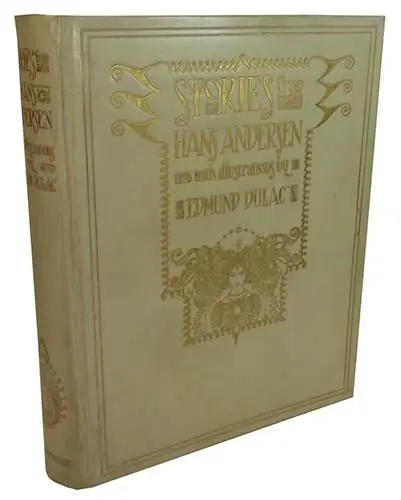
When Edmund Dulac turned his attention to the fairy tales of Hans Christian Andersen in 1911, the Golden Age of Illustration was at its zenith. Arthur Rackham had already produced his celebrated editions of Rip Van Winkle and Alice, and Dulac himself had dazzled the public with his Arabian Nights and The Rubáiyát of Omar Khayyám. Yet his Stories from Hans Andersen, published by Hodder & Stoughton in London, stands as one of the crowning achievements of his career—a volume that captures the melancholy beauty, the quiet wonder, and the profound humanity of the Danish master’s tales .
Edmund Dulac (1882–1953) was born in Toulouse, France, but made his name in London, where he arrived in the early 1900s and quickly established himself as one of the most sought-after illustrators of his era . His style was a distinctive synthesis of influences: the decorative elegance of Art Nouveau, the rich color traditions of Persian miniature painting, and a theatrical sensibility that gave his compositions a sense of drama and depth. By 1911, he had perfected a technique of layered watercolor washes that produced images of extraordinary luminosity—a quality perfectly suited to Andersen’s tales of mermaids, snow queens, and nightingales.
The 1911 edition was a lavish production befitting its status. The large quarto volume, measuring approximately 29 centimeters in height—with elaborate gilt decorations on the spine and front cover. Inside, readers discovered twenty-eight mounted color plates, each tipped onto heavy paper and protected by captioned tissue guards. The text was printed within double borders, with decorative panels at the top and bottom of each page and headpieces at the beginning of each chapter—a total design approach that made every opening a visual experience. The illustrations were printed by Henry Stone & Son, using techniques that preserved the subtle gradations of Dulac’s watercolors.
The tales selected for this volume represented some of Andersen’s most beloved—and most haunting—works. The collection included “The Snow Queen,” “The Nightingale,” “The Real Princess” (the princess and the pea), “The Garden of Paradise,” “The Little Mermaid,” “The Emperor’s New Clothes,” and “The Wind’s Tale” . Each story received Dulac’s full attention, and the resulting illustrations rank among the most beautiful of his career.
What distinguishes Dulac’s Andersen is his ability to capture the emotional complexity of the tales. His palette shifts to match the mood of each story: the icy blues and whites of “The Snow Queen,” the warm golds and greens of “The Nightingale,” the cool, watery tones of “The Little Mermaid.” His figures possess an idealized grace, yet there is a psychological depth to his characterizations that brings Andersen’s creations to life. The Little Mermaid’s longing, the Snow Queen’s cold beauty, the Emperor’s foolish vanity—all are rendered with a sensitivity that matches the text.
The book was issued in multiple formats. A limited edition of 750 copies was signed by Dulac, bound in vellum, and printed on superior paper. The trade edition, while more modest, was itself a handsome production that found its way into libraries and homes across Britain and America. An American edition was published by George H. Doran in 1923, though with fewer plates than the original British edition. The 1911 first edition remains the most desirables .
Today, Dulac’s Stories from Hans Andersen stands as a testament to the heights achieved by the illustrated book in the early twentieth century. It is a volume that does not merely accompany Andersen’s text but illuminates it, finding in the Danish storyteller’s blend of wonder and melancholy a perfect counterpart in Dulac’s luminous art. In its pages, the Snow Queen still reigns in her frozen palace, the Little Mermaid still longs for an immortal soul, and the Nightingale still sings for the Emperor—each rendered with a beauty that has not faded in more than a century. It is a treasure of the Golden Age, and for collectors and lovers of fairy tales, an enduring delight.
Recommended for Collectors
- The Sleeping Beauty and Other Fairy Tales (1910), illustrated by Edmund Dulac – Lavishly illustrated French fairy tales with Dulac’s romantic flair.
- Andersen’s Fairy Tales (1916) illustrated by Harry Clarke – For a darker, more Gothic interpretation
- The Fairy Tales of the Brothers Grimm (1909) illustrated by Arthur Rackham – A complementary classic of the Golden Age illustration
Other books illustrated by Edmund Dulac available to view at our gallery: Stories from the Arabian Nights, Lyrics, Pathetic and Humourous from A to Z, The Rubaiyat of Omar Khayyam, The Sleeping Beauty, The Bells, and other poems, Princess Badoura, Sindbad the Sailor and other stories and The Kingdom of the Pearl.
- Complete list of books illustrated by Edmund Dulac.
- Our Edmund Dulac Art Gallery
Art Gallery: Edmund Dulac – Illustrations from Hans Andersen’s Fairy Tales 1911