A Symphony of Shadows: Edmund Dulac’s The Bells and Other Poems
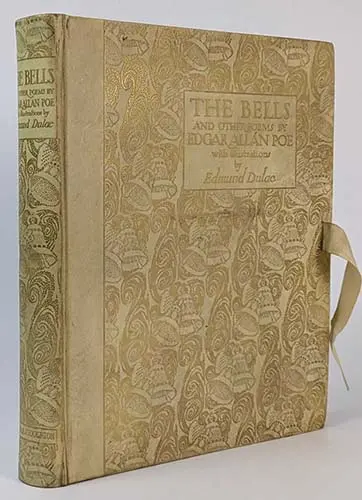
Limited Edition
In the winter of 1912, a remarkable volume appeared that would stand as one of the most haunting achievements of Edmund Dulac’s career. The Bells and Other Poems, published by Hodder & Stoughton in London, brought together the darkly lyrical verse of Edgar Allan Poe with the luminous artistry of one of the Golden Age’s greatest illustrators. It was a collaboration of singular power—a meeting of two artists, separated by a continent and a generation, united by a shared fascination with the macabre, the beautiful, and the strange.
Edmund Dulac (1882–1953) was, by 1912, already celebrated for his Arabian Nights, The Rubáiyát of Omar Khayyám, and his Stories from Hans Andersen. His style—a synthesis of Persian miniature influences, Art Nouveau elegance, and a theatrical sense of composition—had established him as one of the premier illustrators of the Edwardian era. Yet The Bells revealed a new dimension of his talent: a willingness to explore the darker currents of the imagination, to render not only beauty but dread.
The volume was a lavish production, issued in both trade and limited editions. The binding was in green cloth with gilt stamping—a somber canvas that hinted at the contents within. Inside, readers discovered twenty-eight tipped-in color plates, each mounted on heavy paper and protected by captioned tissue guards. The plates were among the most extensive Dulac ever produced for a single volume, and they represented some of the most extraordinary work of his career.
The poems selected for this edition included Poe’s most celebrated works: “The Bells,” “The Raven,” “Ulalume,” “Annabel Lee,” “The Haunted Palace,” and others. Each presented Dulac with a distinct challenge—to render in visual form the musical rhythms, the psychological intensity, and the supernatural atmosphere of Poe’s verse.
Dulac’s illustrations for “The Bells” are a study in atmospheric progression. The silver bells of the poem’s opening are rendered in soft golds and silvers, a vision of sleigh-ride merriment. The golden wedding bells follow in warmer tones. But as the poem descends into the “brazen” and “iron” bells—bells of alarm, bells of mourning—Dulac’s palette darkens, his compositions grow more turbulent, and the shadows deepen. It is a masterful visual translation of Poe’s onomatopoeic tour de force.
“The Raven” receives perhaps the most memorable treatment in the volume. Dulac’s raven is no mere bird but a presence—a creature of shadow and intellect, its feathers rendered in deep blues and blacks, its eye gleaming with an almost human intelligence. The chamber over which it presides is a study in Gothic elegance: velvet drapes, a bust of Pallas, the lamplight casting long shadows across the floor. Dulac’s scholar, collapsed in his chair, is a figure of exhausted grief, rendered with a psychological depth that matches Poe’s verse.
“Ulalume” and “Annabel Lee” allowed Dulac to explore Poe’s more lyrical, elegiac register. The landscapes of these poems—the misty kingdom by the sea, the haunted region of Weir—are rendered in soft blues, greens, and silvers, creating an atmosphere of ethereal melancholy. His figures, with their elongated grace and distant expressions, seem suspended between the world of the living and the realm of memory.
The critical response to Dulac’s The Bells was enthusiastic. Reviewers praised his ability to capture “the very spirit of Poe” and his “extraordinary range” as an artist. The volume sold well and quickly became a collector’s treasure. It appeared at a moment when Dulac’s career was at its peak, and it remains one of the most sought-after of his works.
Today, first editions of The Bells and Other Poems are prized by collectors. The tipped-in color plates, the vellum binding, the limited print run—all contribute to a volume that embodies the heights of Golden Age bookmaking. For admirers of Dulac’s art, it represents a high point in his career, a work where his decorative elegance met the dark genius of Poe, and the result was a symphony of shadows, a masterpiece of the illustrated book.
In its pages, the bells still toll—silver, golden, brazen, iron. The raven still perches above the chamber door. Annabel Lee still lies in her kingdom by the sea. And Edmund Dulac, with his palette and his brush, gave them all a visual language of extraordinary power—a reminder that the greatest illustrations are those that not only accompany a text but illuminate it, finding in the shadows a beauty all their own.
For collectors:
• The Raven by Edgar Allan Poe, illustrated by Gustave Doré (1884) – The most famous 19th-century Poe illustrations
• Tales of Mystery and Imagination by Poe, illustrated by Harry Clarke (1919) – A darker Art Deco interpretation
• The Rubaiyat of Omar Khayyam illustrated by Dulac (1909) – Showcases his Persian-inspired styleNew chat
Other books illustrated by Edmund Dulac available in our gallery: Stories from the Arabian Nights, Lyrics, Pathetic and Humourous from A to Z, The Rubaiyat of Omar Khayyam, The Sleeping Beauty, Stories from Hans Andersen, Princess Badoura, Sindbad the Sailor and other stories, The Kingdom of the Pearl.
- Complete list of books illustrated by Edmund Dulac.
- Our Edmund Dulac Art Gallery
Art Gallery: Edmund Dulac – The Bells and other Poems 1912