A Tale of Two Lovers: Edmund Dulac’s Princess Badoura
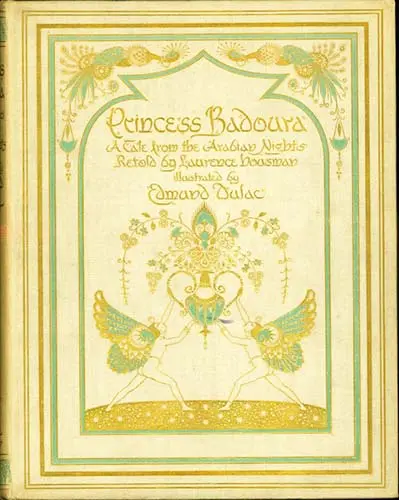
In the dazzling constellation of illustrated books that Edmund Dulac produced during his early years in London, the 1913 edition of Princess Badoura holds a special place. Taken from the Arabian Nights and retold by Laurence Housman, this volume showcases Dulac at the height of his powers—a master of Orientalist fantasy, a virtuoso of color and composition, and a storyteller in his own right, capable of rendering the complex emotions of love, longing, and transformation with exquisite sensitivity.
Laurence Housman (1865–1959), the brother of the poet A.E. Housman, was a prolific writer, playwright, and illustrator in his own right. His retelling of the story of Princess Badoura—taken from the cycle of tales surrounding Prince Camaralzaman—emphasized the tale’s romantic and psychological dimensions. The story follows two royal lovers separated by fate and magic: Princess Badoura of China and Prince Camaralzaman of the Isles, who fall in love through a portrait, endure separation and transformation, and finally find their way back to one another through trials of mistaken identity and the interventions of genies.
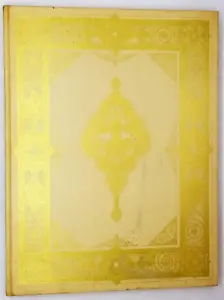
Edmund Dulac (1882–1953) had already illustrated the Arabian Nights in 1907, but Princess Badoura allowed him to focus his full attention on a single tale, to explore its emotional arc with a depth that a broader collection could not accommodate. The 1913 edition, published by Hodder & Stoughton in London, was a lavish production, issued in both trade and limited editions. The binding was in white cloth with gilt stamping—a pristine canvas for the rich colors within. Inside, readers discovered ten full-page color plates, each mounted on heavy paper and protected by captioned tissue guards, alongside numerous black-and-white illustrations and decorative elements woven throughout the text.
What distinguishes Dulac’s Princess Badoura is the emotional range of its illustrations. The opening plates capture the opulence of the royal courts of China and the Isles—a world of silk and gold, of ornate architecture and ceremonial grandeur. Yet as the story turns toward separation, Dulac’s palette shifts: the warm golds and crimsons give way to cool blues and greens, the bustling courts to empty landscapes. The scenes of Badoura’s transformation and her search for her lost love are rendered with a tenderness that captures the tale’s melancholy beauty.
The color plates are among the most exquisite Dulac ever produced. The illustration of Princess Badoura discovering the portrait of Camaralzaman is a study in quiet revelation—the princess in a gown of flowing silk, her face illuminated by the lamp as she gazes at the image of her unknown beloved. The scene of their first meeting, after the genies have transported them to the same bed, is rendered with a delicacy that honors the story’s romantic innocence. And the final plate—the lovers reunited, their kingdoms united, the genies blessing their union—is a vision of harmonious beauty, the colors warm and luminous, the composition balanced and serene.
Dulac’s technique in this volume reflects his mature style. His watercolors are built in layers, achieving a luminosity that seems to emanate from within. The influence of Persian miniatures is evident in the flattened perspectives and intricate patterning; the influence of the stage is evident in the theatrical compositions and dramatic lighting. Yet the total effect is entirely Dulac’s own—a synthesis of influences that yields something new and beautiful.
Today, Princess Badoura is among the most sought-after of Dulac’s works. The white cloth binding was notoriously fragile, and surviving copies in fine condition—with clean plates, intact tissue guards, and bright gilt—are increasingly scarce. For collectors, the volume represents a high point of the Golden Age of Illustration, a work where Dulac’s Orientalist fantasy and his romantic sensibility found perfect expression.
In the pages of this book, Princess Badoura still searches for her lost prince; Camaralzaman still dreams of his unknown love; the genies still intervene with their magic. And Edmund Dulac, with his palette and his brush, gave them a visual language of extraordinary beauty—a reminder that the greatest love stories, like the greatest illustrations, transcend time.
For collectors:
• Stories from the Arabian Nights (1907) illustrated by Dulac—his first major foray into Eastern themes
• The Arabian Nights (1924) illustrated by Edward J. Detmold—another magnificent visual interpretation of Eastern tales
Other books illustrated by Edmund Dulac available in our gallery: Stories from the Arabian Nights, Lyrics, Pathetic and Humourous from A to Z, The Rubaiyat of Omar Khayyam, The Sleeping Beauty, Stories from Hans Andersen, The Bells, and other poems, Sindbad the Sailor and other stories, The Kingdom of the Pearl.
- Complete list of books illustrated by Edmund Dulac.
- Our Edmund Dulac Art Gallery
Art Gallery: Edmund Dulac – Princess Badoura 1913