A Day in the Nursery: Anne Anderson’s The Rosie-Posie Book
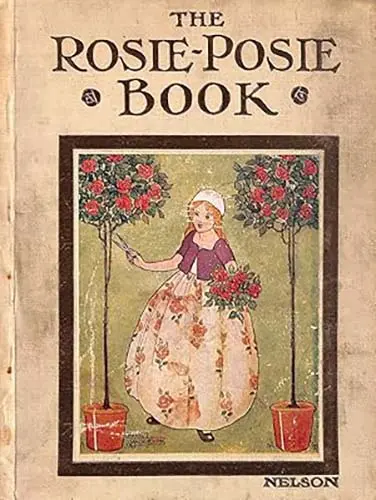
In the golden years of children’s book illustration, few artists captured the quiet magic of childhood with such consistent charm as the Scottish illustrator Anne Anderson. Her 1911 volume, The Rosie-Posie Book, published by Thomas Nelson & Sons in London, stands as a delightful example of her work—a slender collection of poems that follows two young sisters through the gentle rhythms of a single day, from waking to bedtime, each moment rendered in Anderson’s unmistakable Art Nouveau style.
Anne Anderson (1874–1952) was a prolific illustrator whose career flourished in the early decades of the twentieth century . Born in Scotland, she spent part of her childhood in Argentina before returning to Britain to pursue art . She studied at the Slade School of Fine Art in London, where she absorbed influences that would shape her distinctive style: the sinuous lines of Art Nouveau, the decorative elegance of contemporaries like Charles Robinson and Jessie M. King, and the warmth of illustrators such as Mabel Lucie Attwell . She married fellow illustrator Alan Wright in 1912, and together they formed a creative partnership that produced some of the era’s most beloved children’s books.
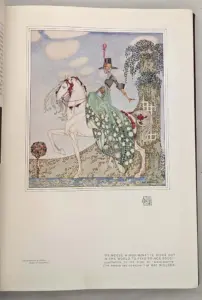
The Rosie-Posie Book was one of Anderson’s major early commissions. The first UK edition appeared around 1911, with an American edition published by Sully and Kleinteich around 1920. Inside, readers discovered twelve full-page color plates, each printed on one side of the leaf only and protected by captioned tissue guards . The structure was carefully considered: one text page, one illustration page, and two blank pages alternated throughout, creating a sense of spaciousness and reverence for the images .
The poems within follow a day in the lives of two young sisters and their friends . The verses—short, rhythmic, and designed for reading aloud—carry titles that trace the arc of the day: “Morning,” “Dressing,” “Going to School,” “Lessons,” “Playtime,” “Tea,” “Evening,” and “Bedtime” . Each poem faces its corresponding color plate, creating a dialogue between word and image that invites lingering. The verses are framed within decorative black-and-white borders, a hallmark of Anderson’s style, which echo the sinuous floral motifs of the Art Nouveau movement .
What distinguishes Anderson’s illustrations in this volume is their integration of the book’s title motif. Roses appear throughout—woven into borders, framing the text, adorning the children’s dresses—creating a cohesive visual theme that links the poems . Her palette is soft yet vibrant: the gentle pinks and greens of the garden, the warm golds of morning light, the soft blues of evening shadows. Her figures possess the elegant, elongated grace characteristic of her work, yet there is also a warmth to them, a tenderness that captures the innocence and wonder of childhood.
Anderson’s artistic style drew upon multiple influences. She was initially inspired by the Pre-Raphaelites, but soon looked to contemporaries such as Jessie M. King and Mabel Lucie Attwell as she developed her own voice . The influence of King is evident in the sinuous lines and decorative borders; the influence of Attwell appears in the gentle humor and accessibility of the children . Yet Anderson’s work is distinctively her own—a synthesis that produced a bright, delicate nursery world that proved particularly popular during the 1920s .
The critical reception of The Rosie-Posie Book was positive, and the volume found its audience in nurseries and libraries across Britain and America. It was reprinted in subsequent years, with later editions appearing in 1917, 1922, and beyond . The book’s popularity reflected a broader cultural moment: the Edwardian fascination with childhood innocence, the Arts and Crafts commitment to beautiful bookmaking, and the growing market for illustrated gift books designed for children.
Today, first editions of The Rosie-Posie Book are prized by collectors. The book is recognized as a significant work in Anderson’s bibliography, representing her style at its most refined and her sensibility at its most gentle. For collectors of Golden Age illustration, for admirers of Art Nouveau book design, and for those who cherish the quiet beauty of Edwardian children’s books, The Rosie-Posie Book remains a treasure.
In its pages, the two sisters still wake to morning light, still dress for the day, still go to school and play and take their tea. The roses still bloom in the borders, the verses still invite reading aloud, and Anne Anderson’s delicate watercolors still capture the timeless magic of childhood—a day in the nursery, preserved forever in ink and paint.
Recommended for collectors:
- Grimm’s Fairy Tales (1917), illustrated by Anne Anderson – A beautifully illustrated edition of classic stories with Anderson’s signature gentle touch.
- The Anne Anderson Fairy Tale Book (1920), illustrated by Anne Anderson – A compilation of fairy stories enhanced by her delicate, decorative style.
- A Child’s Garden of Verses (1895), by Robert Louis Stevenson, illustrated by Charles Robinson – A lyrical companion to The Rosie-Posie Book, featuring equally charming illustrations.
Art Gallery: Anne Anderson – The Rosie-Posie Book 1911