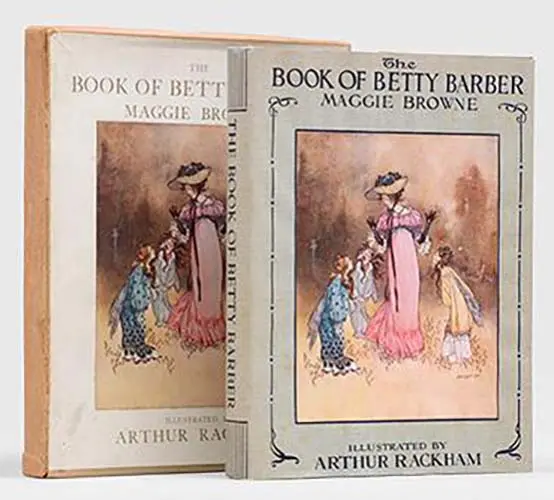
The Book of Betty Barber, published in 1910 occupies a unique and cherished place among the works illustrated by Arthur Rackham, standing apart as one of the most elusive volumes from the artist’s celebrated career. Written by Maggie Browne—the pseudonym of Margaret Hamer Andrewes—the book emerged as a singular collaboration, transforming a story that first appeared serially in Little Folks magazine in 1900 into a handsomely produced illustrated edition. Published in 1910 by Duckworth & Co. in London and Richard G. Badger in Boston, the volume represents a fascinating intersection of literary charm and artistic craftsmanship.
The narrative itself is a quintessential Edwardian children’s tale, following the whimsical adventures and everyday discoveries of its young protagonist, Betty Barber. While Browne’s storytelling possesses a gentle, period charm, it is Rackham’s illustrations that elevate the book into the realm of lasting significance. The volume contains a total of eighteen illustrations: six full-page color plates and twelve delicate line drawings that weave through the text with characteristic elegance. Rackham’s distinctive style—marked by sinuous contours, expressive figures, and a keen sensitivity to the subtle interplay between the real and the fantastical—imbues the modest story with an unexpected depth of character and atmosphere.
A particularly distinctive feature of this edition lies in its production. Although the drawings originated from Rackham’s hand, he consented to have the six color plates executed by the artist Harry Rountree, who applied the watercolor washes that bring the images to life. This collaboration resulted in a visual character distinct from Rackham’s fully hand-colored works, yet the plates retain the unmistakable essence of his draftsmanship, with Rountree’s palette complementing rather than overshadowing the underlying forms.
Physically, the first edition reflects the high standards of early twentieth-century bookmaking. Bound in brown cloth with black lettering to the spine, the cover is distinguished by an onlaid pictorial plate—one of Rackham’s illustrations—set directly into the front board. The pages are trimmed with gilt edges, a detail that underscores the volume’s status as a carefully produced object intended for discerning readers and collectors alike.
Today, The Book of Betty Barber is regarded as one of the rarest and most sought-after titles in the Rackham canon. Its limited print run, the unusual collaboration between Rackham and Rountree, and its position as a bridge between the artist’s early magazine work and his later masterpieces all contribute to its enduring allure. For collectors and admirers of the Golden Age of Illustration, the book remains a treasured discovery—a quiet gem in which Rackham’s singular vision, however sparingly applied, transforms a simple children’s story into a work of lasting beauty.
Recommended for collectors and readers:
- Peter Pan in Kensington Gardens (1906), illustrated by Arthur Rackham – A celebrated early example of Rackham’s richly imaginative style.
- The Allies’ Fairy Book (1916), illustrated by Arthur Rackham – A diverse collection of fairy tales unified by Rackham’s iconic illustrations.
- Undine (1909), illustrated by Arthur Rackham – A beautifully illustrated tale of water spirits and romance.
Art Gallery: Arthur Rackham – The Book of Betty Barber, 1910
![Arthur Rackham - The Book of Betty Barber [rackham-betty01] (art, illustrations)](https://www.nocloo.com/wp-content/plugins/justified-image-grid/timthumb.php?src=https%3A%2F%2Fwww.nocloo.com%2Fart%2Frackham-betty%2Frackham-betty01.jpg&h=280&q=90&f=.jpg "Arthur Rackham - Illustrations for The Book of Betty Barber 1910")
![Arthur Rackham - The Book of Betty Barber [rackham-betty02] (art, illustrations)](https://www.nocloo.com/wp-content/plugins/justified-image-grid/timthumb.php?src=https%3A%2F%2Fwww.nocloo.com%2Fart%2Frackham-betty%2Frackham-betty02.jpg&h=280&q=90&f=.jpg "Arthur Rackham - Illustrations for The Book of Betty Barber 1910")
![Arthur Rackham - The Book of Betty Barber [rackham-betty03] (art, illustrations)](https://www.nocloo.com/wp-content/plugins/justified-image-grid/timthumb.php?src=https%3A%2F%2Fwww.nocloo.com%2Fart%2Frackham-betty%2Frackham-betty03.jpg&h=280&q=90&f=.jpg "Arthur Rackham - Illustrations for The Book of Betty Barber 1910")
![Arthur Rackham - The Book of Betty Barber [rackham-betty04] (art, illustrations)](https://www.nocloo.com/wp-content/plugins/justified-image-grid/timthumb.php?src=https%3A%2F%2Fwww.nocloo.com%2Fart%2Frackham-betty%2Frackham-betty04.jpg&h=280&q=90&f=.jpg "Arthur Rackham - Illustrations for The Book of Betty Barber 1910")
![Arthur Rackham - The Book of Betty Barber [rackham-betty05] (art, illustrations)](https://www.nocloo.com/wp-content/plugins/justified-image-grid/timthumb.php?src=https%3A%2F%2Fwww.nocloo.com%2Fart%2Frackham-betty%2Frackham-betty05.jpg&h=280&q=90&f=.jpg "Arthur Rackham - Illustrations for The Book of Betty Barber 1910")
![Arthur Rackham - The Book of Betty Barber [rackham-betty06] (art, illustrations)](https://www.nocloo.com/wp-content/plugins/justified-image-grid/timthumb.php?src=https%3A%2F%2Fwww.nocloo.com%2Fart%2Frackham-betty%2Frackham-betty06.jpg&h=280&q=90&f=.jpg "Arthur Rackham - Illustrations for The Book of Betty Barber 1910")