Andersen’s Darker Dreams: Arthur Rackham’s Haunting Vision
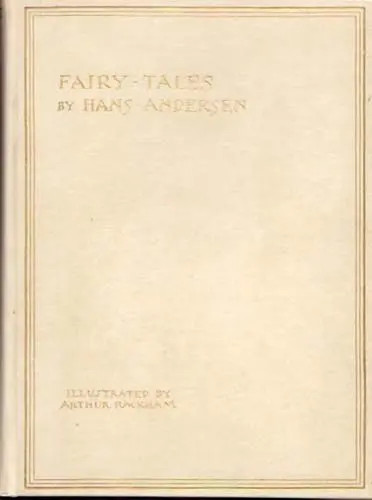
There is a particular kind of cold that only Hans Christian Andersen could write—the cold of a little match girl’s final vision, the cold of a snow queen’s heart, the cold of a steadfast tin soldier melting alone in a furnace. Arthur Rackham, the master of shadow and gnarled branch, understood that cold perfectly. When his illustrated edition of Andersen’s Fairy Tales appeared in 1932, late in the artist’s career, it represented a meeting of two kindred spirits: a Danish storyteller who believed that fairy tales should break your heart, and an English illustrator who believed that beauty should always carry a trace of menace.
Andersen’s tales, first published in Copenhagen between 1835 and 1872, revolutionized the fairy tale genre. Unlike the Brothers Grimm, who collected and polished existing folk stories, Andersen invented his own. He wrote with the rhythm of oral storytelling but the psychological depth of a novelist. His heroes are often outsiders—ugly ducklings, naked emperors, little mermaids who sacrifice everything for an unattainable soul. His stories do not always end happily. They end truthfully. The little mermaid does not win the prince; she dissolves into sea foam. The fir tree, longing for greatness, ends as firewood. Andersen never lied to children. He told them that the world is beautiful, strange, and often cruel, and that grace sometimes arrives too late.
Arthur Rackham, by 1932, had spent four decades perfecting a visual language equal to that complexity. His signature style—pen-and-ink linework combined with muted watercolor washes in olive greens, rusty browns, and soft golds—found its ideal subject in Andersen’s Scandinavia. Rackham’s landscapes are never merely backgrounds. They are emotional states made visible. The snowy wastes of The Snow Queen stretch across the page in layers of white and blue-gray, punctuated by twisted, leafless trees that seem to reach for the viewer with bony fingers. Gerda’s journey to rescue Kai becomes a pilgrimage through a world that is half real and half nightmare, every step illuminated by Rackham’s delicate, obsessive line.
His characters are equally striking. Rackham’s little mermaid is not a Disney heroine with flowing red hair. She is a pale, slender creature with enormous, sorrowful eyes, her fish tail curling beneath dark waters. She looks less like a princess and more like a ghost—a girl already mourning herself. His Thumbelina, tiny and blonde, peers up at a world of giant frogs and moles with a mixture of courage and exhaustion. His emperor, parading in his new clothes, wears an expression of magnificent foolishness that is both hilarious and pathetic. Even Rackham’s trolls and goblins, drawn with his trademark knobbly limbs and pointed ears, seem less like villains than like sad, misunderstood inhabitants of the forest’s edge.
What makes Rackham’s Andersen so extraordinary is its refusal to soften. He does not rescue the little match girl. He shows her shivering against a wall, her matches flaring with ghostly visions of warmth and love that the reader knows will soon fade. He does not save the tin soldier. He lets him burn. Rackham trusted Andersen’s original texts, and he trusted his young readers to handle the truth. The result is a book of rare emotional power—an edition that honors the Danish master’s vision by adding a visual layer of equal depth, darkness, and heartbreaking beauty. To open it is to step into a fairy tale that feels, for better and worse, exactly like life.
Recommended for collectors:
- Grimm’s Fairy Tales (1909), illustrated by Arthur Rackham – A rich, darker companion collection featuring German folk stories.
- Stories from Hans Andersen (1911), illustrated by Edmund Dulac – Features romantic, luminous illustrations in a different visual style.
- The Sleeping Beauty and Other Fairy Tales (1910), illustrated by Edmund Dulac – A beautifully presented fairy tale edition with lavish art.
Art Gallery: Arthur Rackham – Andersen’s Fairy Tales, 1932
![Arthur Rackham - Fairy Tales by Hans Andersen [rackham-andersen01] (art, illustrations)](https://www.nocloo.com/wp-content/plugins/justified-image-grid/timthumb.php?src=https%3A%2F%2Fwww.nocloo.com%2Fart%2Frackham-andersen%2Frackham-andersen01.jpg&h=280&q=90&f=.jpg "Arthur Rackham - Illustrations for Andersen's Fairy Tales 1932")
![Arthur Rackham - Fairy Tales by Hans Andersen [rackham-andersen02] (art, illustrations)](https://www.nocloo.com/wp-content/plugins/justified-image-grid/timthumb.php?src=https%3A%2F%2Fwww.nocloo.com%2Fart%2Frackham-andersen%2Frackham-andersen02.jpg&h=280&q=90&f=.jpg "Arthur Rackham - Illustrations for Andersen's Fairy Tales 1932")
![Arthur Rackham - Fairy Tales by Hans Andersen [rackham-andersen03] (art, illustrations)](https://www.nocloo.com/wp-content/plugins/justified-image-grid/timthumb.php?src=https%3A%2F%2Fwww.nocloo.com%2Fart%2Frackham-andersen%2Frackham-andersen03.jpg&h=280&q=90&f=.jpg "Arthur Rackham - Illustrations for Andersen's Fairy Tales 1932")
![Arthur Rackham - Fairy Tales by Hans Andersen [rackham-andersen04] (art, illustrations)](https://www.nocloo.com/wp-content/plugins/justified-image-grid/timthumb.php?src=https%3A%2F%2Fwww.nocloo.com%2Fart%2Frackham-andersen%2Frackham-andersen04.jpg&h=280&q=90&f=.jpg "Arthur Rackham - Illustrations for Andersen's Fairy Tales 1932")
![Arthur Rackham - Fairy Tales by Hans Andersen [rackham-andersen05] (art, illustrations)](https://www.nocloo.com/wp-content/plugins/justified-image-grid/timthumb.php?src=https%3A%2F%2Fwww.nocloo.com%2Fart%2Frackham-andersen%2Frackham-andersen05.jpg&h=280&q=90&f=.jpg "Arthur Rackham - Illustrations for Andersen's Fairy Tales 1932")
![Arthur Rackham - Fairy Tales by Hans Andersen [rackham-andersen06] (art, illustrations)](https://www.nocloo.com/wp-content/plugins/justified-image-grid/timthumb.php?src=https%3A%2F%2Fwww.nocloo.com%2Fart%2Frackham-andersen%2Frackham-andersen06.jpg&h=280&q=90&f=.jpg "Arthur Rackham - Illustrations for Andersen's Fairy Tales 1932")
![Arthur Rackham - Fairy Tales by Hans Andersen [rackham-andersen07] (art, illustrations)](https://www.nocloo.com/wp-content/plugins/justified-image-grid/timthumb.php?src=https%3A%2F%2Fwww.nocloo.com%2Fart%2Frackham-andersen%2Frackham-andersen07.jpg&h=280&q=90&f=.jpg "Arthur Rackham - Illustrations for Andersen's Fairy Tales 1932")
![Arthur Rackham - Fairy Tales by Hans Andersen [rackham-andersen08] (art, illustrations)](https://www.nocloo.com/wp-content/plugins/justified-image-grid/timthumb.php?src=https%3A%2F%2Fwww.nocloo.com%2Fart%2Frackham-andersen%2Frackham-andersen08.jpg&h=280&q=90&f=.jpg "Arthur Rackham - Illustrations for Andersen's Fairy Tales 1932")
![Arthur Rackham - Fairy Tales by Hans Andersen [rackham-andersen09] (art, illustrations)](https://www.nocloo.com/wp-content/plugins/justified-image-grid/timthumb.php?src=https%3A%2F%2Fwww.nocloo.com%2Fart%2Frackham-andersen%2Frackham-andersen09.jpg&h=280&q=90&f=.jpg "Arthur Rackham - Illustrations for Andersen's Fairy Tales 1932")
![Arthur Rackham - Fairy Tales by Hans Andersen [rackham-andersen10] (art, illustrations)](https://www.nocloo.com/wp-content/plugins/justified-image-grid/timthumb.php?src=https%3A%2F%2Fwww.nocloo.com%2Fart%2Frackham-andersen%2Frackham-andersen10.jpg&h=280&q=90&f=.jpg "Arthur Rackham - Illustrations for Andersen's Fairy Tales 1932")
![Arthur Rackham - Fairy Tales by Hans Andersen [rackham-andersen11] (art, illustrations)](https://www.nocloo.com/wp-content/plugins/justified-image-grid/timthumb.php?src=https%3A%2F%2Fwww.nocloo.com%2Fart%2Frackham-andersen%2Frackham-andersen11.jpg&h=280&q=90&f=.jpg "Arthur Rackham - Illustrations for Andersen's Fairy Tales 1932")
![Arthur Rackham - Fairy Tales by Hans Andersen [rackham-andersen12] (art, illustrations)](https://www.nocloo.com/wp-content/plugins/justified-image-grid/timthumb.php?src=https%3A%2F%2Fwww.nocloo.com%2Fart%2Frackham-andersen%2Frackham-andersen12.jpg&h=280&q=90&f=.jpg "Arthur Rackham - Illustrations for Andersen's Fairy Tales 1932")