Swinburne’s Childhood Muse: Rackham’s The Springtide of Life
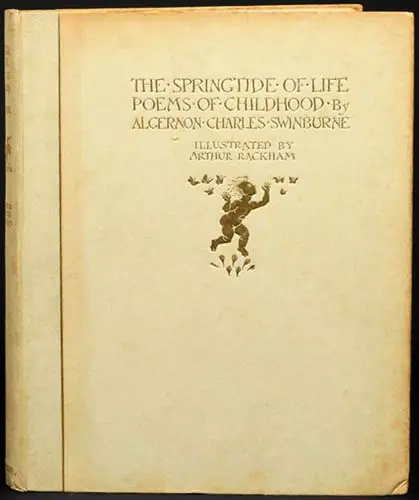
Arthur Rackham’s illustrated edition of Algernon Charles Swinburne’s The Springtide of Life occupies a distinctive and poignant place in the artist’s celebrated career. Published in 1918 by William Heinemann in London, this volume appeared during the final months of the First World War, offering a war-weary public a tender retreat into the innocence of childhood verse . The collaboration joined one of Victorian literature’s most notoriously bohemian poets with the preeminent illustrator of the Edwardian Golden Age, yielding a volume of unexpected charm and delicacy.
The poems collected in The Springtide of Life represent a departure from Swinburne’s more characteristic themes of pagan sensuality and political radicalism. Selected from his Poems and Ballads (second and third series), Tristram of Lyonesse, A Century of Roundels, and the cycle “A Dark Month,” these verses celebrate the world of infancy and early childhood with remarkable tenderness . Swinburne, whose own life was marked by complex personal turmoil, here revealed a gentler sensibility, crafting poems that capture the wonder, vulnerability, and fleeting beauty of a child’s earliest years. The volume was further distinguished by a preface from the esteemed critic and man of letters Edmund Gosse, a close friend of Swinburne and a lifelong champion of his work .
Rackham’s illustrations for the volume comprise nine color plates, including the frontispiece, alongside numerous black-and-white line drawings dispersed throughout the text . The color plates are tipped onto brown or grey art paper, each protected by a captioned tissue guard, reflecting the high production values associated with Heinemann’s deluxe illustrated editions . The illustrations depict cherubic infants and young toddlers in moments of quiet repose and gentle play—a subject matter that prompted mixed responses from contemporary critics. The poet and critic Edmund Gosse expressed unreserved admiration, writing to Rackham in October 1918 that the volume would be “not merely the best book of the present art-season, but a joy to all sensitive people for years and years to come” . Yet some observers wondered whether Rackham’s singular gifts were fully suited to “baby worship on such an intensive scale” .
The book was issued in two distinct states. The trade edition featured green cloth binding with gilt decorations to the spine and front cover, containing eight color plates . The deluxe edition, limited to 765 copies signed by Rackham, was printed on finer handmade paper with untrimmed page edges and featured an additional color plate—the frontispiece—not present in the trade issue . Bindings for the deluxe copies varied between quarter vellum over ivory or white boards and, in some instances, three-quarter morocco executed by fine binders .
The Springtide of Life captures a singular moment in both literary and publishing history—a volume of childhood verse by a notoriously complex poet, illustrated by a master approaching the later phase of his career, issued to a public emerging from four years of unprecedented horror. It remains a distinctive and sought-after work in the Rackham canon, a testament to the enduring appeal of innocence rendered through the lens of mature artistic vision.
Recommended for collectors:
- Peter Pan in Kensington Gardens (1906), illustrated by Arthur Rackham – A beloved classic with richly atmospheric illustrations.
- A Child’s Garden of Verses (1905), by Robert Louis Stevenson, illustrated by Jessie Willcox Smith – A poetic celebration of childhood with elegant, timeless artwork.
- Mother Goose (1913), illustrated by Arthur Rackham – A collection of nursery rhymes brought vividly to life with Rackham’s playful yet refined illustrations.
Art Gallery: Arthur Rackham – Poems of Childhood 1918
![Arthur Rackham - The Springtide of Life. Poems of Childhood [rackham-childhood01] (art, illustrations)](https://www.nocloo.com/wp-content/plugins/justified-image-grid/timthumb.php?src=https%3A%2F%2Fwww.nocloo.com%2Fart%2Frackham-childhood%2Frackham-childhood01.jpg&h=280&q=90&f=.jpg "Arthur Rackham - Illustrations for Poems of Childhood 1918")
![Arthur Rackham - The Springtide of Life. Poems of Childhood [rackham-childhood02] (art, illustrations)](https://www.nocloo.com/wp-content/plugins/justified-image-grid/timthumb.php?src=https%3A%2F%2Fwww.nocloo.com%2Fart%2Frackham-childhood%2Frackham-childhood02.jpg&h=280&q=90&f=.jpg "Arthur Rackham - Illustrations for Poems of Childhood 1918")
![Arthur Rackham - The Springtide of Life. Poems of Childhood [rackham-childhood03] (art, illustrations)](https://www.nocloo.com/wp-content/plugins/justified-image-grid/timthumb.php?src=https%3A%2F%2Fwww.nocloo.com%2Fart%2Frackham-childhood%2Frackham-childhood03.jpg&h=280&q=90&f=.jpg "Arthur Rackham - Illustrations for Poems of Childhood 1918")
![Arthur Rackham - The Springtide of Life. Poems of Childhood [rackham-childhood04] (art, illustrations)](https://www.nocloo.com/wp-content/plugins/justified-image-grid/timthumb.php?src=https%3A%2F%2Fwww.nocloo.com%2Fart%2Frackham-childhood%2Frackham-childhood04.jpg&h=280&q=90&f=.jpg "Arthur Rackham - Illustrations for Poems of Childhood 1918")
![Arthur Rackham - The Springtide of Life. Poems of Childhood [rackham-childhood05] (art, illustrations)](https://www.nocloo.com/wp-content/plugins/justified-image-grid/timthumb.php?src=https%3A%2F%2Fwww.nocloo.com%2Fart%2Frackham-childhood%2Frackham-childhood05.jpg&h=280&q=90&f=.jpg "Arthur Rackham - Illustrations for Poems of Childhood 1918")
![Arthur Rackham - The Springtide of Life. Poems of Childhood [rackham-childhood06] (art, illustrations)](https://www.nocloo.com/wp-content/plugins/justified-image-grid/timthumb.php?src=https%3A%2F%2Fwww.nocloo.com%2Fart%2Frackham-childhood%2Frackham-childhood06.jpg&h=280&q=90&f=.jpg "Arthur Rackham - Illustrations for Poems of Childhood 1918")
![Arthur Rackham - The Springtide of Life. Poems of Childhood [rackham-childhood07] (art, illustrations)](https://www.nocloo.com/wp-content/plugins/justified-image-grid/timthumb.php?src=https%3A%2F%2Fwww.nocloo.com%2Fart%2Frackham-childhood%2Frackham-childhood07.jpg&h=280&q=90&f=.jpg "Arthur Rackham - Illustrations for Poems of Childhood 1918")
![Arthur Rackham - The Springtide of Life. Poems of Childhood [rackham-childhood08] (art, illustrations)](https://www.nocloo.com/wp-content/plugins/justified-image-grid/timthumb.php?src=https%3A%2F%2Fwww.nocloo.com%2Fart%2Frackham-childhood%2Frackham-childhood08.jpg&h=280&q=90&f=.jpg "Arthur Rackham - Illustrations for Poems of Childhood 1918")