A Child’s Garden of Verses: Jessie Willcox Smith’s Window into Childhood
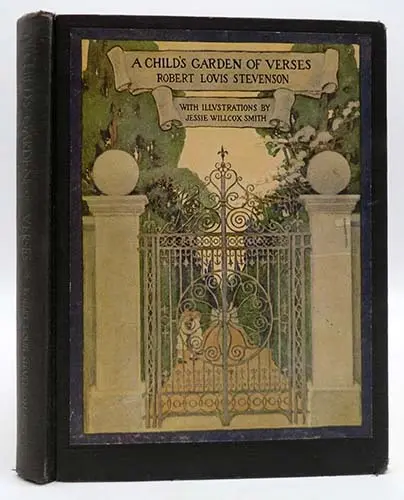
There are certain books that seem less like objects and more like time machines. Robert Louis Stevenson‘s A Child’s Garden of Verses, first published in 1885, is one of them. But when you add the illustrations of Jessie Willcox Smith—those warm, golden, deeply affectionate visions of Victorian childhood—the time machine becomes almost unbearably powerful. To open this edition is to step back into a world of nursery firesides, rainy afternoons, toy soldiers, and the particular, precious magic of being very young and very loved.
Stevenson’s poems are among the most beloved in the English language. Written from the perspective of a child who is simultaneously present and remembering, these verses capture the small, enormous dramas of early life. The Land of Counterpane transforms a sickbed into a landscape of toy kingdoms. My Shadow follows that strange, silent companion who jumps when you jump and grows when you grow. The Lamplighter watches a daily ritual that seems, to a child, as significant as the turning of the stars. Stevenson understood that children do not live in a smaller world than adults. They live in a deeper one, where every shadow holds a story and every bedtime is a small farewell.
Jessie Willcox Smith was born in Philadelphia in 1863 and studied under the great American illustrator Howard Pyle. She became one of the most successful and beloved illustrators of her generation, part of the “Red Rose Girls” alongside Elizabeth Shippen Green and Violet Oakley. Her specialty was children. No one painted them better. No one captured their particular blend of vulnerability, mischief, wonder, and dignity quite like Jessie Willcox Smith.
When Smith turned her attention to A Child’s Garden of Verses, she brought to it a lifetime of observation and a deep, almost maternal tenderness. Her children are not idealized cherubs. They are real children—round-cheeked, slightly rumpled, with hair that escapes its ribbons and knees that show the scuffs of play. They sit in windowsills with their chins in their hands, dreaming. They march with tin soldiers across nursery floors. They fall asleep in armchairs with books still open on their laps. They are caught in moments of utter absorption, unaware that anyone is watching.
Smith’s palette is warm and golden, dominated by soft yellows, gentle browns, cream whites, and touches of dusty rose and blue. She loved the quality of indoor light—the glow of a fireplace, the slant of afternoon sun through a lace curtain, the soft lamplight of a bedroom at twilight. Her compositions are intimate, often close-cropped, as if the viewer has been invited into a private space. You are not observing these children from a distance. You are in the room with them, sitting quietly in the corner while they build their block towers and whisper their secrets.
Perhaps Smith’s greatest gift was her ability to capture the relationship between children and their imaginations. In her illustration for The Land of Counterpane, a boy in a nightshirt lies in bed, his hand moving toy soldiers across the quilt that has become a battlefield. His face is utterly serious, utterly transported. He is not pretending. He is there. Smith painted that absorption with such skill that you almost believe you could reach out and touch the edge of his dream.
A Child’s Garden of Verses with Jessie Willcox Smith’s illustrations is not a book you read. It is a book you return to—as a child, as a parent, as a grandparent. It is a reminder that childhood is not a time to be hurried through but a garden to be walked in slowly, noticing every flower. Smith gave Stevenson’s poems a face, a room, a warm embrace. She made them home.
Recommended for collectors and readers:
- Heidi (1922), illustrated by Jessie Willcox Smith – A classic tale paired with Smith’s heartfelt imagery.
- Little Women (1915), illustrated by Jessie Willcox Smith – A beautifully illustrated edition of Louisa May Alcott’s cherished novel.
- The Water-Babies (1916), illustrated by Jessie Willcox Smith – A poetic and whimsical interpretation of Charles Kingsley’s fantasy classic.
- At the back of the North Wind (1919), by George Macdonald. Also illustrated by Jessie Wilcox Smith.
Art Gallery: Jessie Wilcox Smith – A Child’s Garden of Verses 1905
![Jessie Wilcox Smith - A Child's Garden of Verses [jwsmith-verses01] (art, illustrations)](https://www.nocloo.com/wp-content/plugins/justified-image-grid/timthumb.php?src=https%3A%2F%2Fwww.nocloo.com%2Fart%2Fjwsmith-verses%2Fjwsmith-verses01.jpg&h=280&q=90&f=.jpg)
![Jessie Wilcox Smith - A Child's Garden of Verses [jwsmith-verses02] (art, illustrations)](https://www.nocloo.com/wp-content/plugins/justified-image-grid/timthumb.php?src=https%3A%2F%2Fwww.nocloo.com%2Fart%2Fjwsmith-verses%2Fjwsmith-verses02.jpg&h=280&q=90&f=.jpg)
![Jessie Wilcox Smith - A Child's Garden of Verses [jwsmith-verses03] (art, illustrations)](https://www.nocloo.com/wp-content/plugins/justified-image-grid/timthumb.php?src=https%3A%2F%2Fwww.nocloo.com%2Fart%2Fjwsmith-verses%2Fjwsmith-verses03.jpg&h=280&q=90&f=.jpg)
![Jessie Wilcox Smith - A Child's Garden of Verses [jwsmith-verses04] (art, illustrations)](https://www.nocloo.com/wp-content/plugins/justified-image-grid/timthumb.php?src=https%3A%2F%2Fwww.nocloo.com%2Fart%2Fjwsmith-verses%2Fjwsmith-verses04.jpg&h=280&q=90&f=.jpg)
![Jessie Wilcox Smith - A Child's Garden of Verses [jwsmith-verses05] (art, illustrations)](https://www.nocloo.com/wp-content/plugins/justified-image-grid/timthumb.php?src=https%3A%2F%2Fwww.nocloo.com%2Fart%2Fjwsmith-verses%2Fjwsmith-verses05.jpg&h=280&q=90&f=.jpg)
![Jessie Wilcox Smith - A Child's Garden of Verses [jwsmith-verses06] (art, illustrations)](https://www.nocloo.com/wp-content/plugins/justified-image-grid/timthumb.php?src=https%3A%2F%2Fwww.nocloo.com%2Fart%2Fjwsmith-verses%2Fjwsmith-verses06.jpg&h=280&q=90&f=.jpg)
![Jessie Wilcox Smith - A Child's Garden of Verses [jwsmith-verses07] (art, illustrations)](https://www.nocloo.com/wp-content/plugins/justified-image-grid/timthumb.php?src=https%3A%2F%2Fwww.nocloo.com%2Fart%2Fjwsmith-verses%2Fjwsmith-verses07.jpg&h=280&q=90&f=.jpg)
![Jessie Wilcox Smith - A Child's Garden of Verses [jwsmith-verses08] (art, illustrations)](https://www.nocloo.com/wp-content/plugins/justified-image-grid/timthumb.php?src=https%3A%2F%2Fwww.nocloo.com%2Fart%2Fjwsmith-verses%2Fjwsmith-verses08.jpg&h=280&q=90&f=.jpg)
![Jessie Wilcox Smith - A Child's Garden of Verses [jwsmith-verses09] (art, illustrations)](https://www.nocloo.com/wp-content/plugins/justified-image-grid/timthumb.php?src=https%3A%2F%2Fwww.nocloo.com%2Fart%2Fjwsmith-verses%2Fjwsmith-verses09.jpg&h=280&q=90&f=.jpg)
![Jessie Wilcox Smith - A Child's Garden of Verses [jwsmith-verses10] (art, illustrations)](https://www.nocloo.com/wp-content/plugins/justified-image-grid/timthumb.php?src=https%3A%2F%2Fwww.nocloo.com%2Fart%2Fjwsmith-verses%2Fjwsmith-verses10.jpg&h=280&q=90&f=.jpg)
![Jessie Wilcox Smith - A Child's Garden of Verses [jwsmith-verses11] (art, illustrations)](https://www.nocloo.com/wp-content/plugins/justified-image-grid/timthumb.php?src=https%3A%2F%2Fwww.nocloo.com%2Fart%2Fjwsmith-verses%2Fjwsmith-verses11.jpg&h=280&q=90&f=.jpg)
![Jessie Wilcox Smith - A Child's Garden of Verses [jwsmith-verses12] (art, illustrations)](https://www.nocloo.com/wp-content/plugins/justified-image-grid/timthumb.php?src=https%3A%2F%2Fwww.nocloo.com%2Fart%2Fjwsmith-verses%2Fjwsmith-verses12.jpg&h=280&q=90&f=.jpg)