Clifford D. Simak: The Collector’s Guide to First Editions, Rare and Collectible Books
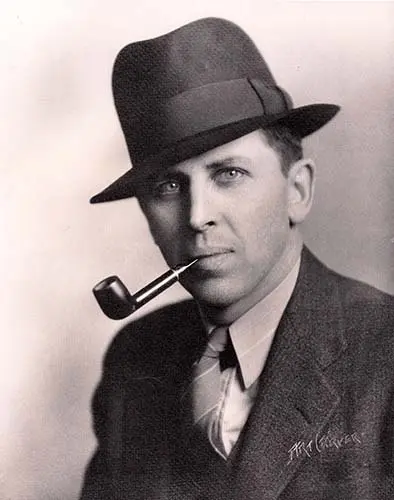
The Rural Journalist and the Pulp Apprentice (1904-1938)
Clifford Donald Simak was born in 1904 in Millville, Wisconsin, a small rural community whose landscapes, values, and sense of community would forever shape his fiction. Unlike many of his contemporaries who were drawn to the bustling cities, Simak’s heart remained in the countryside. He worked as a journalist and editor for small-town newspapers throughout the Midwest, eventually spending most of his career with the Minneapolis Star and Tribune. This profession honed his clear, concise, and humane prose style and kept him grounded in the lives of ordinary people. He began writing science fiction in the early 1930s, initially producing space operas and adventure stories for the pulp magazines that were typical of the era.
However, Simak quickly grew dissatisfied with the genre’s conventions. As he later stated, he was tired of the “bug-eyed monster” trope and wanted to write stories that reflected his own sensibilities. A pivotal moment came with the rise of John W. Campbell Jr. as editor of Astounding Science Fiction in 1937. Campbell encouraged his writers to bring greater sophistication and scientific plausibility to their work. Simak, inspired by this new direction, found his voice. He began writing stories that replaced galactic conflict with a gentle, philosophical wonder. His first major story of this period, “Rule 18” (1938), a clever football story involving antigravity, showed his shift towards a more thoughtful and character-driven style, setting the stage for his future classics.
The Voice of the Cosmic Pastoral: The Golden Age (1939-1952)
The 1940s and early 1950s marked Simak’s most prolific and celebrated period, during which he crafted the stories that define his legacy. While the world was engulfed in war and then the anxieties of the Cold War, Simak’s fiction offered a unique vision: a peaceful, pastoral future. His most famous work, City (1944-1951, published as a novel in 1952), is a series of interconnected stories presented as “legends” told by intelligent, philosophical dogs about a mythical creature called “Man.” The book depicts humanity not ascending to the stars in conquest, but gently fading away, leaving Earth to its robots and animals. It is a wistful, elegiac narrative that won international acclaim and is considered one of the foundational works of soft, anthropological science fiction.
During this time, he also produced masterpieces like “The Big Front Yard” (1958), a quintessential Simak tale in which a rural handyman’s home becomes a gateway to the stars, and “Way Station” (1963), which won the Hugo Award. The latter novel perfectly encapsulates his themes: a reclusive Civil War veteran living in the Wisconsin woods acts as a caretaker for a secret interstellar transit station, mediating between a peaceful galactic culture and a paranoid, war-torn humanity. Simak’s universe was not threatening; it was full of enigmatic, often benevolent, aliens who were more interested in conversation and trade than conquest. His stories frequently featured humble protagonists—farmers, journalists, antiques dealers—who encounter the cosmic in their own backyards.
The Consistent Master: Later Career and Recognition (1953-1988)
As the science fiction genre evolved through the New Wave and beyond, Simak’s fundamental style remained consistent. He continued to write novels and short stories that explored his core concerns: the relationship between humanity and the land, the promise of technology versus its perils, and the search for meaning in a vast cosmos. Works like The Goblin Reservation (1968) blended science fiction with folklore, and A Heritage of Stars (1977) depicted a post-collapse America where knowledge is preserved in quiet, monastic universities—a classic Simakian vision of a decentralized, pastoral future.
Though his output slowed in his later years, the quality of his work remained high, and he received numerous accolades that cemented his status as a grand master. He won three Hugo Awards and a Nebula Award, and in 1977, the Science Fiction Writers of America named him the third Grand Master, after Robert Heinlein and Jack Williamson. His writing, always characterized by its gentle wisdom, nostalgia, and deep humanism, never went out of style because it spoke to timeless values. He passed away in 1988, leaving behind a body of work that stands as a unique and comforting presence in the genre.
The Legacy of Gentle Wonder: Simak’s Quiet Influence
Clifford D. Simak’s influence is subtle yet profound. He carved out a unique niche that contrasted sharply with the technological optimism of Asimov, the dramatic conflict of Heinlein, and the dystopian visions of many of his peers. His primary legacy is the “pastoral” or “cosmic pastoral” strain in science fiction. He demonstrated that stories about first contact and the future could be quiet, contemplative, and set in the countryside. This tradition can be seen in the works of authors who explore similar themes of rural wonder and gentle alien contact, such as Zenna Henderson’s The People stories and, more recently, in the emotional and character-driven science fiction of authors like Becky Chambers, whose A Long Way to a Small, Angry Planet focuses on community and understanding rather than conflict.
His influence is also evident in the way he humanized the non-human. By giving voices to dogs, robots, and aliens as thoughtful, compassionate beings, he expanded the emotional range of the genre. This empathetic approach to artificial and alien intelligence is a cornerstone of much modern SF. Furthermore, his concept of a “Way Station”—a neutral, peaceful nexus for interstellar travel—has become a standard trope, and his portrayal of a galactic civilization based on communication and trade, rather than empire, offered a hopeful alternative to more militaristic futures.
While he may not have the same name recognition as the “Big Three” of the Golden Age, Simak’s legacy is one of profound decency and intellectual curiosity. In a genre often preoccupied with shock and awe, he championed quiet wonder. He remains a writer’s writer, beloved by those who value compassion, elegant prose, and the profound idea that the universe, in the end, might be a fundamentally friendly place. For readers seeking solace and wisdom in science fiction, the work of Clifford D. Simak remains an essential destination.
Clifford D. Simak – First Editions Identification Guide
A Complete Bibliography of Clifford D. Simak: Novels, Rare Books & First Editions
| Year | Title | Publisher | First edition/printing identification points |
|---|---|---|---|
| 1961 | ALIENS FOR NEIGHBOURS | London: Faber and Faber, [1961] | Boards. First published in mcmlxi on © page. Abridged reprint. Collects nine of the twelve stories originally appearing in THE WORLDS OF CLIFFORD SIMAK. |
| 1965 | ALL FLESH IS GRASS | Garden City: Doubleday & Company, Inc., 1965 | First edition so stated on © page. |
| 1975 | THE BEST OF CLIFFORD D. SIMAK | London: Sidgwick & Jackson, [1975] | Boards. First published in Great Britain in 1975 on © page. |
| 1967 | BEST SCIENCE FICTION STORIES OF CLIFFORD SIMAK | London: Faber and Faber, [1967] | First published in mcmlxvii on © page. |
| 1973 | CEMETERY WORLD | New York: G.P. Putnam's Sons, [1973] | Boards. No statement of printing on © page. |
| 1972 | A CHOICE OF GODS | New York: G. P. Putnam's Sons, [1972] | Boards. No statement of printing on © page. |
| 1952 | CITY | [New York]: Gnome Press, [1952] | Boards. First edition so stated on © page. |
| 1946 | THE CREATOR | [Los Angeles]: A Crawford Publication, [1946] | Wrappers. No statement of printing on © page. |
| 1971 | DESTINY DOLL | New York: G. P. Putnam's Sons, [1971] | No statement of printing on © page. |
| 1975 | ENCHANTED PILGRIM AGE | New York: Published by Berkley Publishing Corp., [1975] | No statement of printing on © page. |
| 1953 | FIRST HE DIED | [New York]; A Dell Book, [1953] | Wrappers. No statement of printing on © page. Dell Book 680 (250). Reissue of TIME AND AGAIN. |
| 1965 | THE GOBLIN RESERVATION | New York: G. P. Putnam's Sons, [196S] | No statement of printing on © page. |
| 1977 | A HERITAGE OF STARS | New York: Published by Berkley Publishing Corp., [1977] | No statement of printing on © page. Note: Bound uncorrected galley proofs were issued with the title PLACE OF GOING TO THE STARS. |
| 1962 | OTHER WORLDS OF CLIFFORD SIMAK | New York: Avon Book Division, [1962] | Wrappers. No statement of printing on © page. An Avon Book G-l 124 (50¢). Reprints six stories from THE WORLDS OF CLIFFORD SIMAK. |
| 1974 | OUR CHILDREN'S CHILDREN | New York: G. P. Putnam's Sons, [1974] | No statement of printing on © page. |
| 1970 | OUT OF THEIR MINDS | New York: G. P. Putnam's Sons, [1970] | No statement of printing on © page. |
| 1953 | RING AROUND THE SUN | New York: Simon and Schuster, 1953 | Boards. First printing so stated on © page. |
| 1976 | SHAKESPEARE'S PLANET | New York: Published by Berkley Publishing Corp., [1976} | No statement of printing on © page. |
| 1977 | SKIRMISH | New York: Published byG.P. Putnam's Sons, [1977] | Boards with cloth shelf back. No statement of printing on © page. |
| 1968 | SO BRIGHT THE VISION | New York: Ace Books, Inc., [1968] | Wrappers. No statement of printing on © page. Ace Double H-95 (60¢). Bound with THE MAN WHO SAW TOMORROW by Jeff Sutton. |
| 1962 | THEY WALKED LIKE MEN | Garden City: Doubleday & Company, Inc., 1962 | First edition so stated on © page. |
| 1951 | TIME AND AGAIN | New York: Simon and Schuster, 1951 | Boards with cloth shelf back. No statement of printing on © page. Reissued as FIRST HE DIED. |
| 1961 | TIME IS THE SIMPLEST THING | Garden City: Doubleday & Company, Inc.. 1961 | First edition so stated on © page. |
| 1961 | THE TROUBLE WITH TYCHO | New York: Ace Books, Inc., [1961] | Wrappers. No statement of printing on © page. Ace Double Novel Books D-517 (35¢). Bound with BRING BACK YESTERDAY by A. Bertram Chandler. |
| 1963 | WAY STATION | Garden City: Doubleday & Company, Inc., 1963 | First edition so stated on © page. |
| 1967 | THE WEREWOLF PRINCIPLE | New York: G. P. Putnam's Sons, [1967] | No statement of printing on © page. |
| 1967 | WHY CALL THEM BACK FROM HEAVEN | Garden City: Doubleday & Company, Inc., 1967 | First edition so stated on © page. |
| 1962 | ALL THE TRAPS OF EARTH | Garden City: Doubleday & Company, Inc., 1962 | First edition so stated on © page. Five of these nine stories were reprinted under the title THE NIGHT OF THE PUUDLY. ALSO:[New York]: A Macfadden Book, [1963]. Wrappers. A Macfadden Book ... 1963 on © page. Macfadden Books 50-165 (50¢). Abridged reprint. Collects six of the nine stories. [London]: A Four Square Book, [1964]. Wrappers. First Four Square edition 1964 on © page. Foursquare 993 (2'6). Abridged reprint. Collects four of the nine stories. |
| 1950 | COSMIC ENGINEERS | New York: Gnome Press, Publishers, [1950] | Two bindings, probable priority as listed:
|
| 1951 | EMPIRE | New York: World Editions, Inc., [1951] | Wrappers. No statement of printing on © page. Galaxy Science Fiction Novel No. 7 (35¢). Note: Original version of EMPIRE was written by John W. Campbell Jr. as a teenager. Unable to find a publisher for it, he turned it over to Simak and asked that he rewrite it for Astounding. According to Simak, "EMPIRE was essentially a rewrite of John's plot. I may have taken a few of the ideas and action, but I didn't use any of his words. And I certainly tried to humanize his characters" (quote via Muriel Becker). Simak's version was rejected by Campbell and ultimately appeared as a Galaxy Novel. |
| 1964 | THE NIGHT OF THE PUUDLY | [London]: A Four Square Book, [1964] | Wrappers. First Four Square Edition 1964 on © page. Four Square Science Fiction 1040 (3'6). Abridged reprint. Collects five stories from ALL THE TRAPS OF EARTH with lead story "Good Night, Mr. James" retitled "The Night of the Pudly." ALSO: London, New York, Sydney and Toronto: White Lion Publishers Limited, [1975], Boards. White Lion Edition 1975 on © page. First hardcover edition of this collection. |
| 1960 | THE WORLDS OF CLIFFORD SIMAK | New York: Simon and Schuster, 1960 | Boards. First printing so stated on © page. ALSO: New York: Avon Book Division, [1961]. Wrappers. No statement of printing on © page. Avon G-1096 (50¢). Abridged reprint. Collects six of the twelve stories. |
| 1964 | WORLDS WITHOUT END | New York: Belmont Books, [1964] | Wrappers. A Belmont Book-April 1964 on © page. Belmont L92-584 (50¢). Note: Second printing bears no statement of printing on © page and book number is changed to B50-791. ALSO: London: Herbert Jenkins, [1965]. Boards. First published in Great Britain ... 1965 on © page. First hardcover edition. |
Clifford D. Simak – First Printing Dust Jackets Identification Guide
Gallery of First state Dust Jackets of works.


Reference:
- Wikipedia
- L. W. Currey, Science Fiction and Fantasy Authors: A Bibliography of First Printings of Their Fiction and Selected Nonfiction.