A Fairy Garden in Verse: Florence Harrison’s Elfin Song
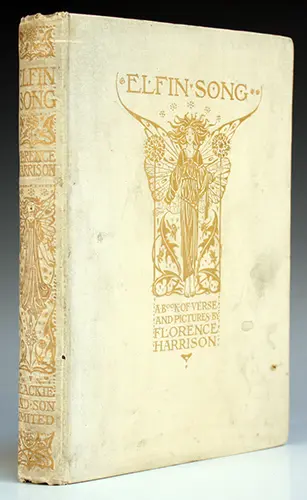
In the golden years before the First World War, when the illustrated gift book reached its zenith, one artist brought the ethereal beauty of the Pre-Raphaelite tradition into the world of children’s poetry. Florence Harrison’s Elfin Song: A Book of Verse and Pictures, published in 1912 by Blackie & Son in London, stands as a jewel of that era—a volume where lyrical verse and luminous illustration combine to create a vision of fairy enchantment that has captivated collectors for more than a century .
Florence Susan Harrison (1877–1955) was an Australian-born illustrator whose career flourished in England. Her style, deeply influenced by both the Pre-Raphaelite Brotherhood and Art Nouveau, is characterized by vibrant, richly coloured drawings with a distinctive strong black outline around her figures . She worked primarily for Blackie & Son, the celebrated Glasgow-based publisher, and became known for illustrating works by the Pre-Raphaelite circle poets—Christina Rossetti, William Morris, and Alfred, Lord Tennyson . But Elfin Song was something special: a book of her own verse and pictures, a complete artistic vision that revealed the full range of her talent .
The 1912 first edition was Blackie’s gift book of the year, a lavish production intended for the discerning collector . Bound in cream or grey cloth with elaborate gilt decoration—often featuring a fairy with wings framed by flowers—the volume was designed to delight from the moment it was seen. The top edge gilt, the endpapers were decorated with Harrison’s delicate patterns. Inside, readers discovered twelve mounted color plates, each protected by a captioned tissue guard and numerous vignette illustrations woven throughout the 142 pages .
What distinguishes Harrison’s work in Elfin Song is the seamless integration of word and image. She wrote the verses as well as creating the pictures, and the result is a unified artistic vision—a fairy garden rendered in poetry and paint. The poem “Ships of the Sky,” featured in a recent exhibition at Princeton University’s Cotsen Children’s Library, likens clouds to fairy vessels sailing across the heavens, “carrying gold from the sun and coffers of the moon,” with rain, hail, and thunder as their defences . Harrison’s illustration for this poem captures the dreamy, fantastical quality that defines her work: a rainbow arches across the sky, fairy figures drift among the clouds, and the whole scene shimmers with ethereal light .
Harrison’s artistic style reflects her deep engagement with the Pre-Raphaelite tradition. Her line drawings possess strong decorative elements, while her watercolors are often dreamy and fantastical in their imagery . The black outlines around her figures—a signature technique—give her fairies and flowers a stained-glass quality, as if they might glow if held up to the light. Her color plates are rich in jewel tones: deep blues, soft pinks, mossy greens, and touches of gold that evoke both the natural world and the fairy realm.
The book’s content reflects the fairy folklore revival that flourished in Edwardian Britain. Harrison’s verses celebrate the small enchantments of nature—the flutter of wings, the sparkle of dew, the secrets hidden in flowers. Her fairies are not the formidable figures of older folklore but gentle, curious creatures, as much a part of the landscape as the blossoms they tend. It is a world of innocence and wonder, rendered with an artist’s precision and a poet’s heart.
Today, Elfin Song is a scarce and coveted collectible. The white or grey cloth binding was notoriously fragile, and the tipped-in plates were vulnerable to handling, making surviving copies in good condition increasingly rare. T
In the pages of Elfin Song, the fairy garden still blooms. The ships of the sky still sail, the rainbow still arches, and the small enchantments of childhood still await discovery. Florence Harrison, in her singular fusion of Pre-Raphaelite beauty and Art Nouveau grace, created a book that transcends its era—a reminder that the best illustrated books, like the fairy realms they depict, have the power to enchant across the generations.
Recommended for Collectors and Fans:
- Goblin Market and Other Poems by Christina Rossetti, illustrated by Florence Harrison – Another masterpiece combining Rossetti’s poetry with Harrison’s enchanting visuals.
- The Book of Fairy Poetry, edited by Dora Owen, illustrated by Warwick Goble – A delightful anthology of fairy-themed poems with exquisite watercolor plates.
- Poems by William Morris, illustrated by Florence Harrison – A beautifully designed volume that pairs Morris’s romantic verse with Harrison’s richly decorative style.
These titles are ideal for collectors of fantasy illustration, Pre-Raphaelite art, and early 20th-century fine press books.
Art Gallery: Florence Harrison – Elfin Song 1912
![Florence Harrison- Elfin Song [fharrison-elfin01] (art, illustrations)](https://www.nocloo.com/wp-content/plugins/justified-image-grid/timthumb.php?src=https%3A%2F%2Fwww.nocloo.com%2Fart%2Fharrison-elfin%2Ffharrison-elfin01.jpg&h=280&q=90&f=.jpg)
![Florence Harrison- Elfin Song [fharrison-elfin02] (art, illustrations)](https://www.nocloo.com/wp-content/plugins/justified-image-grid/timthumb.php?src=https%3A%2F%2Fwww.nocloo.com%2Fart%2Fharrison-elfin%2Ffharrison-elfin02.jpg&h=280&q=90&f=.jpg)
![Florence Harrison- Elfin Song [fharrison-elfin03] (art, illustrations)](https://www.nocloo.com/wp-content/plugins/justified-image-grid/timthumb.php?src=https%3A%2F%2Fwww.nocloo.com%2Fart%2Fharrison-elfin%2Ffharrison-elfin03.jpg&h=280&q=90&f=.jpg)
![Florence Harrison- Elfin Song [fharrison-elfin04] (art, illustrations)](https://www.nocloo.com/wp-content/plugins/justified-image-grid/timthumb.php?src=https%3A%2F%2Fwww.nocloo.com%2Fart%2Fharrison-elfin%2Ffharrison-elfin04.jpg&h=280&q=90&f=.jpg)
![Florence Harrison- Elfin Song [fharrison-elfin05] (art, illustrations)](https://www.nocloo.com/wp-content/plugins/justified-image-grid/timthumb.php?src=https%3A%2F%2Fwww.nocloo.com%2Fart%2Fharrison-elfin%2Ffharrison-elfin05.jpg&h=280&q=90&f=.jpg)
![Florence Harrison- Elfin Song [fharrison-elfin06] (art, illustrations)](https://www.nocloo.com/wp-content/plugins/justified-image-grid/timthumb.php?src=https%3A%2F%2Fwww.nocloo.com%2Fart%2Fharrison-elfin%2Ffharrison-elfin06.jpg&h=280&q=90&f=.jpg)
![Florence Harrison- Elfin Song [fharrison-elfin07] (art, illustrations)](https://www.nocloo.com/wp-content/plugins/justified-image-grid/timthumb.php?src=https%3A%2F%2Fwww.nocloo.com%2Fart%2Fharrison-elfin%2Ffharrison-elfin07.jpg&h=280&q=90&f=.jpg)
![Florence Harrison- Elfin Song [fharrison-elfin08] (art, illustrations)](https://www.nocloo.com/wp-content/plugins/justified-image-grid/timthumb.php?src=https%3A%2F%2Fwww.nocloo.com%2Fart%2Fharrison-elfin%2Ffharrison-elfin08.jpg&h=280&q=90&f=.jpg)
![Florence Harrison- Elfin Song [fharrison-elfin09] (art, illustrations)](https://www.nocloo.com/wp-content/plugins/justified-image-grid/timthumb.php?src=https%3A%2F%2Fwww.nocloo.com%2Fart%2Fharrison-elfin%2Ffharrison-elfin09.jpg&h=280&q=90&f=.jpg)
![Florence Harrison- Elfin Song [fharrison-elfin10] (art, illustrations)](https://www.nocloo.com/wp-content/plugins/justified-image-grid/timthumb.php?src=https%3A%2F%2Fwww.nocloo.com%2Fart%2Fharrison-elfin%2Ffharrison-elfin10.jpg&h=280&q=90&f=.jpg)
![Florence Harrison- Elfin Song [fharrison-elfin11] (art, illustrations)](https://www.nocloo.com/wp-content/plugins/justified-image-grid/timthumb.php?src=https%3A%2F%2Fwww.nocloo.com%2Fart%2Fharrison-elfin%2Ffharrison-elfin11.jpg&h=280&q=90&f=.jpg)
![Florence Harrison- Elfin Song [fharrison-elfin12] (art, illustrations)](https://www.nocloo.com/wp-content/plugins/justified-image-grid/timthumb.php?src=https%3A%2F%2Fwww.nocloo.com%2Fart%2Fharrison-elfin%2Ffharrison-elfin12.jpg&h=280&q=90&f=.jpg)