A Fairy Tale Visionary: Gustaf Tenggren’s The Red Fairy Book
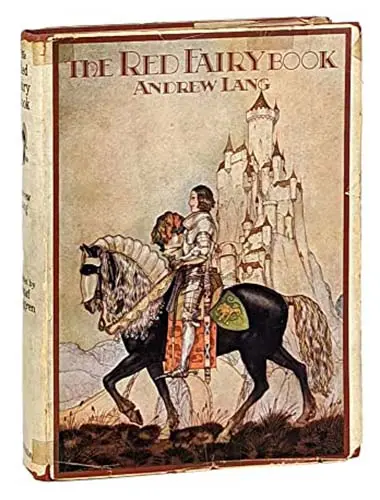
In the pantheon of fairy-tale illustration, certain artists leave an indelible mark on the collective imagination—their images becoming the very lens through which generations envision enchanted forests, heroic princes, and magical realms. Gustaf Tenggren’s 1924 edition of Andrew Lang’s The Red Fairy Book represents such a moment: a meeting of master storyteller and visionary artist that produced one of the most beautiful and sought-after volumes of the Golden Age of Illustration .
Andrew Lang’s “Color Fairy Book” series, which began with The Blue Fairy Book in 1889, had already become a cornerstone of children’s literature when David McKay Company of Philadelphia commissioned a new illustrated edition of The Red Fairy Book in 1924 . The original series, edited by the Scottish scholar and poet Lang, collected fairy tales from France, Germany, Scandinavia, and Russia—including beloved stories like “The Twelve Dancing Princesses,” “Jack and the Beanstalk,” and “The Story of Sigurd” . For this new edition, the publisher turned to a young Swedish-American artist whose work would soon transform the world of children’s books.
Gustaf Adolf Tenggren was born in Sweden in 1896 and studied art at Valands Konstskola in Gothenburg, where he was exposed to the modernist movements sweeping Europe . By the time he emigrated to America in 1920, he had already begun developing the style that would make him famous—a blend of Nordic folk influences, atmospheric lighting, and what one critic described as “lush, painterly” compositions . His work for The Red Fairy Book showcases his early European style at its most refined: rich in detail, warm in palette, and infused with the quiet magic of the old world .
The 1924 edition is a handsome production befitting its status as a collector’s treasure. Bound in red cloth with a pictorial pastedown on the front cover and gilt lettering on the spine, the volume measures approximately 7 by 9.5 inches and contains eight full-page color plates mounted on glossy paper, each protected by captioned tissue guards . The endpapers are illustrated, and black-and-white drawings appear throughout the 285-page text, creating a seamless visual experience from cover to cover . Some early copies feature a top edge tinted in red rather than gilt—a detail that distinguishes variant printings .
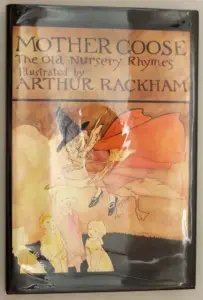
What makes Tenggren’s illustrations for this volume so extraordinary is their distinctive fusion of influences. His style has often been compared to that of Arthur Rackham, the great English Golden Age illustrator, and indeed Tenggren acknowledged Rackham’s influence . Yet his work possesses a warmth and accessibility that sets it apart. His fairy-tale scenes are rendered in a palette of deep greens, rich golds, and soft earth tones—colors that evoke the forests and castles of European folklore. His figures are both elegant and approachable, with a tendency toward what critics have called “silhouetted figures with caricatured faces”—a technique that gives his characters expressive personality without sacrificing their fairy-tale dignity .
Tenggren’s early career coincided with a period of significant transition in illustration. The so-called Golden Age—dominated by artists like Rackham, Kay Nielsen, and Edmund Dulac—was giving way to new styles and new media . Tenggren, who had absorbed modernist influences during his training in Sweden, brought a fresh sensibility to the fairy-tale tradition. His work for The Red Fairy Book stands at the crossroads of old and new: rooted in the decorative elegance of the Golden Age yet forward-looking in its bold use of color and form .
For collectors, the 1924 Red Fairy Book holds a special significance. It represents a pivotal moment in Tenggren’s career—the culmination of his early European style before he would go on to become one of Disney’s most influential concept artists, contributing to Snow White and the Seven Dwarfs, Bambi, and Pinocchio . Later, he would achieve popular fame as the illustrator of Little Golden Books classics like The Poky Little Puppy and The Saggy Baggy Elephant . Yet for many admirers, his Red Fairy Book illustrations remain the pinnacle of his art—a pure, unmediated expression of fairy-tale enchantment.
Today, first editions of this volume are increasingly scarce and expensive. Surviving copies with clean plates, intact bindings, and original dust jackets are especially prized. For those fortunate enough to own one, it offers not merely a book but a journey—into the forests of European folklore, through the imagination of a master artist, and back to a moment when fairy tales were illustrated with a beauty that seems, in our own age, almost enchanted itself.
Recommended for Collectors
- The Blue Fairy Book (1889) by Andrew Lang, illustrated by H.J. Ford – The first of Lang’s series, with classic Victorian engravings
- East of the Sun and West of the Moon (1914) illustrated by Kay Nielsen – For another Nordic-inspired fairy-tale vision
- Tenggren’s Story Book (1930) – Showcasing the artist’s later, more polished style
Art Gallery: Gustaf Tenggren – Red Fairy Tales 1924