Decadent Depths: Harry Clarke’s Selected Poems of Charles Swinburne
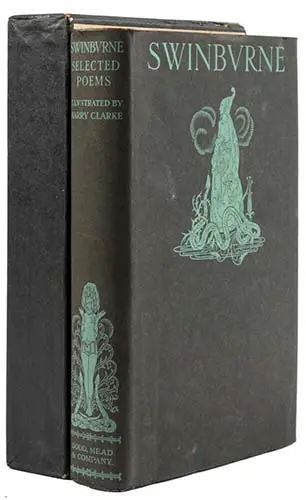
In the annals of literary illustration, certain pairings seem predestined—a convergence of artistic sensibility so perfect that the result transcends both text and image. The collaboration between Harry Clarke and the poetry of Algernon Charles Swinburne is one such convergence. Clarke’s 1928 edition of Selected Poems of Charles Swinburne stands as a masterpiece of the Irish artist’s late career, a volume that matches the Victorian poet’s decadent intensity with an equal measure of visual brilliance.
Harry Clarke (1889–1931) had already established himself as one of the most distinctive illustrators of his generation with his haunting visions for Edgar Allan Poe’s Tales of Mystery and Imagination and Hans Christian Andersen’s fairy tales. His style—characterized by intricate line work, obsessive detail, and a willingness to venture into the grotesque—had found its perfect subject in the darker currents of literature. Swinburne, the great Victorian poet whose work pulsed with themes of paganism, forbidden love, and the ecstatic embrace of death, offered Clarke a new and fertile ground.
Algernon Charles Swinburne (1837–1909) was a poet who divided critical opinion like few others. His work, with its intoxicating rhythms, lush imagery, and unapologetic exploration of sensual and sadomasochistic themes, had scandalized Victorian England. Yet beneath the surface provocations lay a profound engagement with classical mythology, a lyrical gift of extraordinary range, and a vision of beauty that embraced both ecstasy and despair. Poems like “The Garden of Proserpine,” “Hymn to Proserpine,” and “Dolores” had become touchstones of the Decadent movement.
The 1928 edition, published by John Lane The Bodley Head in London, was a lavish production typical of Clarke’s major works. The volume contained eleven photogravure illustrations and numerous in-text decorations. The binding was in black cloth with gilt stamping, a somber canvas that hinted at the intensity within.
What distinguishes Clarke’s Swinburne is his ability to translate the poet’s rhythmic and thematic obsessions into visual form. The sinuous lines of his illustrations echo Swinburne’s rolling cadences; the intricate decorative borders recall the poet’s love of classical form; the figures—elongated, ethereal, often caught in gestures of ecstatic surrender—embody the fusion of sensual and spiritual longing that pulses through Swinburne’s verse.
Clarke’s palette in this volume reflects the poet’s preoccupations. Deep purples, blood reds, shadowed blues, and touches of gold—colors that evoke both the richness of classical antiquity and the decadent allure of the forbidden. His illustrations for “The Garden of Proserpine,” with its meditation on the peace of death, are rendered in cool, muted tones that capture the poem’s quiet resignation. For “Dolores,” the poet’s notorious ode to the goddess of pain, Clarke’s palette intensifies, the colors growing richer and more saturated, the lines more intricate and obsessive.
The photogravure illustrations, as always with Clarke, are equally remarkable. His line work reaches new heights of intricacy, creating textures and patterns that reward sustained attention. Decorative initials, tailpieces, and marginal drawings weave throughout the text, each a miniature masterpiece of the illustrator’s art. The influence of medieval manuscript illumination, which Clarke had absorbed during his training in Dublin, is evident throughout.
The 1928 edition appeared at a time when Clarke’s health was already in decline. His tuberculosis, which would claim his life just three years later, had begun to take its toll. Yet there is no diminishment in the work. If anything, the Swinburne illustrations possess an intensity that suggests an artist working against time, pouring all his remaining creative energy into a subject that spoke to his deepest sensibilities.
Today, first editions of Clarke’s Selected Poems of Charles Swinburne are among the most coveted of his works. For collectors, the volume represents a high point of the Golden Age of Illustration—a work that stands alongside Clarke’s Poe and his Andersen as a testament to his singular genius.
In the pages of this book, Swinburne’s poems find their visual counterpart. Proserpine gathers her flowers in the garden of eternal sleep; Dolores dances in her crimson gown; the sea-winds blow across the headlands of a classical world rendered with all the intensity of the modern imagination. It is a collaboration that transcends time—a meeting of two artists, separated by a generation but united by a shared vision of beauty in its most dangerous and most intoxicating forms.
For the discerning collector:
- The Fairy Tales of Hans Christian Andersen illustrated by Harry Clarke (1916) – showcases his early color work
- Salomé by Oscar Wilde, illustrated by Aubrey Beardsley (1894) – the quintessential Decadent pairing
- Flowers of Evil by Charles Baudelaire, illustrated by Carlos Schwabe (1900) – a Symbolist counterpart
Other books illustrated by the great Harry Clarke are also available for perusal in our gallery: Faust, The Fairy Tales of Charles Perrault, Tales of Mystery and Imagination, Andersen’s Fairy Tales, Year’s at the Spring.
Art Gallery: Harry Clarke – Selected Poems of Charles Swinburne 1928
![Harry Clarke - Poems of Swinburne [clarke-swinburne00] (art, illustrations)](https://www.nocloo.com/wp-content/plugins/justified-image-grid/timthumb.php?src=https%3A%2F%2Fwww.nocloo.com%2Fart%2Fclarke-swinburne%2Fclarke-swinburne00.jpg&h=280&q=90&f=.jpg)
![Harry Clarke - Poems of Swinburne [clarke-swinburne01] (art, illustrations)](https://www.nocloo.com/wp-content/plugins/justified-image-grid/timthumb.php?src=https%3A%2F%2Fwww.nocloo.com%2Fart%2Fclarke-swinburne%2Fclarke-swinburne01.jpg&h=280&q=90&f=.jpg)
![Harry Clarke - Poems of Swinburne [clarke-swinburne02] (art, illustrations)](https://www.nocloo.com/wp-content/plugins/justified-image-grid/timthumb.php?src=https%3A%2F%2Fwww.nocloo.com%2Fart%2Fclarke-swinburne%2Fclarke-swinburne02.jpg&h=280&q=90&f=.jpg)
![Harry Clarke - Poems of Swinburne [clarke-swinburne03] (art, illustrations)](https://www.nocloo.com/wp-content/plugins/justified-image-grid/timthumb.php?src=https%3A%2F%2Fwww.nocloo.com%2Fart%2Fclarke-swinburne%2Fclarke-swinburne03.jpg&h=280&q=90&f=.jpg)
![Harry Clarke - Poems of Swinburne [clarke-swinburne04] (art, illustrations)](https://www.nocloo.com/wp-content/plugins/justified-image-grid/timthumb.php?src=https%3A%2F%2Fwww.nocloo.com%2Fart%2Fclarke-swinburne%2Fclarke-swinburne04.jpg&h=280&q=90&f=.jpg)
![Harry Clarke - Poems of Swinburne [clarke-swinburne05] (art, illustrations)](https://www.nocloo.com/wp-content/plugins/justified-image-grid/timthumb.php?src=https%3A%2F%2Fwww.nocloo.com%2Fart%2Fclarke-swinburne%2Fclarke-swinburne05.jpg&h=280&q=90&f=.jpg)
![Harry Clarke - Poems of Swinburne [clarke-swinburne06] (art, illustrations)](https://www.nocloo.com/wp-content/plugins/justified-image-grid/timthumb.php?src=https%3A%2F%2Fwww.nocloo.com%2Fart%2Fclarke-swinburne%2Fclarke-swinburne06.jpg&h=280&q=90&f=.jpg)
![Harry Clarke - Poems of Swinburne [clarke-swinburne07] (art, illustrations)](https://www.nocloo.com/wp-content/plugins/justified-image-grid/timthumb.php?src=https%3A%2F%2Fwww.nocloo.com%2Fart%2Fclarke-swinburne%2Fclarke-swinburne07.jpg&h=280&q=90&f=.jpg)
![Harry Clarke - Poems of Swinburne [clarke-swinburne08] (art, illustrations)](https://www.nocloo.com/wp-content/plugins/justified-image-grid/timthumb.php?src=https%3A%2F%2Fwww.nocloo.com%2Fart%2Fclarke-swinburne%2Fclarke-swinburne08.jpg&h=280&q=90&f=.jpg)
![Harry Clarke - Poems of Swinburne [clarke-swinburne09] (art, illustrations)](https://www.nocloo.com/wp-content/plugins/justified-image-grid/timthumb.php?src=https%3A%2F%2Fwww.nocloo.com%2Fart%2Fclarke-swinburne%2Fclarke-swinburne09.jpg&h=280&q=90&f=.jpg)
![Harry Clarke - Poems of Swinburne [clarke-swinburne10] (art, illustrations)](https://www.nocloo.com/wp-content/plugins/justified-image-grid/timthumb.php?src=https%3A%2F%2Fwww.nocloo.com%2Fart%2Fclarke-swinburne%2Fclarke-swinburne10.jpg&h=280&q=90&f=.jpg)