A Dance with the Devil: Harry Clarke’s Faust
There are certain works of literature that seem to demand illustration—texts so rich in visual possibility that they cry out for an artist to give them form. Goethe’s Faust is such a work, and Harry Clarke’s 1925 edition of the great drama stands as one of the crowning achievements of his tragically brief career. It is a volume where the Irish artist’s signature blend of intricate beauty and macabre intensity finds its perfect subject in the story of the scholar who sells his soul for knowledge.
Harry Clarke (1889–1931) had already established his reputation with haunting visions for Edgar Allan Poe, Hans Christian Andersen, and Charles Perrault when he turned his attention to Goethe’s masterpiece. His style—characterized by obsessive detail, elongated figures, and a willingness to venture into the grotesque—was ideally suited to the dual nature of Faust, a work that moves between the celestial and the infernal, between the yearning for transcendence and the embrace of damnation.
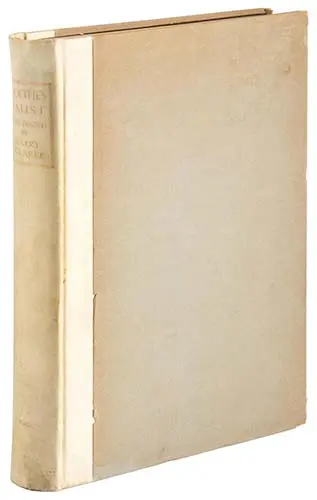
The 1925 edition, published by George G. Harrap & Co. in London, was a lavish production. The volume contained eight color and 13 black-and-white illustrations and decorative elements that transformed every page into a visual experience. The binding was in black cloth with gilt stamping, a somber canvas that reflected the gravity of the subject. The book was issued in both trade and limited editions, the latter signed by the artist.
What distinguishes Clarke’s Faust is his ability to capture the psychological complexity of the drama. His Faust is not merely a damned soul but a figure of tragic ambition—a scholar whose pursuit of knowledge has left him hollow, desperate enough to bargain with the devil. His Mephistopheles is a masterpiece of ambiguous menace: elegant, sophisticated, with a smile that promises both fulfillment and ruin. The devil’s figure in Clarke’s illustrations seems to shift between forms—a courtier, a tempter, a presence that is never quite solid, never quite graspable.
Clarke’s palette in this volume reflects the drama’s moral and emotional range. The celestial scenes—the prologue in heaven, the final redemption—are rendered in soft golds, pale blues, and luminous whites. The earthly scenes are dominated by rich, warm tones—the deep reds of the wine cellar, the golden glow of the cathedral, the muted greens of the forest. And the infernal scenes—the witches’ sabbath on the Brocken, the descent into the realm of the mothers—are rendered in deep purples, blood reds, and shadows so dense they seem to swallow the light.
The black-and-white illustrations are among the most extraordinary Clarke ever produced. His line work reaches new heights of intricacy, creating textures and patterns that reward sustained attention. The famous scene of Faust and Mephistopheles galloping through the night is rendered in a whirlwind of line—figures, landscape, and shadow merging into a single, breathtaking composition. The decorative borders, initials, and tailpieces that weave throughout the text are themselves miniature masterpieces, each one a meditation on the themes of the drama.
The selection of scenes Clarke chose to illustrate reflects his understanding of the work’s emotional arc. The opening scene in Faust’s study, the pact with Mephistopheles, the seduction of Gretchen, the Walpurgis Night, the final redemption—each moment is rendered with a sensitivity that captures the tragedy and the hope of Goethe’s vision.
Today, Clarke’s Faust is among the most prized of his works. For collectors and admirers of the Golden Age of Illustration, the volume represents a high point of Clarke’s career—a work that stands as a testament to his singular genius.
In the pages of this book, Faust still bargains, Mephistopheles still smiles, and Gretchen still awaits her fate. Harry Clarke gave Goethe’s great drama a visual language of extraordinary power—a dance with the devil rendered in ink and watercolor, a vision of damnation and redemption that lingers in the mind long after the book is closed. It is a masterpiece of the illustrated book, and a fitting legacy for an artist whose own life was tragically brief, but whose work endures.
For collectors:
- Tales of Mystery and Imagination by Edgar Allan Poe, illustrated by Harry Clarke (1919) – Clarke’s breakthrough work showing his earlier gothic style
- The Divine Comedy by Dante Alighieri, illustrated by Gustave Doré (1861-1868) – Another visionary interpretation of a literary masterpiece
- The Rime of the Ancient Mariner by Samuel Taylor Coleridge, illustrated by Gustave Doré (1876) – A complementary romantic work with supernatural themes
Other books illustrated by the great Harry Clarke are also available for perusal in our gallery: The Fairy Tales of Charles Perrault, Selected Poems of Charles Swinburne, Tales of Mystery and Imagination, Andersen’s Fairy Tales, Year’s at the Spring.
Art Gallery: Harry Clarke – Faust 1925
![Harry Clarke - Faust [harryclarke-faust01] (art, illustrations)](https://www.nocloo.com/wp-content/plugins/justified-image-grid/timthumb.php?src=https%3A%2F%2Fwww.nocloo.com%2Fart%2Fclarke-faust%2Fharryclarke-faust01.jpg&h=280&q=90&f=.jpg)