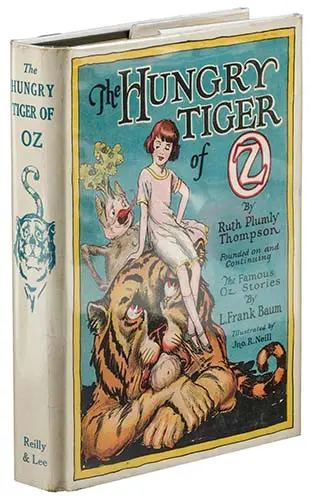
The Hungry Tiger of Oz was published in 1926 by Reilly & Lee Co. in Chicago as the twentieth book in the Oz series and the sixth written by Ruth Plumly Thompson, who succeeded L. Frank Baum as Royal Historian of Oz after his death in 1919. John R. Neill provided twelve color plates and numerous black-and-white illustrations throughout the 252-page volume.
The book focused on the Hungry Tiger, a minor character from Baum’s original The Wonderful Wizard of Oz who famously longs to eat a fat baby but never does because his conscience prevents him.The work entered the public domain in the United States in 2022. A paperback reprint edition was published by Del Rey / Random House in 1985, followed by a facsimile hardcover from the International Wizard of Oz Club in 1991.
Summary
Thompson begins with a usurping tyrant, Irasha the Rough, the Pasha of Rash, a tiny kingdom in the southwest of Ev. The Pasha has a problem: his prison is too full to cram any more Rashers in. His Vizier’s solution is to obtain a ferocious animal from nearby Oz to devour the luckless prisoners. Travelling to the Emerald City by his magical “hurry cane”, the Vizier lures the Hungry Tiger (first seen in Ozma of Oz) to Rash. As might be expected from his history, however, the Hungry Tiger is too tenderhearted to eat prisoners.
Meanwhile, through an unfortunate series of events involving a winding road and a pair of Quick Sandals, Betsy Bobbin (introduced in Tik-Tok of Oz) and her new acquaintance, Carter Green, the Vegetable Man, end up in Rash, and no sooner do they arrive than they’re thrown into the crowded prison. There they meet the Scarlet Prince Evered (known as Reddy), the rightful ruler of Rash. Together with the Tiger, they escape, and have varied adventures with Big Wigs and Gnomes in their search for three magic rubies.
Back in Oz, Princess Ozma has troubles of her own: she is confronted by Atmos Fere, a balloon-like being who lives in the upper stratosphere. His plan is to kidnap her up to his own kingdom, to prove to his skeptical fellows that living beings can exist on the surface of the Earth. Ozma, however, has a secret weapon (a pin).
In time, the adventurers recover the magic rubies, and Reddy is restored to the Rashian throne. The Pasha and his evil Vizier end up stranded on a desert island in the Nonestic Ocean.
The Hungry Tiger of Oz | First Edition Identification Guide
Please refer to the gallery for detailed images of binding(s) and dust jackets.
| Year | Title | Publisher | First edition/printing identification points |
|---|---|---|---|
| 1926 | The Hungry Tiger of Oz | Reilly & Lee Co., [1926] | First edition. Illustrated by John R. Neill, 261 pages. Textual points: The two pages (each with a blank verso) of advertisements at the end of the book were included without charge in all printings for many years. Pictorial self-endpapers in black and white.* Color plates: 12 full-color inserts, tipped in facing the title page and pages 32, 64, 72, 128, 136, 152, 200, 216, 224, 240, 256. Plate stock is coated only on the printed side. Binding: dark drab-green cloth with pictorial paper label in colors. Spine imprint: “Reilly | & Lee”. Size of leaf: 9 by 6 5/8 inches. Thickness of volume: About 1 3/8 inches. An issue with the imprint of the Copp, Clark Co., Limited, of Toronto on the title page and spine is known. It is otherwise identical with the American first state.
Later states have color plates coated on both sides. Such copies have been seen in dark emerald-green, medium-green, and medium brick-red cloth. Around 1935, the color plates were discontinued. |
The Hungry Tiger of Oz First Edition Dust Jacket Identification Guide
First edition binding(s) and various dust jacket printings identification.


References:
- Wikipedia
- Bibliographia Oziana – Haff, Greeme, Martin. 2002