The Surreal Soul of Hoffmann: Mario Laboccetta’s Illustrated Masterpiece
There are illustrated books that merely decorate a text, and then there are those rare volumes where the artist’s vision seems to crawl inside the very marrow of the stories, giving visual form to their deepest anxieties and most fevered dreams. Mario Laboccetta’s 1932 edition of Tales of Hoffmann—published in France as Contes d’Hoffmann by the prestigious Editions d’Art H. Piazza—belongs decisively to the latter category. It is a work that stands as one of the crowning achievements of Art Deco illustration, a collaboration between a German Romantic genius and an Italian artist whose sensibility was perfectly attuned to the strange, the uncanny, and the beautiful.
Mario Laboccetta was born in Naples in 1899, but his artistic soul found its true home in Paris during the 1920s and 1930s . It was there, in the ferment of the Années Folles, that he established his reputation, contributing to fashion magazines, designing posters, and creating illustrations that blended Art Deco elegance with a distinctly surrealist sensibility . His work drew upon the graphic traditions of Art Nouveau while embracing the bold geometries and psychological depths of the modern era . By the time he undertook the Hoffmann commission, Laboccetta had already become a name among connoisseurs—an artist capable of moving between the worlds of high fashion and literary illustration with equal grace.
The book itself is a testament to the art of fine press production. Published in a limited edition of 2,200 copies, it featured an extraordinary forty-one color compositions by Laboccetta: a cover illustration, a title vignette, seven headpieces, ten full-page plates, fifteen in-text illustrations, and seven tailpieces . The sheer abundance of imagery creates an immersive experience—a world in which Hoffmann’s words are constantly in dialogue with Laboccetta’s visions. The selected tales include five of Hoffmann’s most haunting stories: The Interdependence of Things, The Sandman, The Mystery of the Deserted House, The Lost Reflection, and The Walled-in Door .
What makes Laboccetta’s illustrations so extraordinary is their psychological resonance. Hoffmann’s stories occupy a peculiar territory—hovering between Gothic horror, Romantic longing, and dark comedy—and Laboccetta captures this tonal complexity with remarkable sensitivity. His figures possess an elegant, elongated grace typical of Art Deco illustration, yet there is something unsettling beneath the surface. Eyes are wide, gazes unfocused; bodies contort into impossible poses; shadows fall where they should not. The influence of Surrealism is palpable, particularly in his handling of space and perspective . Rooms tilt, landscapes warp, and the boundaries between the real and the imagined dissolve—a perfect visual analogue for Hoffmann’s tales of obsession, doubling, and the uncanny.
The story of The Sandman, which Freud would later use as the foundation for his essay on the uncanny, receives particularly memorable treatment. Laboccetta’s rendering of the sinister Coppelius is a study in ambiguous menace—part puppet-maker, part demon, his features both grotesque and strangely elegant. The illustrations for The Lost Reflection, a tale of identity and fragmentation, employ mirrors, doubles, and fractured compositions that anticipate the visual language of Surrealist painting.
Laboccetta’s artistic journey, which began with scenery painting for a traveling marionette theater, proved a perfect preparation for Hoffmann’s world . There is a theatricality to his illustrations, a sense that these are scenes staged for maximum emotional effect. Yet beneath the artifice lies genuine psychological depth—an understanding that Hoffmann’s tales are not merely fantastic entertainments but explorations of the darkest corners of the human psyche.
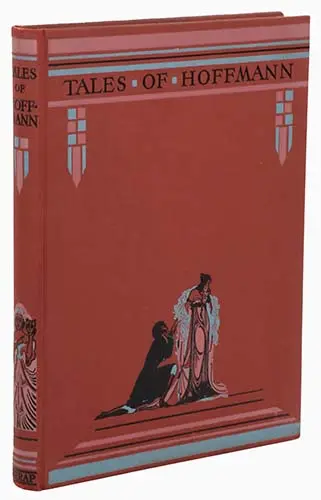
The 1932 Tales of Hoffmann was published simultaneously in Paris by H. Piazza and in London by George G. Harrap, with an American edition following from Dodd, Mead . The British edition, bound in rust-red boards with a pictorial wrapper designed by Laboccetta himself, is particularly prized by collectors . In France, the book was issued on vélin chiffon paper, the color plates tipped in by hand—a production quality that reflected the publisher’s commitment to the illustrated book as a work of art.
Despite his achievements, Laboccetta remained an enigmatic figure—described by those who knew him as a solitary, melancholic man, more comfortable with his mandolin than with the social circuits of the art world . He spent his later years on the island of Capri, painting dreamlike canvases that blended Neapolitan folklore with surrealist imagery. Yet his illustrated books, and particularly his Tales of Hoffmann, endure as monuments to his singular vision.
Today, Laboccetta’s Hoffmann is considered one of his finest achievements—a work that critics have placed alongside the contributions of Barbier, Brunelleschi, and Dulac to the great tradition of French illustrated publishing . In its pages, the strange soul of E.T.A. Hoffmann finds its perfect visual counterpart: elegant, unsettling, and utterly unforgettable.
For Fans of This Edition
- Grimm’s Fairy Tales (1909) illustrated by Arthur Rackham – For another masterful take on dark folklore
Art Gallery: Mario Laboccetta – Tales of Hoffmann 1932
![Mario Laboccetta - Tales of Hoffmann [laboccetta-hoffmann01] (art, illustrations)](https://www.nocloo.com/wp-content/plugins/justified-image-grid/timthumb.php?src=https%3A%2F%2Fwww.nocloo.com%2Fart%2Flaboccetta-hoffman%2Flaboccetta-hoffmann01.jpg&h=280&q=90&f=.jpg "Mario Laboccetta - Illustrations for Tales of Hoffmann 1932")
![Mario Laboccetta - Tales of Hoffmann [laboccetta-hoffmann02] (art, illustrations)](https://www.nocloo.com/wp-content/plugins/justified-image-grid/timthumb.php?src=https%3A%2F%2Fwww.nocloo.com%2Fart%2Flaboccetta-hoffman%2Flaboccetta-hoffmann02.jpg&h=280&q=90&f=.jpg "Mario Laboccetta - Illustrations for Tales of Hoffmann 1932")
![Mario Laboccetta - Tales of Hoffmann [laboccetta-hoffmann03] (art, illustrations)](https://www.nocloo.com/wp-content/plugins/justified-image-grid/timthumb.php?src=https%3A%2F%2Fwww.nocloo.com%2Fart%2Flaboccetta-hoffman%2Flaboccetta-hoffmann03.jpg&h=280&q=90&f=.jpg "Mario Laboccetta - Illustrations for Tales of Hoffmann 1932")
![Mario Laboccetta - Tales of Hoffmann [laboccetta-hoffmann04] (art, illustrations)](https://www.nocloo.com/wp-content/plugins/justified-image-grid/timthumb.php?src=https%3A%2F%2Fwww.nocloo.com%2Fart%2Flaboccetta-hoffman%2Flaboccetta-hoffmann04.jpg&h=280&q=90&f=.jpg "Mario Laboccetta - Illustrations for Tales of Hoffmann 1932")
![Mario Laboccetta - Tales of Hoffmann [laboccetta-hoffmann05] (art, illustrations)](https://www.nocloo.com/wp-content/plugins/justified-image-grid/timthumb.php?src=https%3A%2F%2Fwww.nocloo.com%2Fart%2Flaboccetta-hoffman%2Flaboccetta-hoffmann05.jpg&h=280&q=90&f=.jpg "Mario Laboccetta - Illustrations for Tales of Hoffmann 1932")
![Mario Laboccetta - Tales of Hoffmann [laboccetta-hoffmann06] (art, illustrations)](https://www.nocloo.com/wp-content/plugins/justified-image-grid/timthumb.php?src=https%3A%2F%2Fwww.nocloo.com%2Fart%2Flaboccetta-hoffman%2Flaboccetta-hoffmann06.jpg&h=280&q=90&f=.jpg "Mario Laboccetta - Illustrations for Tales of Hoffmann 1932")
![Mario Laboccetta - Tales of Hoffmann [laboccetta-hoffmann07] (art, illustrations)](https://www.nocloo.com/wp-content/plugins/justified-image-grid/timthumb.php?src=https%3A%2F%2Fwww.nocloo.com%2Fart%2Flaboccetta-hoffman%2Flaboccetta-hoffmann07.jpg&h=280&q=90&f=.jpg "Mario Laboccetta - Illustrations for Tales of Hoffmann 1932")
![Mario Laboccetta - Tales of Hoffmann [laboccetta-hoffmann08] (art, illustrations)](https://www.nocloo.com/wp-content/plugins/justified-image-grid/timthumb.php?src=https%3A%2F%2Fwww.nocloo.com%2Fart%2Flaboccetta-hoffman%2Flaboccetta-hoffmann08.jpg&h=280&q=90&f=.jpg "Mario Laboccetta - Illustrations for Tales of Hoffmann 1932")
![Mario Laboccetta - Tales of Hoffmann [laboccetta-hoffmann09] (art, illustrations)](https://www.nocloo.com/wp-content/plugins/justified-image-grid/timthumb.php?src=https%3A%2F%2Fwww.nocloo.com%2Fart%2Flaboccetta-hoffman%2Flaboccetta-hoffmann09.jpg&h=280&q=90&f=.jpg "Mario Laboccetta - Illustrations for Tales of Hoffmann 1932")
![Mario Laboccetta - Tales of Hoffmann [laboccetta-hoffmann10] (art, illustrations)](https://www.nocloo.com/wp-content/plugins/justified-image-grid/timthumb.php?src=https%3A%2F%2Fwww.nocloo.com%2Fart%2Flaboccetta-hoffman%2Flaboccetta-hoffmann10.jpg&h=280&q=90&f=.jpg "Mario Laboccetta - Illustrations for Tales of Hoffmann 1932")