A Masterwork of Dickensian Vision: Rackham’s A Christmas Carol
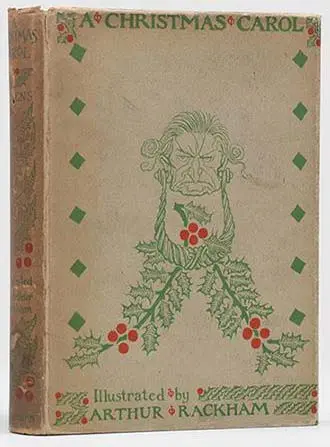
Arthur Rackham’s illustrated edition of A Christmas Carol represents one of the most extraordinary marriages of literary and artistic genius in the history of book illustration. Published in 1915 by William Heinemann in London and J. B. Lippincott in Philadelphia, this volume arrived at the zenith of Rackham’s creative maturity, following his celebrated interpretations of Peter Pan in Kensington Gardens, The Ring of the Nibelung, and Rip Van Winkle. By this juncture in his career, Rackham had established himself as the preeminent illustrator of the Edwardian Golden Age, and his rendering of Charles Dickens’s beloved Christmas tale would come to be regarded as one of his finest achievements.
The edition features twelve full-color plates, each reproduced from Rackham’s original watercolor paintings with exceptional care, complemented by numerous pen-and-ink drawings delicately woven throughout the text. These illustrations are distinguished not only by their technical mastery but by their remarkable interpretive insight. Rackham approached Dickens’s narrative as a work of profound psychological depth, capturing Scrooge’s spiritual journey with a visual vocabulary that mirrors the text’s emotional arc. In the early scenes, Scrooge appears as a figure of almost grotesque angularity—his frame bent against the frosty London wind, his features sharpened by decades of avarice and solitude. As the tale progresses and redemption takes hold, Rackham’s rendering subtly softens, the harsh lines giving way to a more rounded and human presence.
The artist’s depictions of the three spirits have become definitive visual interpretations. The Ghost of Christmas Past emerges as a delicate, ambiguous figure bearing a sprig of holly, rendered in muted golds and soft greens that evoke the elusive, dreamlike quality of memory. The Ghost of Christmas Present stands in stark contrast—a colossal, bearded figure robed in fur and crowned with holly, his abundance spilling across the page in a celebration of warmth and generosity. Most haunting is Rackham’s Ghost of Christmas Yet to Come: a shrouded, skeletal form whose shadowed hood and outstretched hand embody the terror of fate unexamined, a visual rendering of dread that has lost none of its power across the decades.
Beyond the supernatural elements, Rackham lavished equal attention upon the human figures who populate Dickens’s London. The Cratchit family is rendered with genuine tenderness—Tiny Tim perched upon his father’s shoulder in an image of delicate pathos, while the bustling streets of the city come alive through Rackham’s precise yet atmospheric line work. The illustrations capture both the grim fog of Scrooge’s pre-redemption world and the radiant warmth of its transformed conclusion, the visual atmosphere shifting in harmony with the narrative’s moral arc.
The physical production of the first edition reflects the high standards of Heinemann’s deluxe illustrated volumes. Bound in gilt-stamped cloth with a pictorial cover design drawn from one of the interior plates, the book was issued in both trade and limited editions, the latter signed by the artist and printed on larger paper with the plates mounted on art paper.
More than a century after its publication, Rackham’s A Christmas Carol remains the definitive illustrated edition of Dickens’s masterpiece—a testament to the singular power that emerges when two masters of their respective arts are brought into dialogue across the illuminated page.
Recommended for collectors and readers:
- The Night Before Christmas (1931), illustrated by Arthur Rackham – Another holiday classic rendered in Rackham’s magical style.
- Grimm’s Fairy Tales (1909), illustrated by Arthur Rackham – A perfect companion for those who enjoy darker, folkloric storytelling.
- The Chimes (1912), by Charles Dickens, illustrated by Hugh Thomson – Another Dickens holiday tale with finely detailed period illustrations.
Art Gallery: Arthur Rackham – A Christmas Carol, 1915
![Arthur Rackham - A Christmas Carol [rackham-carol01] (art, illustrations)](https://www.nocloo.com/wp-content/plugins/justified-image-grid/timthumb.php?src=https%3A%2F%2Fwww.nocloo.com%2Fart%2Frackham-carol%2Frackham-carol01.jpg&h=280&q=90&f=.jpg "Arthur Rackham - Illustrations for A Christmas Carol 1915")
![Arthur Rackham - A Christmas Carol [rackham-carol02] (art, illustrations)](https://www.nocloo.com/wp-content/plugins/justified-image-grid/timthumb.php?src=https%3A%2F%2Fwww.nocloo.com%2Fart%2Frackham-carol%2Frackham-carol02.jpg&h=280&q=90&f=.jpg "Arthur Rackham - Illustrations for A Christmas Carol 1915")
![Arthur Rackham - A Christmas Carol [rackham-carol03] (art, illustrations)](https://www.nocloo.com/wp-content/plugins/justified-image-grid/timthumb.php?src=https%3A%2F%2Fwww.nocloo.com%2Fart%2Frackham-carol%2Frackham-carol03.jpg&h=280&q=90&f=.jpg "Arthur Rackham - Illustrations for A Christmas Carol 1915")
![Arthur Rackham - A Christmas Carol [rackham-carol04] (art, illustrations)](https://www.nocloo.com/wp-content/plugins/justified-image-grid/timthumb.php?src=https%3A%2F%2Fwww.nocloo.com%2Fart%2Frackham-carol%2Frackham-carol04.jpg&h=280&q=90&f=.jpg "Arthur Rackham - Illustrations for A Christmas Carol 1915")
![Arthur Rackham - A Christmas Carol [rackham-carol05] (art, illustrations)](https://www.nocloo.com/wp-content/plugins/justified-image-grid/timthumb.php?src=https%3A%2F%2Fwww.nocloo.com%2Fart%2Frackham-carol%2Frackham-carol05.jpg&h=280&q=90&f=.jpg "Arthur Rackham - Illustrations for A Christmas Carol 1915")
![Arthur Rackham - A Christmas Carol [rackham-carol06] (art, illustrations)](https://www.nocloo.com/wp-content/plugins/justified-image-grid/timthumb.php?src=https%3A%2F%2Fwww.nocloo.com%2Fart%2Frackham-carol%2Frackham-carol06.jpg&h=280&q=90&f=.jpg "Arthur Rackham - Illustrations for A Christmas Carol 1915")
![Arthur Rackham - A Christmas Carol [rackham-carol07] (art, illustrations)](https://www.nocloo.com/wp-content/plugins/justified-image-grid/timthumb.php?src=https%3A%2F%2Fwww.nocloo.com%2Fart%2Frackham-carol%2Frackham-carol07.jpg&h=280&q=90&f=.jpg "Arthur Rackham - Illustrations for A Christmas Carol 1915")
![Arthur Rackham - A Christmas Carol [rackham-carol08] (art, illustrations)](https://www.nocloo.com/wp-content/plugins/justified-image-grid/timthumb.php?src=https%3A%2F%2Fwww.nocloo.com%2Fart%2Frackham-carol%2Frackham-carol08.jpg&h=280&q=90&f=.jpg "Arthur Rackham - Illustrations for A Christmas Carol 1915")
![Arthur Rackham - A Christmas Carol [rackham-carol09] (art, illustrations)](https://www.nocloo.com/wp-content/plugins/justified-image-grid/timthumb.php?src=https%3A%2F%2Fwww.nocloo.com%2Fart%2Frackham-carol%2Frackham-carol09.jpg&h=280&q=90&f=.jpg "Arthur Rackham - Illustrations for A Christmas Carol 1915")
![Arthur Rackham - A Christmas Carol [rackham-carol10] (art, illustrations)](https://www.nocloo.com/wp-content/plugins/justified-image-grid/timthumb.php?src=https%3A%2F%2Fwww.nocloo.com%2Fart%2Frackham-carol%2Frackham-carol10.jpg&h=280&q=90&f=.jpg "Arthur Rackham - Illustrations for A Christmas Carol 1915")
![Arthur Rackham - A Christmas Carol [rackham-carol11] (art, illustrations)](https://www.nocloo.com/wp-content/plugins/justified-image-grid/timthumb.php?src=https%3A%2F%2Fwww.nocloo.com%2Fart%2Frackham-carol%2Frackham-carol11.jpg&h=280&q=90&f=.jpg "Arthur Rackham - Illustrations for A Christmas Carol 1915")
![Arthur Rackham - A Christmas Carol [rackham-carol12] (art, illustrations)](https://www.nocloo.com/wp-content/plugins/justified-image-grid/timthumb.php?src=https%3A%2F%2Fwww.nocloo.com%2Fart%2Frackham-carol%2Frackham-carol12.jpg&h=280&q=90&f=.jpg "Arthur Rackham - Illustrations for A Christmas Carol 1915")