Four Gardens, One Enchanting Vision: Charles Robinson’s The Four Gardens
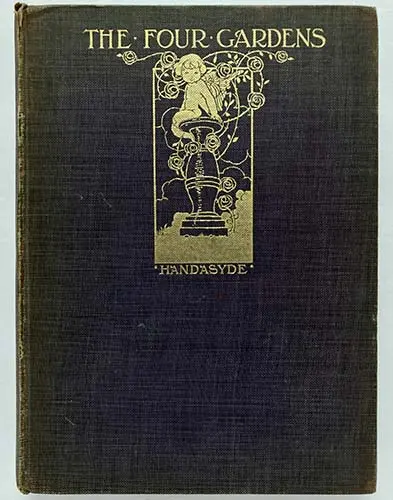
In the spring of 1912, British readers were treated to a quiet literary gem—a collection of four garden-themed stories by the writer Emily Handasyde Buchanan, who wrote under the pen name “Handasyde.” The Four Gardens might have remained a modest success, were it not for the extraordinary illustrations of Charles Robinson, one of the most gifted artists of the Edwardian era . This collaboration transformed a pleasant collection of tales into a lasting treasure of the illustrated book tradition .
Emily Handasyde Buchanan (1872–?) was a British author whose work often explored domestic themes and the quiet rhythms of country life . The Four Gardens brought together four stories: “The Haunted Garden,” “The Old-Fashioned Garden,” “The Poor Man’s Garden,” and “The Rich Man’s Garden” . Each tale, according to a contemporary review in The Spectator, possessed “a wholesome fragrance” and “a character of its own” . The “Haunted Garden” told of a ghost whose only trace was a worn path through a bed of mint—a detail the reviewer found “so convincingly told that one would like to hear if the ghost’s feet left any impression on newly fallen snow” .
But it was Charles Robinson (1870–1937) who elevated the volume. A member of a remarkable artistic family—his brothers Thomas and William Heath Robinson were also celebrated illustrators—Robinson had already made his name with A Child’s Garden of Verses (1896) and his own edition of Alice’s Adventures in Wonderland (1907) . His style was characterized by delicate line work, a subtle decorative sensibility, and a gift for capturing mood through the smallest gestures .
The 1912 edition, published simultaneously in London by William Heinemann and in Philadelphia by J.B. Lippincott Co., was a handsome octavo volume . Bound in purple or green cloth decorated in gilt—often featuring a design of a small angel sitting on a garden urn—the book measured approximately 21 centimeters in height . Inside, readers discovered eight full-page color plates. These plates were accompanied by numerous black-and-white drawings scattered throughout the text, as well as decorative borders and pictorial endpapers that created a unified visual experience .
The color plates in The Four Gardens reflect Robinson’s mature style at its most refined. His palette is soft and luminous—gentle greens, warm golds, touches of pink and blue—evoking the quiet beauty of the garden settings . His figures, rendered with the elegant, elongated grace characteristic of his work, possess a tenderness that matches Handasyde’s prose. The black-and-white illustrations, printed throughout the text, demonstrate Robinson’s extraordinary draftsmanship; each line contributes to an atmosphere of quiet enchantment .
Contemporary reviews praised Robinson’s contribution warmly. The International Studio noted that “the chief attraction for us, however, lies in the illustrations, decorations and ornaments. Mr. Robinson’s work has a character of sympathy and charm peculiarly its own, and the drawings he has executed for this book are delicate in draughtsmanship and very decorative in composition” . The Spectator was somewhat less enthusiastic about the color plates, noting technical limitations, but praised “the little black-and-white illustrations” without reservation .
Today, The Four Gardens is a prized collectible. First editions in good condition are increasingly scarce. For collectors and admirers of Golden Age illustration, it offers a glimpse into a vanished world—a world of haunted mint paths, old-fashioned borders, and gardens where the line between the natural and the enchanted blurs.
In the pages of this book, the gardens still bloom. The ghost still walks through the mint; the old-fashioned borders still hold their secrets; the rich man’s garden still welcomes its visitors. And Charles Robinson, with his delicate pen and his luminous watercolors, invites us to wander through them all—a reminder that the greatest illustrated books, like the finest gardens, reward those who pause, look closely, and linger.
For collectors:
- The Secret Garden by Frances Hodgson Burnett, illustrated by Charles Robinson (1911) – His artwork enhances this classic children’s novel
- Our Sentimental Garden (1914) – A garden-themed memoir enriched by Robinson’s gentle, romantic illustrations.
- The Happy Prince and Other Tales by Oscar Wilde, illustrated by Charles Robinson (1913) – A perfect marriage of Wilde’s fairy tales and Robinson’s delicate style
Other books illustrated by Charles Robinson available in our gallery: The Secret Garden, The Big Book of Fairy Tales, Bee, Princess of the Dwarfs, Margaret’s Book, The Happy Prince, Our Sentimental Garden, Songs and Sonnets.
Art Gallery: Charles Robinson – The Four Gardens 1912