A Gentle Grimm: Mabel Lucie Attwell’s Fairy Tales
There is a certain perception of the Brothers Grimm that has persisted for generations: that their tales are dark, bloody, and not for the faint of heart. Mabel Lucie Attwell, one of the most beloved illustrators of the early twentieth century, took a different approach. Her 1910 edition of Grimm’s Fairy Tales transformed the often-fearsome world of German folklore into something warm, cozy, and utterly endearing—a volume that invited children into the enchanted forest with a reassuring hand held out.
Mabel Lucie Attwell (1879–1964) was an English illustrator whose name became synonymous with childhood itself. Born in London’s East End, she studied at the Regent Street School of Art and the Heatherley School of Fine Art, but her true education came from an innate understanding of children—their expressions, their emotions, their capacity for both mischief and wonder. Her style, characterized by round-faced, rosy-cheeked toddlers with button noses and mischievous expressions, struck a chord with the public that never wavered throughout her long career. She did not merely illustrate children; she seemed to inhabit their world.
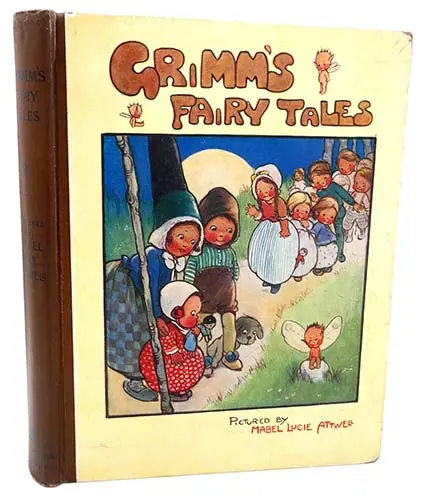
The 1910 edition, published by Raphael Tuck in London, was a handsome production. The volume contained twelve full-page color plates—, alongside numerous black-and-white illustrations scattered throughout the text. The binding was in cloth with an illustrated cover, often featuring Attwell’s signature chubby-cheeked children in scenes of fairy-tale adventure. It was a book designed not for the collector’s shelf but for the nursery—a volume meant to be held, read aloud, and cherished.
What distinguishes Attwell’s approach to the Grimms’ tales is her refusal to dwell on their darker elements. In her hands, the witch of “Hansel and Gretel” is rendered more comically menacing than truly terrifying; the wolf in “Little Red Riding Hood” possesses a certain bumbling charm; even the darker moments of “The Goose Girl” and “The Six Swans” are softened with a gentleness that reassures rather than unsettles. Her palette is warm and inviting—soft pinks, gentle blues, warm yellows, and touches of green that evoke the comfort of a well-loved nursery rather than the gloom of a dark forest.
Attwell’s children are the stars of her illustrations. Her Hansel and Gretel are plump, wide-eyed, and utterly endearing; her Red Riding Hood is the quintessential Attwell child—rosy-cheeked, golden-haired, with a expression of innocent curiosity. Even the princesses and princes of the more romantic tales possess a cozy domesticity that makes them approachable rather than remote. These are not the idealized figures of Art Nouveau illustration but children who could live next door, children who might be the reader’s own friends.
The book’s success was immediate. Attwell’s Grimm’s Fairy Tales joined her growing list of beloved children’s books, including her Mother Goose and Peter Pan editions. Parents appreciated the gentleness of her interpretations; children adored the familiarity of her characters. The book remained in print for decades, going through numerous reprintings and editions, a testament to the enduring appeal of Attwell’s vision.
Today, Attwell’s Grimm’s Fairy Tales is a cherished collectible. First editions in good condition, with clean plates and intact bindings, are increasingly scarce, as the book’s intended use—in the hands of children—meant that many copies were loved to pieces. For collectors and admirers of Attwell’s work, the volume represents a high point in her career—a work where her gentle, accessible style found perfect alignment with stories that have captivated children for centuries.
In the pantheon of Grimm illustrators, Attwell occupies a unique place. Where Arthur Rackham emphasized mystery and Kay Nielsen conjured grandeur, Attwell offered warmth. Her Grimm is not a world to fear but a world to explore—a place where the enchanted forest is just beyond the garden gate, where witches can be outwitted, where good prevails, and where children, plump-cheeked and wide-eyed, can have adventures and still be home in time for tea. In Attwell’s hands, even the Brothers Grimm become a source of comfort—a reminder that the best fairy tales, like the best childhoods, are those that balance wonder with reassurance, and that always, always, end happily.
Recommended for Collectors
- Mother Goose Nursery Rhymes (1910) illustrated by Attwell – A beautifully illustrated collection of classic verses for young children.
- Peter Pan and Wendy (1921), illustrated by Mabel Lucie Attwell – A magical rendering of Barrie’s classic with gentle, playful charm.
- Alice’s Adventures in Wonderland (1910), illustrated by Mabel Lucie Attwell – A whimsical take on Lewis Carroll’s fantastical world.
- The Fairy Tales of the Brothers Grimm (1909) illustrated by Arthur Rackham – A darker, more intricate counterpoint
- The Water-Babies (1915) illustrated by Warwick Goble – For another gentle, early 20th-century fairy-tale vision
Art Gallery: Mabel Lucie Attwell – Grimms’ Fairy Tales 1912