Peter Pan & Wendy Through Attwell’s Eyes: A Nursery Neverland
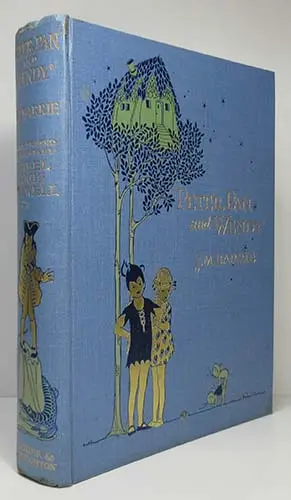
Of the many illustrators who have tried to capture the magic of J.M. Barrie’s Peter Pan and Wendy, none have embraced the story’s essential innocence quite like Mabel Lucie Attwell. While other artists emphasized the wildness of Neverland or the shadowy menace of Captain Hook, Attwell turned the story toward the nursery. Her illustrations, first published in an edition of the early 1920s, are not about adventure in the grand sense. They are about the secret, cozy, tear-stained world of childhood itself—a world where pirates are only slightly scarier than a creaky floorboard, and fairies look suspiciously like the dolls on a little girl’s shelf.
The text of Peter Pan and Wendy needs little introduction. J.M. Barrie’s 1911 novel tells the story of the boy who refuses to grow up, his fairy companion Tinker Bell, the lost boys of Neverland, and the Darling children—Wendy, John, and Michael—who fly away from their London nursery to a world of pirates, mermaids, and ticking crocodiles. It is a story about the thrill of freedom and the ache of home. It is funny, frightening, and finally, heartbreakingly sad. Barrie understood that growing up is not a choice but a theft, and that every child must eventually say goodbye to the window through which Peter Pan once flew.
Mabel Lucie Attwell was the perfect illustrator for a certain reading of that story. Born in London in 1879, she had built a career drawing precisely what Edwardian and postwar audiences loved most: chubby, rosy-cheeked toddlers with enormous eyes, tiny rosebud mouths, and expressions of wide-eyed wonder or comical distress. Her style was sentimental, commercial, and enormously popular. Critics sometimes dismissed her as saccharine, but generations of children adored her. Her babies—often depicted in diapers, with wisps of hair and puckish grins—felt like friends.
In Attwell’s Peter Pan and Wendy, that signature style transforms Neverland into something unexpected. Her Peter Pan is not a lean, athletic boy but a round-faced cherub in a leafy tunic. Her Wendy is the kindest of big sisters, her hair neatly ribboned even in the midst of adventure. Her Captain Hook is more ridiculous than terrifying—a flamboyant, mustachioed figure whose outrage seems almost theatrical rather than murderous. Even the crocodile, with its ticking clock, appears as a friendly, almost lumbering creature rather than a threat. The pirates look like naughty uncles. The lost boys look like a kindergarten class on a field trip gone slightly wrong.
Yet Attwell’s approach is not a betrayal of Barrie. It is an interpretation. She understood that for many young readers, the scariest thing about Peter Pan is not Hook’s hook but the idea of being lost, forgotten, or left behind. Her soft colors—pale pinks, gentle greens, warm yellows—create a world where danger always comes with a safety net. The watercolors are dreamy, slightly blurred, as if seen through tears or remembered from a distant bedtime story. Her Tinker Bell, glowing like a firefly, is exactly the size and shape of a child’s belief.
To read Peter Pan and Wendy with Attwell’s illustrations is to read it through a nursery window. It is a version of the story for the very young and the young at heart—a Neverland where no one gets hurt too badly, where the lost boys are always found, and where Wendy grows up but never really leaves the room where Peter once landed. It is a gentle, forgiving, and deeply affectionate reading of a classic, and it remains a treasure of illustrated literature.
Recommended for collectors and readers:
- Alice’s Adventures in Wonderland (1910s), illustrated by Mabel Lucie Attwell – A gentle, child-friendly version of Carroll’s fantastical world.
- The Water-Babies (1909), illustrated by Warwick Goble – A classic tale of transformation with enchanting watercolor illustrations.
- The Princess and the Goblin (1920), illustrated by Jessie Willcox Smith – A richly imagined fantasy with heartfelt artwork.
Presenting the illustrations from the First edition of Peter Pan, illustrated by Mabel Lucie Attwell. Published by Hodder & Stoughton, 1921. Twelve full-page color plates.
Art Gallery: Mabel Lucie Attwell – Peter Pan & Wendy, 1921