A Seasonal Allegory: Walter Crane’s Queen Summer
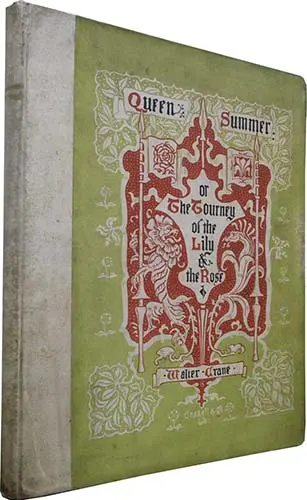
In the golden twilight of the nineteenth century, a remarkable artist turned his considerable talents to a subject that had captivated him for decades: the pageantry of the seasons. Walter Crane’s Queen Summer, published in 1891, stands as one of the most exquisite creations of the Arts and Crafts movement—a book that transforms a simple poetic allegory into a visual festival of color, design, and symbolic richness.
Walter Crane (1845–1915) was a titan of Victorian illustration, a founding figure of the Arts and Crafts movement, and a lifelong champion of the belief that art should elevate everyday life. Trained as a wood engraver and influenced by the Pre-Raphaelites, he developed a style characterized by bold outlines, flat planes of color, and intricate decorative borders. His toy books and nursery rhymes had already delighted generations of children, but Queen Summer represented something more ambitious: a book conceived as a total work of art, from its verse to its illustrations to its very binding.
The text of Queen Summer is a poem written by Crane himself, celebrating the arrival of the summer season personified as a radiant queen. She is attended by a court of flowers, butterflies, and birds, and her realm is one of abundance, color, and life. The poem is simple, even slight—a vehicle, really, for the visual richness that Crane pours into every page.
And what pages they are. Published by Cassell & Company in London, Queen Summer was produced with extraordinary care. The book is printed in a large quarto format, allowing Crane’s illustrations to command the page. The binding is a work of art in itself: quarter vellum, with a design that echoes the themes within. The endpapers are decorated, the title page is ornamented, and every spread is framed by borders that vary with each turn of the page.
The heart of the book lies in its illustrations. Crane employs a limited but vibrant palette—gold, blue, green, pink, and touches of red—printed with the chromolithographic techniques that had advanced significantly by the 1890s. His style in Queen Summer is more refined and decorative than his earlier work, reflecting the influence of Japanese prints and Italian Renaissance painting. The figures are stylized yet graceful; the compositions are balanced yet dynamic; the decorative elements are lavish yet never overwhelming.
The allegorical nature of the poem allowed Crane to indulge his passion for symbolism. Queen Summer herself is depicted as a figure of classical grace, her gown flowing, her crown made of flowers. Her attendants include figures representing the months, the hours, the winds, and the flowers of the field. There is a sense of timeless ritual to the proceedings, as if the procession of seasons has been unfolding since the beginning of time and will continue long after.
Crane’s approach to Queen Summer was informed by his broader artistic philosophy. He believed that art should be accessible, that beauty should be woven into the fabric of everyday life. His work for this book reflects that belief: it is lavish without being ostentatious, decorative without being superficial. The book was intended not merely for collectors but for families, for children, for anyone who could appreciate the joy of a beautiful object.
The critical reception of Queen Summer was warm, and the book sold well. It appeared at a moment when the illustrated gift book was at its peak, and it held its own alongside the work of contemporaries like Kate Greenaway and Randolph Caldecott. For Crane, it represented a mature achievement, a synthesis of the decorative and the allegorical that he had been developing throughout his career.
Today, Queen Summer is a prized collectible. First editions in good condition, with their delicate white bindings intact, are increasingly scarce. The book’s place in the history of illustration is secure: it stands as a testament to Walter Crane’s vision of art as celebration, as ritual, as the embodiment of joy.
In the pages of Queen Summer, the season arrives in all her glory. The sun shines, the flowers bloom, the court processes through a landscape of perpetual summer. It is a world without shadow, a season without end—a reminder that even in the changing of the year, there is beauty that endures. Walter Crane, with his brush and his pen, captured that beauty and gave it permanent form, a book that remains, more than a century later, a summer that never fades.
Recommended for Collectors
- The Baby’s Opera (1877) by Walter Crane – A beloved example of his nursery rhyme illustrations
- Flora’s Feast (1889) by Walter Crane – A floral fantasy in the same style as Queen Summer
- A Day in a Child’s Life (1881) illustrated by Kate Greenaway – For a softer, but equally seasonal, companion
- The Shepheardes Calender (1898), by Edmund Spenser, illustrated by Walter Crane – A poetic journey through the year with ornate Renaissance styling.
- A Flower Wedding (1905), by Walter Crane – Another floral allegory presented as a lavishly illustrated bridal procession.
Other books illustrated by Walter Crane available in our gallery: Wonderbook for Boys and Girls, Flora Feast: A Masque of Flowers.
Art Gallery: Walter Crane – Queen Summer 1891