A Wonderbook Indeed: Walter Crane’s A Wonder Book for Girls & Boys
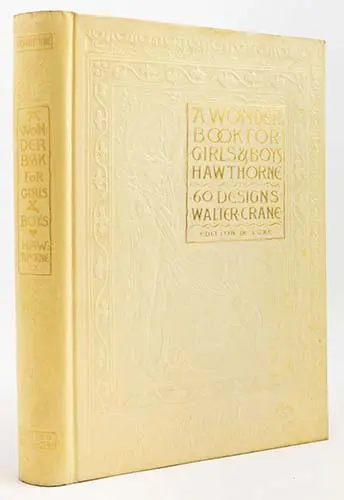
Limited Edition
In the grand tradition of illustrated books for young readers, few collaborations have achieved the enduring charm of Walter Crane’s 1893 edition of Nathaniel Hawthorne’s A Wonder Book for Girls & Boys. This volume brought together one of America’s greatest authors with one of Britain’s most celebrated illustrators, creating a work that has delighted generations with its retellings of Greek myths and its extraordinary visual richness.
Nathaniel Hawthorne (1804–1864) had first published A Wonder Book in 1852, seeking to make the myths of ancient Greece accessible to young readers. The book contained six tales—“The Gorgon’s Head,” “The Golden Touch,” “The Paradise of Children,” “The Three Golden Apples,” “The Miraculous Pitcher,” and “The Chimæra”—each framed within the narrative of Eustace Bright, a college student who tells the stories to a group of children gathered at Tanglewood, a country estate in the Berkshires. Hawthorne’s retellings were remarkable for their warmth, their humor, and their ability to convey the moral and psychological depth of the myths without losing their sense of wonder.
Walter Crane (1845–1915) was, by 1893, already established as one of the preeminent illustrators of the Victorian era. A central figure in the Arts and Crafts movement, he had developed a style characterized by bold outlines, flat planes of color, and intricate decorative borders. His work for children’s books was legendary, and when the Boston publisher Houghton, Mifflin & Company commissioned him to illustrate a new edition of Hawthorne’s classic, he approached the task with characteristic care and imagination.
The 1893 edition was a handsome production. Bound in cloth with gilt stamping. Inside, readers discovered a wealth of visual delights: nineteen full-page color illustrations, numerous black-and-white designs, decorative borders, and ornamental initials that transformed each page into a unified work of art. The book was issued in both trade and limited editions, reflecting the publisher’s confidence in Crane’s work.
What distinguishes Crane’s illustrations for A Wonder Book is his ability to capture both the grandeur and the humanity of the myths. His Perseus, slaying the Gorgon, is rendered with heroic dignity; his King Midas, clutching his daughter transformed to gold, is a figure of tragic foolishness; his Pandora, opening the forbidden box, is captured in a moment of fateful curiosity. Crane’s palette is rich and varied—deep blues, warm golds, soft greens, and touches of crimson—creating an atmosphere that evokes both the timelessness of the myths and the Victorian sensibility of the retellings.
The decorative elements are particularly remarkable. Crane’s borders weave around the text with the organic flow of classical motifs—acanthus leaves, Greek key patterns, figures from mythology—creating the impression of a Renaissance manuscript rendered in the language of the Arts and Crafts movement. Each tale is introduced with an elaborate headpiece, and the marginal drawings throughout the text reward sustained attention with their wit and invention.
Crane’s interpretation of Hawthorne’s framing narrative is also notable. The children of Tanglewood—Primrose, Periwinkle, Sweet Fern, and the others—are rendered with the same care as the mythological figures, creating a bridge between the world of the reader and the world of the tales. These illustrations capture the joy of storytelling itself, the wonder of children gathered to hear tales of gods and heroes.
The critical response to Crane’s A Wonder Book was enthusiastic, and the volume quickly found its place in libraries and nurseries. It has remained in print in various forms over the years, a testament to the enduring appeal of Hawthorne’s retellings and Crane’s visual interpretation.
Today, first editions of Crane’s A Wonder Book are prized by collectors. The combination of Hawthorne’s classic text, Crane’s peerless illustrations, and the exceptional production quality creates a volume that embodies the heights of Victorian bookmaking. In its pages, Perseus still slays the Medusa, Midas still repents his greed, Pandora still releases hope into the world—and Walter Crane’s art gives these ancient tales a visual language that continues to enchant, more than a century after it was created. It is a wonderbook indeed.
For collectors:
- The Faerie Queene (1897), illustrated by Walter Crane – A richly decorated epic poem with elaborate borders and classical imagery.
- Grimm’s Household Stories (1882), illustrated by Walter Crane – A collection of fairy tales featuring bold illustrations and ornamental designs.
- Stories from the Greek Tragedians (1907), illustrated by W. Russell Flint – A beautifully illustrated companion to Greek myths with a more dramatic tone.
Other books illustrated by Walter Crane available in our gallery: Wonderbook for Boys and Girls, Flora Feast: A Masque of Flowers, Queen Summer.
Art Gallery: Walter Crane – Wonderbook for Girls & Boys 1892