Akira Toriyama: The Creative Odyssey from Dr. Slump to Dragon Ball and Beyond

Akira Toriyama, born on April 5, 1955, in Kiyosu, Aichi Prefecture, Japan, is one of the most iconic and influential manga artists and character designers in history. From a young age, he was drawn to drawing, inspired by the animated works of Walt Disney and the manga of Osamu Tezuka, as well as the frenetic comedy of Jackie Chan films. This blend of Western animation, foundational manga storytelling, and kinetic action would later become a hallmark of his own style. Before his artistic career, Toriyama worked at a design firm, but his distaste for the rigid corporate environment led him to quit. He soon entered a manga contest, and while he didn’t win, it set him on a path to professional work.
Toriyama’s breakthrough came in 1980 with the serialization of Dr. Slump in Weekly Shōnen Jump. This gag manga about the quirky inventor Senbei Norimaki and his supremely powerful android daughter, Arale, was a phenomenal success. It showcased Toriyama’s incredible talent for inventive, zany humor, detailed and lively mechanical designs, and a unique, rounded art style that was both incredibly cute and explosively dynamic. Dr. Slump solidified his place in the manga industry, but it was his next work that would change the global landscape of pop culture.
Dragon Ball and Beyond
In 1984, facing pressure to create another hit, Toriyama began Dragon Ball. Initially inspired by the Chinese novel Journey to the West and infused with his love for martial arts films, the series started as a comedic adventure. However, as it evolved, it gradually shifted focus to intense martial arts tournaments and epic battles, following the life of Son Goku from childhood to adulthood. Dragon Ball perfected the “battle shōnen” formula, establishing core tropes like power transformations, escalating power levels, world-threatening villains, and training arcs. Its serialization catapulted Weekly Shōnen Jump to unprecedented circulation heights and became a multimedia juggernaut through anime adaptations, films, and video games. Toriyama’s direct, uncluttered panel layouts and his genius for creating clean, instantly recognizable character silhouettes made the action incredibly easy to follow and thrilling to read.
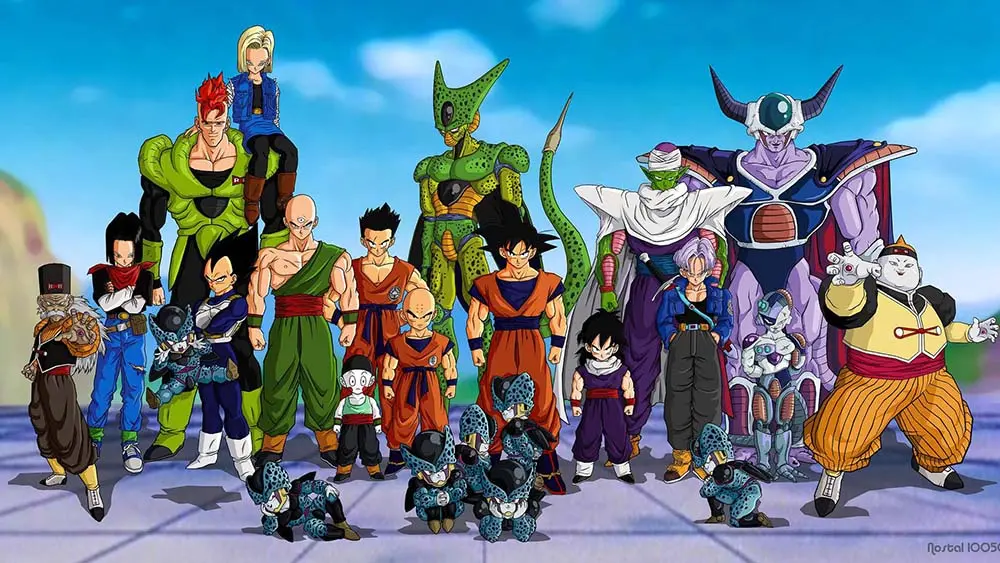

Toriyama’s influence on other mangaka is so pervasive it is difficult to overstate. He is the foundational pillar upon which much of contemporary shōnen manga is built. The “Big Three” of the 2000s—Eiichiro Oda (One Piece), Masashi Kishimoto (Naruto), and Tite Kubo (Bleach)—are all direct creative descendants. Oda’s Luffy is a direct heir to Goku’s boundless appetite and unwavering optimism; Kishimoto openly modeled Naruto’s relentless spirit and rival-driven narrative on Dragon Ball; Kubo’s focus on sleek, stylish battles and transformations follows Toriyama’s blueprint. Nobuhiro Watsuki (Rurouni Kenshin) and Hiroyuki Takei (Shaman King) also worked in his shadow, adopting his clear, action-oriented storytelling.
Beyond narrative, Toriyama’s artistic DNA is everywhere. His character and creature designs are a masterclass in appealing simplicity and memorability, an ethos that influenced not only manga but also the early character designs for the globally beloved Dragon Quest video game series, which he has illustrated since 1986. This crossover cemented his status as a defining visual artist of Japanese pop culture. His approach to world-building—a mix of traditional fantasy, sci-fi, and anachronistic humor—created a flexible, endlessly engaging playground that creators like Yoshihiro Togashi (Yu Yu Hakusho, Hunter x Hunter) would later expand upon with their own complex rules and systems.
Globally, Toriyama’s impact is immeasurable. Dragon Ball was the gateway manga and anime for millions outside Japan in the 1990s and 2000s, normalizing the medium and creating the first truly worldwide manga fandom. His work proved that stories about perseverance, friendship, and self-improvement could transcend cultural barriers. Despite the titanic success of Dragon Ball, Toriyama remained, by all accounts, a modest, homebody who simply loved to draw and tinker with machines—a personality not unlike many of his beloved protagonists. He continued working on spin-offs like Dragon Ball Super, designs for games, and shorter series like Sand Land, never losing his signature playful touch.
Akira Toriyama’s passing on March 1, 2024, was met with global mourning, a testament to his singular role in shaping the childhoods and creative aspirations of countless people. He was more than a mangaka; he was an architect. He built the narrative and visual framework for the action genre in manga, inspired the artists who would carry it forward for decades, and opened the door for Japanese comics to conquer the world. His legacy is not just in the continued adventures of Goku, but in the very spirit of adventure, humor, and boundless imagination that defines the heart of shōnen manga itself.
Akira Toriyama – Bibliography
- Wonder Island (Wandā Ajando) (1975)
- One of Toriyama’s earliest works, a one-shot adventure manga that introduced his humor and dynamic art style.
- Dr. Slump (1980–1984)
- Publisher: Shueisha, Weekly Shōnen Jump
- A comedy series set in Penguin Village, following the mischievous robot Arale Norimaki and the eccentric inventor Senbei Norimaki. 18 volumes.
- Dragon Ball (1984–1995)
- Publisher: Shueisha, Weekly Shōnen Jump
- Toriyama’s most famous work. Follows Goku from childhood to adulthood as he trains in martial arts, seeks the Dragon Balls, and fights increasingly powerful enemies. 42 volumes.
- Dragon Ball Z / Dragon Ball Super (Manga Continuations)
- Dragon Ball Z: Often considered part of the main Dragon Ball series; collected within the 42 volumes of the original run.
- Dragon Ball Super (2015–present)
Publisher: Shueisha, V Jump / Weekly Shōnen Jump
Supervised by Toriyama, illustrated by Toyotarou. Continues Goku’s adventures, introducing new gods and universes. 20+ volumes (ongoing). - Sand Land (2000)
- Publisher: Shueisha, Weekly Shōnen Jump
- A short adventure/fantasy manga set in a desert world, showcasing Toriyama’s signature humor and action. 1 volume.
- Cowa! (1997–1998)
- Publisher: Shueisha, Weekly Shōnen Jump
- A fantasy adventure about a half-vampire, half-human boy. 1 volume.
- Kajika (1998)
- Publisher: Shueisha, Weekly Shōnen Jump
- A short fantasy adventure manga, blending humor and action. Collected in 1 volume.
- Neko Majin (1999–2005)
- Publisher: Shueisha, Weekly Shōnen Jump
- A parody series featuring magical cats and references to Dragon Ball. Collected in 4 volumes.
- Dragon Quest: The Adventure of Dai (Character Designs) (1989–1996)
- Publisher: Shueisha, Weekly Shōnen Jump
- Toriyama contributed character designs and occasional supervision for this popular RPG-based manga. Collected in 37 volumes.