A Lyrical Treasure: Dugald Stewart Walker’s Rainbow Gold
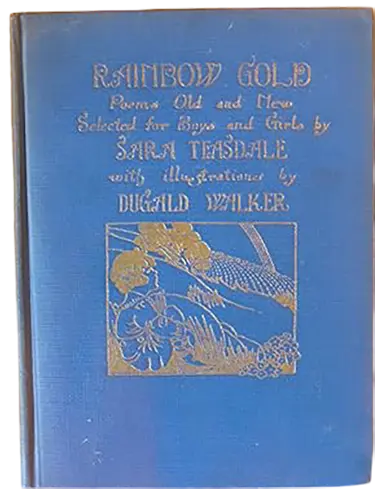
In the early 1920s, the Golden Age of Illustration was beginning to wane, yet there remained artists whose work shone with a brilliance undiminished by changing tastes. Dugald Stewart Walker’s illustrations for Sara Teasdale’s Rainbow Gold, published in 1922, belong to that radiant late flowering. This charming volume, subtitled Poems Old and New Selected for Boys and Girls, represents a perfect meeting of lyrical poetry and visual enchantment—a book that continues to captivate collectors and poetry lovers more than a century after its appearance.
Sara Teasdale (1884–1933), the celebrated American lyric poet, approached the task of compiling this anthology with a clear and heartfelt purpose. In her prefatory note, she wrote that she had made “a small collection of poems that would have pleased the child I used to be and the boy who was my playmate” . She strove to keep the book small, for she recalled that “the big books of poetry on our shelves were always left to themselves. It was the little books that became our intimate companions” . The result is a thoughtfully curated selection spanning English poetry from Shakespeare and Milton to Keats and Shelley, from Tennyson and Browning to Teasdale’s contemporaries like Walter de la Mare and W.B. Yeats.
Dugald Stewart Walker (1883–1937), the artist entrusted with bringing these poems to life, was a native of Richmond, Virginia, who had studied at the University of Virginia and the New York School of Art . His career had been launched with Stories for Pictures in 1912, where the foreword described him as “a new artist of remarkable talent, suggesting Arthur Rackham and Edmund Dulac but entirely original in spirit and execution” . Two years later, his generously illustrated edition of Fairy Tales from Hans Christian Andersen had established his reputation . By the time Rainbow Gold appeared, Walker was recognized for work noted for its “fine detail, elaborate stippling, and lavish design” .
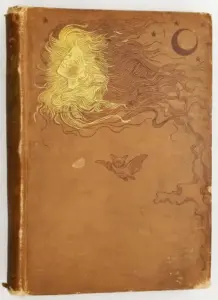
The 1922 edition, published by The Macmillan Company in New York, was a handsome octavo volume . The first edition measured approximately 7 by 5 inches and contained 267 pages . Within its covers, readers discovered sixteen full-page illustrations by Walker, alongside a color frontis. These illustrations showcased Walker’s characteristic Art Nouveau style—sinuous lines, elaborate decorative borders, and a whimsical, slightly dreamlike quality that perfectly complemented Teasdale’s poetic selections.
What distinguishes Walker’s work in Rainbow Gold is its variety. Some illustrations are ornate and richly detailed, filled with the fantastical creatures and enchanted landscapes for which Walker was known. Others are more minimal, even stark, yet equally striking in their elegant simplicity. The artist had a gift for capturing the mood of each poem—the eerie romance of “The Lady of Shalott,” the pastoral charm of “Under the Greenwood Tree,” the playful whimsy of “The Lepracaun.” His style has been described as creating a “whimsical, slightly sinister, and technically precise ‘Once Upon a Time’ world of pleasure gardens, peacocks, satyrs, clowns, archers, and mounted knights” .
Walker’s artistic philosophy, articulated in his foreword to the 1914 Andersen edition, sheds light on his approach to Rainbow Gold. He wrote: “I have never been anywhere except Richmond, Virginia, and New York, because I have always been told that only grown-up people were allowed to travel. But the good East Wind and the kindly Moon have taken me on rapturous journeys high above the world to get an enchanted view of things” . He cautioned readers not to expect realistic depictions, asking instead that they “look with my eyes” and trust in the imagination. “After all is said and done,” he concluded, “what the young ones say about it is the all-important matter” .
The poems Teasdale selected reflect her belief that children respond to “highly accented rhythms” and verses that take them into “a land of clear colors and stories” . She included works as varied as Coleridge’s “Kubla Khan,” Keats’s “Meg Merrilies,” Shakespeare’s “Under the Greenwood Tree,” Tennyson’s “The Lady of Shalott,” and contemporary pieces by de la Mare, Masefield, and Yeats . She deliberately avoided “meditative, moralistic and gloomy poems,” as well as those “full of sentimentality,” trusting that children’s enjoyment was the truest guide .
Today, first editions of Rainbow Gold are cherished by collectors of Golden Age illustration. Copies in good condition, with their full complement of plates and intact bindings, are increasingly scarce . The book represents a high point in Walker’s career—a work where his lavish, magical style found perfect alignment with poetry chosen by one of America’s finest lyric poets. For those who discover it, Rainbow Gold offers a glimpse into a vanished era of bookmaking, when even a small anthology for children could be transformed, through the alchemy of art, into a treasure.
Recommended for Collectors
- A Child’s Garden of Verses (1905) illustrated by Jessie Willcox Smith – A softer, more traditional counterpart
- The Moon-Caller (1929) by Katharine Adams, illustrated by Walker – For more of his Art Deco flair
- When We Were Very Young (1924) by A.A. Milne, illustrated by E.H. Shepard – A similarly spirited poetry collection
Art Gallery: Dugald Walker – Rainbow Gold 1922